Evaluating treasury software: the features you need & pitfalls to avoid
How to identify the functionality your team actually needs, and sidestep the pitfalls of outdated treasury technology.
Why treasury teams are evaluating software in 2026
Cash and liquidity forecasting is the top priority for 63% of treasury teams in the 2026 AFP Treasury Benchmarking Survey, and the most challenging activity for 49%. For the first time, 30% of teams put AI and automation among their top five priorities. Most of those teams work inside a treasury system. The PwC 2025 Global Treasury Survey found that 94% of respondents operate a dedicated TMS, and that the blockers to getting more from technology are budget constraints at 70%, limited technology skills at 56%, and integration partner challenges at 40%.
In most companies the system is in place and the priorities are clear. The obstacle is choosing technology the team can afford, staff, connect, and run. Many legacy treasury systems were designed before bank APIs and cloud infrastructure were common, so an evaluation has to test whether a vendor delivers those capabilities or has relabeled an older architecture. This guide covers how to assess your needs, define the scope, spot the common pitfalls, and question vendors before you sign.
Needs assessment
Start with where your team loses time and where automation would return it. Four challenges come up most often.
Manual processes
Manual data entry and reconciliation take hours away from analysis and forecasting, and every hand-keyed figure is a chance for error. A TD Bank survey of 246 finance leaders at the AFP 2025 conference found that nearly 80% of treasury departments still rely on manual or fragmented systems.
Limited cash flow visibility
Without a real-time view of cash across accounts and entities, cash management turns reactive. Delays in data updates or gaps in account coverage slow decisions and inflate cash buffers.
Complexity of financial operations
Companies with many subsidiaries, bank relationships, or countries need a system built to hold that structure. The traditional pattern is hours spent logging into bank portals, followed by more hours consolidating and normalizing the data in spreadsheets. The output is slow to produce and hard to audit.
Inaccurate forecasting
Manual inputs and stale data produce forecasts that miss opportunities or leave the company exposed. In the PwC 2025 Global Treasury Survey, 76% of treasurers named poor data quality as their top forecasting challenge, ahead of a lack of effective tools.
The backdrop raises the cost of a weak forecast. The Federal Reserve raised its target range by 25 basis points on September 16, 2026, new Section 301 tariffs on imports from 60 economies took effect on July 24, 2026, and PwC projects global M&A value up 13% in 2026 to about $4 trillion. Treasurers need to spend less time gathering data and more time advising the business on what it means.
Walk through a typical day and note every task that involves manual data gathering, repetitive entry, reconciliation, or report assembly. That list becomes your requirements document.
Defining your scope
Prioritize core functions based on your company’s size, industry, bank mix, and operating structure. Nice-to-have features and modules add cost and complicate implementation. Stay focused on the functions that solve your main problems, such as forecasting accuracy or automating manual workflows, so that your budget goes where it changes the daily work.
Once you have identified the processes that benefit from automation, you are ready to go to market. The rest of this guide covers what to ask and which mistakes to avoid.
Key considerations and pitfalls
Implementation and hidden costs
Consider the implementation timeline and the costs around it, including consultants, training, IT support, and bank charges for new connections. Count costs from your bank, the vendor, and your own staff to see the full expense. Weigh that total against the value of the efficiencies you expect, and calculate the return on investment (ROI) before you commit.
Ask every vendor to separate the date your team can start working in the product from the date every bank, integration, and workflow is in place. Vendors that blur the two tend to quote the first and deliver the second. Ask what happens when a project stalls. Park Place Technologies abandoned an eight-month legacy TMS implementation and was live on Trovata in three months. Ask each vendor for a reference customer that went live on the timeline it quoted.
Reshape your tech stack with an API-first approach
Treasurers with real-time bank data can advise the business from current numbers. That requires integration between treasury software, your banks, and the other systems in the finance stack. When you evaluate vendors, ask whether they offer APIs. For those that do, evaluate the quality and timeliness of the data updates their APIs deliver and their commitment to maintaining them. Ask whether the vendor maintains bank connections as a managed service, so that a change on the bank’s side is handled by the vendor. Ask how the vendor handles banks that publish no API. The honest answers are file-based reporting, SWIFT, host-to-host connections, an aggregator, or a virtual account the team updates by importing bank data.
The market is moving in this direction. The PwC 2025 Global Treasury Survey found that 65% of organizations plan to expand API use in the next few years, and the Strategic Treasurer 2026 Treasury Technology Analyst Report found that 45% of treasury teams are using or implementing APIs. API-first connectivity on cloud-native infrastructure means fast data processing and real-time cash visibility, with no waiting on a loading screen to generate a daily cash position report or a short-term forecast.
Drill into API capabilities
Many treasury technology providers now offer API connectivity. Be wary of those that convert API data into legacy file formats. Two points matter here.
Bank data delivered through files is limited to the specific data points a given file format was designed to carry. A file does not contain everything the bank knows about a transaction. Files are the traditional method, and they suit older software that cannot take in complex data structures.
APIs give real-time access to a richer set of bank data. Full transaction descriptions free from character limits, for example, let you categorize transactions precisely and report on them with confidence. API data also flows directly into cloud-native platforms without a conversion step.
This is why you should ask vendors that offer APIs how bank data is integrated into their platforms. Legacy treasury systems were built around file formats, and when they connect to a bank through an API, they convert the data into a known file type before loading it. The conversion strips the metadata the file format cannot hold, so you pay for API connectivity without getting its benefit. Look for vendors that manage the connections for you and offer self-healing functionality so that data keeps flowing when a bank changes something on its end.
Cloud-native versus cloud-based
Some vendors describe software that was written for on-premises servers and later rehosted as “cloud-based.” The distinction between that and software built for the cloud shows up in four areas.
Cloud-native | Cloud-based | |
Design | Tailored for cloud environments, it employs a microservices architecture to enhance flexibility and resilience. | Initially created for on-premises servers or computers, it later transitioned to cloud-based infrastructure. |
Implementation | Quicker to implement since there is no need to install any hardware or software. | Increased possibility of delayed deployment due to the potential need for hardware provisioning or software setup. |
Maintenance | Reduced disruptions through independent microservices, allowing for individual updates or scaling without affecting the entire system. | Potential for increased interruptions because of closely integrated components that might necessitate system-wide downtime for updates. |
Efficiency | Elevated efficiency through swift scalability and adaptability to changing needs. | Limited efficiency due to downtime during system-wide updates and slower adaptability to change. |
The Strategic Treasurer 2026 Treasury Technology Analyst Report found that 60% of treasury teams are using or implementing cloud financial technology. Ask whether the platform was built for the cloud or moved there, how updates are deployed, and what the customer has to do when they arrive.
Assess the vendor’s customer support
Onboarding and training
Evaluate the vendor’s onboarding process and training offerings. Look for programs that include initial setup guidance, user training, documentation, and ongoing educational resources. Good training gets your team working in the system from the first week and protects the ROI. Consider the formats on offer, such as live sessions, online modules, video tutorials, or written guides, and match them to how your team learns.
Ongoing support
Assess the vendor’s support options after go-live. Look for several channels, such as a helpdesk, an online knowledge base, in-app chat, and a named contact for escalation. Support staff who know the product resolve issues faster and keep your daily reporting on schedule.
Prioritize user-friendly interfaces
Design
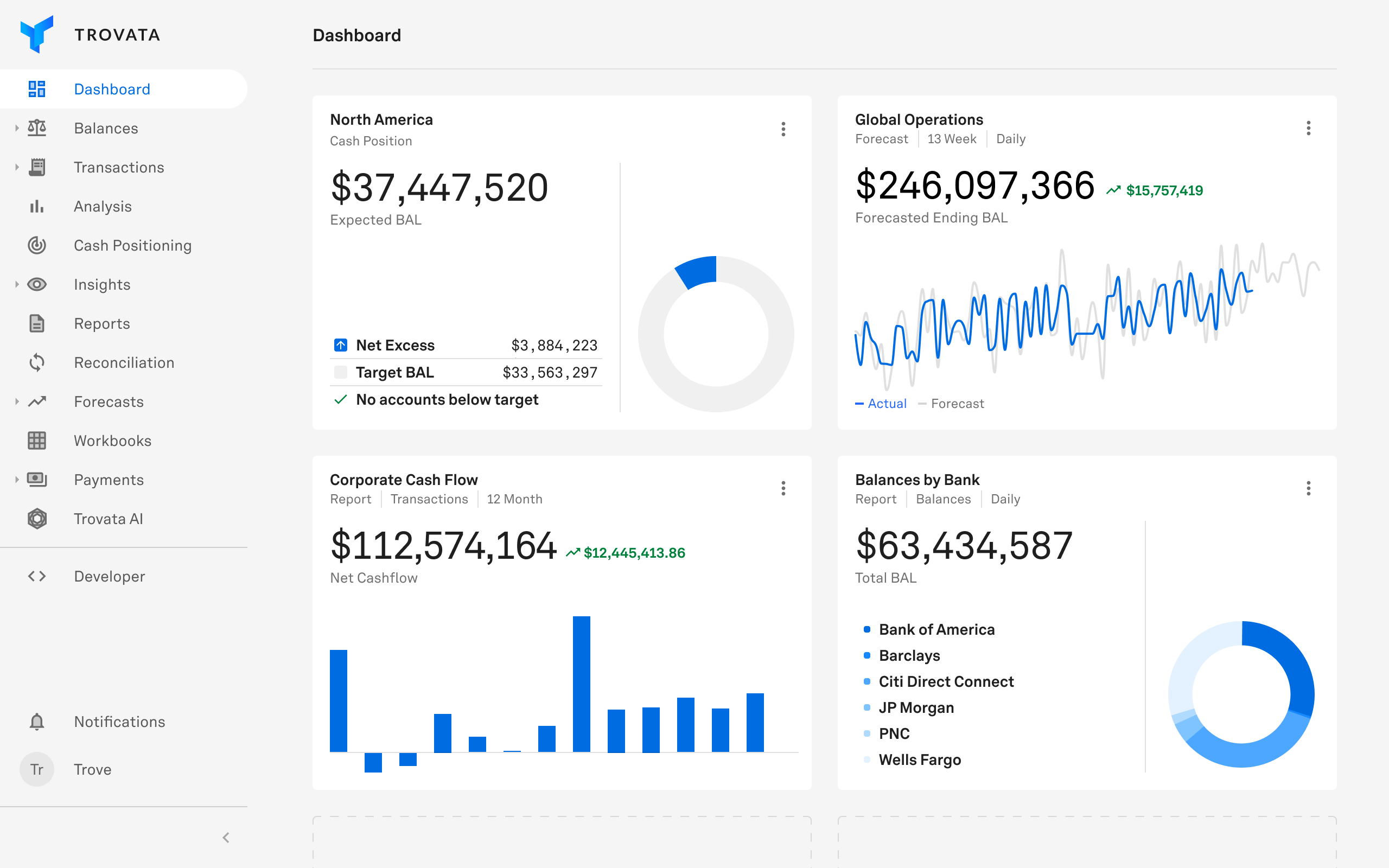
Prioritize interfaces that are clean and uncluttered, with clear navigation and consistent conventions. Clear design reduces training needs and shortens the time to proficiency.
Workflow
Look for features that make daily work faster. These include:
Customizable dashboards
Task automation tools
Search that finds specific transactions quickly
Automated report updates
Scheduled report delivery
User adoption
Consider the vendor’s track record with user adoption. Look for case studies that show how other organizations implemented the platform and won buy-in from their teams.
Data organization and control
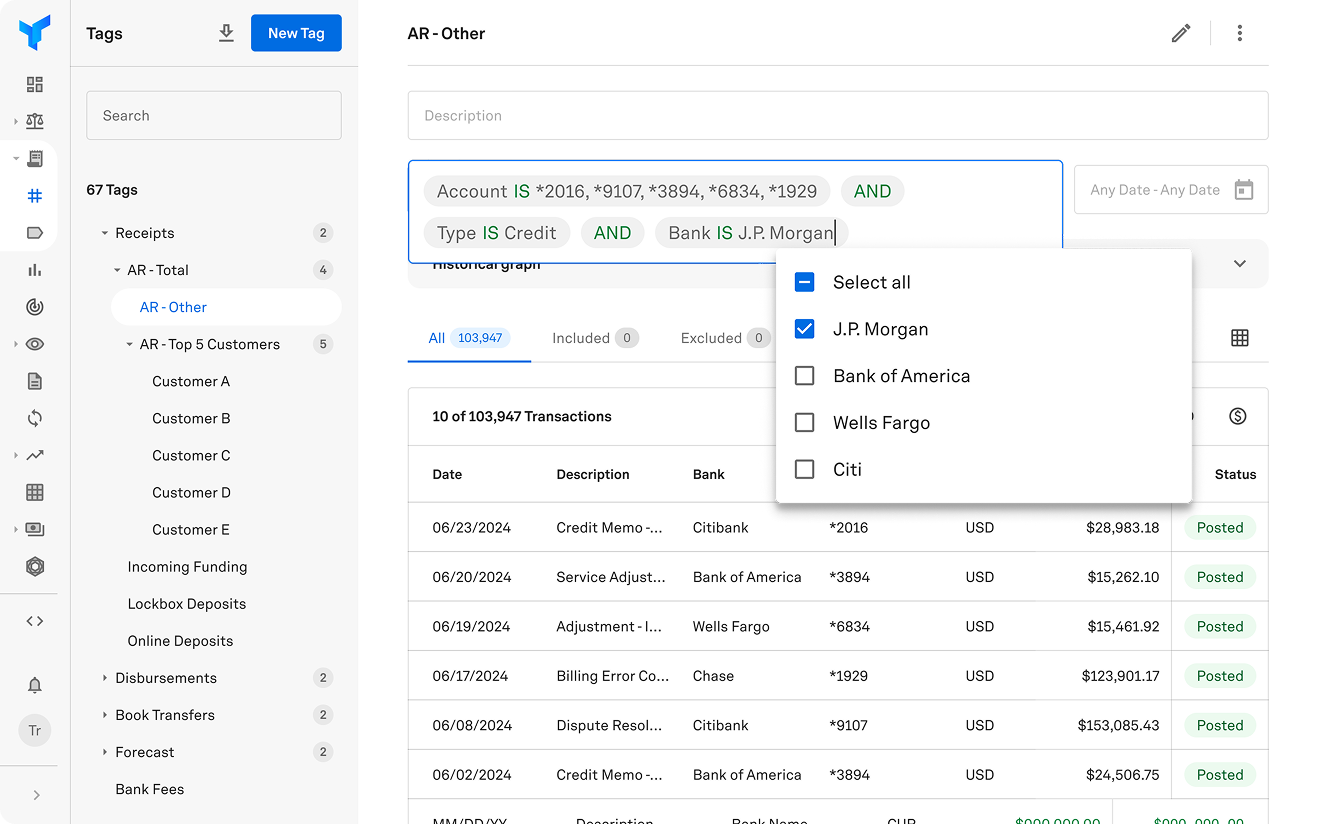
Look for data tagging, user permissions, and entity management to keep financial data secure and accessible. Permissions should work at the entity level as well as the user level, so that a regional treasury analyst sees the entities in scope for their role and nothing else. Granular control over access protects sensitive information across global operations.
AI in treasury technology
Every vendor now shows AI in the demo, and few treasury teams have put it to work. The Citi Institute’s GenAI in Treasury practitioner’s guide, based on an August 2025 survey of 75 senior treasury leaders, found that only 3% claim successful deployment of generative AI in their treasury processes. Crisil Coalition Greenwich found that fewer than 1 in 10 large corporates have implemented AI into daily workflows such as forecasting and fraud detection. That gap is the reason to evaluate AI carefully, across four areas.
The data foundation comes first. AI is only as good as the normalized data under it. The Datarails 2026 CFO Sentiments Survey found that 65% of finance leaders say their most common AI frustration is outputs that give confident answers based on the wrong data, and that only 4% of organizations have a single source of truth for finance and operational data. Before you evaluate any AI feature, ask what data it sees, whether that data is normalized across every bank and connection method, and how current it is.
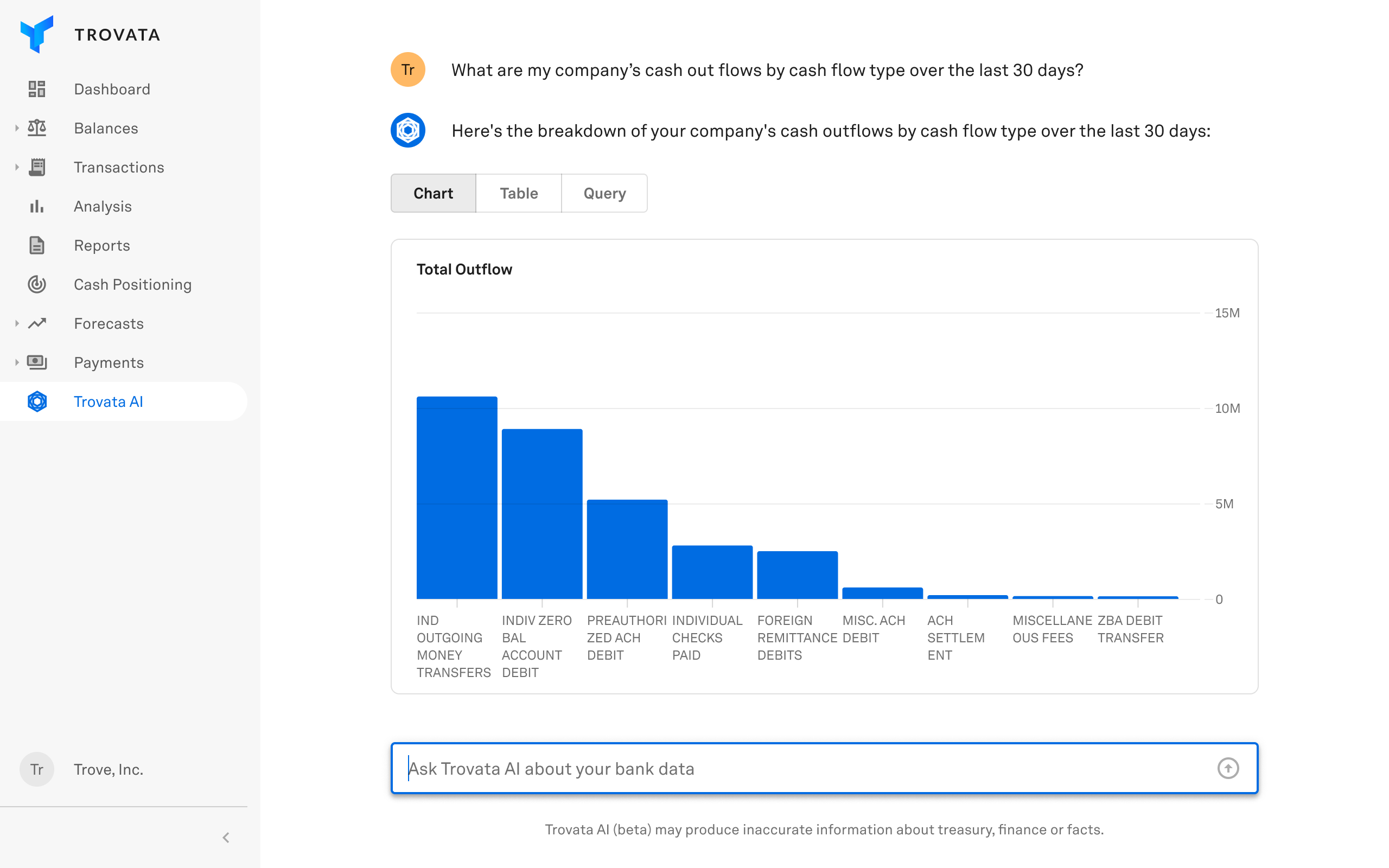
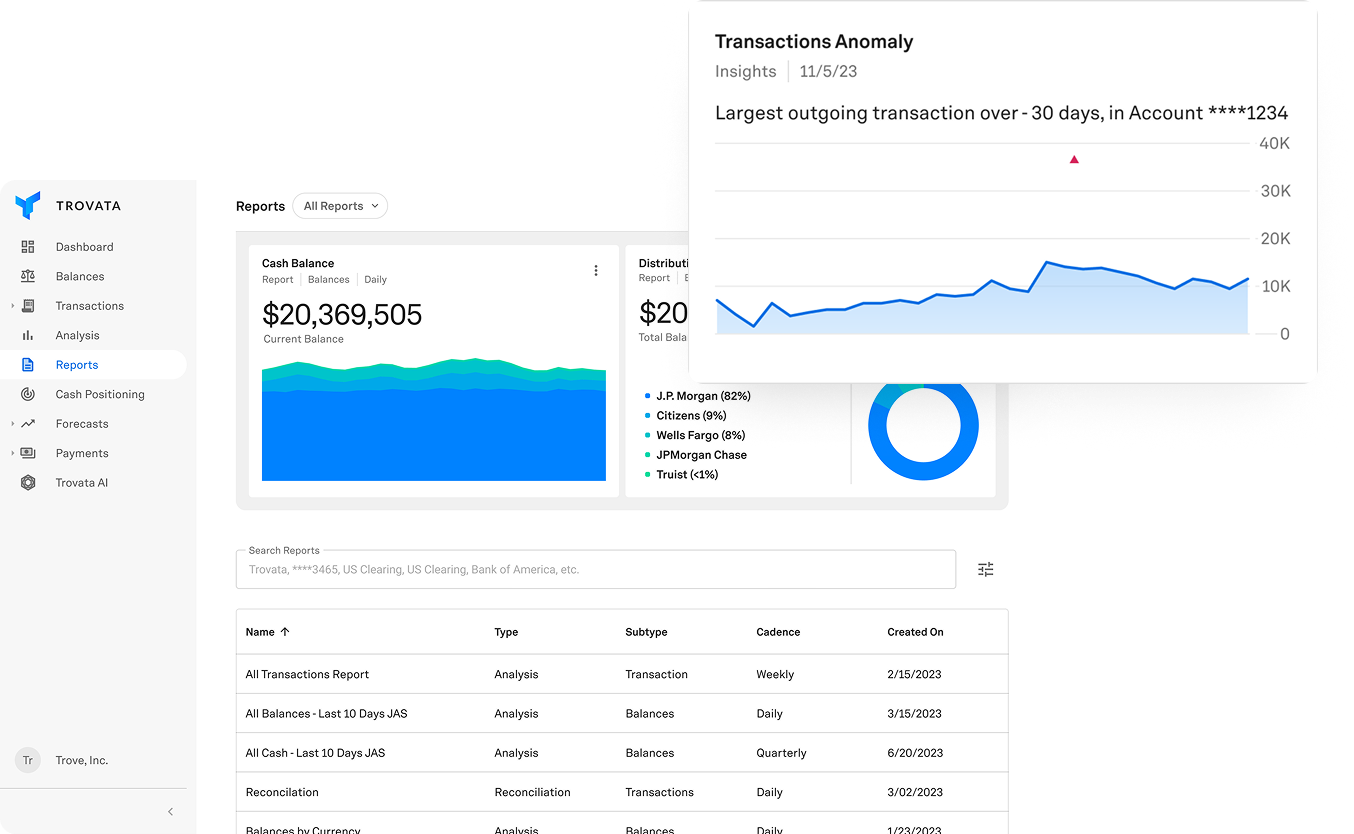
The second area is which forms of AI the vendor offers. Three now appear in treasury tools. Predictive AI covers forecasting, transaction tagging, and anomaly detection, where the system learns from your history and proposes a result. Conversational AI lets a user ask plain-language questions over the data and get an answer with the underlying figures. Agentic AI runs scheduled or triggered workflows, such as a daily position summary or a fee audit, and produces a deliverable for a human to review. Ask which of the three the vendor has shipped, and ask for a demonstration on your own bank data.
The third area is governance. Ask where your data goes when the AI processes it, whether it leaves the vendor’s environment, and how your data is isolated from other customers. Ask whether every AI output can be traced back to the transactions and balances behind it. For agents, ask what they are permitted to do without a human approving the result, and how that permission is configured and logged.
The fourth area is interoperability. Ask whether treasury data can be reached from the AI assistants your team uses elsewhere, for example through a Model Context Protocol (MCP) connector, and whether that access is read-only and governed by the same permissions as the platform itself.
Questions to ask treasury vendors
Onboarding
What does it take to get our banks connected, what connectivity options are available for each, and what does the process require from us? Ask the vendor to separate the date your team can start working in the product from the date everything is set up.
Data updates
How often are transactions and balances refreshed? Frequency varies by bank and by data point, so ask for specifics on your banks.
Supported data points
What metadata is available through the API for each of our banks? Not all APIs carry the same information, and your reporting depends on what arrives.
Security measures
What protects our data in the platform and through the API? Ask about authentication, encryption at rest and in transit, user access controls, and permissions by role and by entity.
Versioning and change management
How does the vendor handle API versioning when a bank changes its specification? Ask who monitors the change and who fixes the connection.
Cloud infrastructure
Was the platform built for the cloud or migrated to it? Ask how updates are deployed and what the customer has to do when they ship.
Connection method per bank
What is the best connection method for each of our banks, and why? The right answer depends on the bank. A vendor that defaults to files for a bank that publishes an API is usually converting API data into a file format and discarding the rest.
AI data handling and isolation
Where does our data go when the AI processes it, does it leave the vendor’s environment, and how is it isolated from other customers’ data?
AI auditability
Can every AI output be traced back to the transactions and balances it came from?
Agent permissions and human approval
What can an agent do without a person approving the result, how is that configured, and where is it logged?
SWIFT connectivity and ISO 20022
Can the vendor connect to our banks through the SWIFT network, and does the platform ingest ISO 20022 messages such as CAMT.053 alongside BAI2 and MT940?
Managed bank connections
Does the vendor maintain the bank connections as a managed service, with no work from our IT team, and what happens when a bank changes something on its side?
How Trovata approaches these criteria
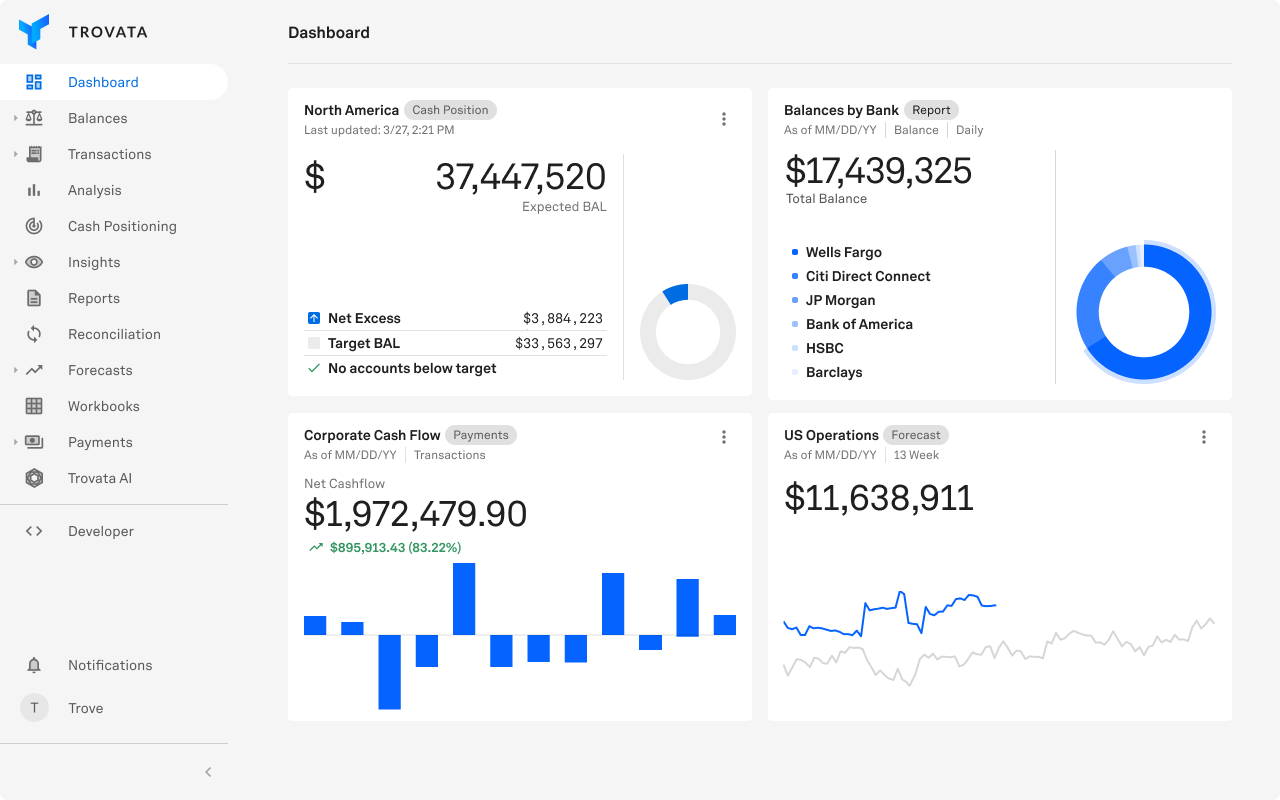
Trovata describes itself as the first new platform to manage corporate cash and liquidity in nearly 30 years. Trovata Cash covers cash visibility, reporting, tagging, and forecasting across every bank and account. Trovata TMS adds payments, bank account management and fee analysis, capital markets for debt and investments, hedging and risk, in-house banking and intercompany, and a treasury sub-ledger. Both run on the same real-time data foundation.
On connectivity, Trovata connects to any financial institution that supports information reporting services, including APIs, file-based reporting such as BAI2 and MT940, and information reporting through the SWIFT network. Any bank on the SWIFT network that offers information reporting services can be connected. Trovata normalizes data from every connection method into one standard format, and bank connectivity is a managed service run by Trovata with no customer IT or third-party consultants.
On implementation, Trovata Cash users typically start working in the product with their first banks connected within days or weeks. The full connection set, ERP integrations, and TMS workflows follow on a plan that depends on bank mix and scope. Trovata TMS implementations take several weeks or longer depending on the number of banks, entities, and workflows, and are run with Trovata’s implementation consultants. Bruce Edlund, Assistant Treasurer at Cloud Software Group, which runs 300+ accounts across 40+ banks and 100+ entities on Trovata, described the start: “It took a week or two.”
On AI, Trovata AI 2.0, released in March 2026, includes Trovata AI Chat for plain-language questions over your data, Trovata AI Insights for patterns and anomalies, and Trovata AI Agents for scheduled and triggered workflows that produce deliverables for review. It runs in an airgapped environment inside Trovata’s AWS architecture with no public internet access. The Trovata MCP Connector gives read-only access to Trovata data from AI assistants such as Claude, ChatGPT, Gemini, and Copilot, under the platform’s permissions. Trovata is SOC 1 Type 2 and SOC 2 Type 2 audited, hosted on AWS, with data encrypted with AES-256 at rest and TLS 1.2 in transit.
For the approver’s side of the decision, the companion checklist “What CFOs Need to Ask Before Approving New Finance Tech” covers the questions a CFO should settle before signing. Schedule a demo to evaluate Trovata on your own bank data.
Subscribe to our newsletter
Other resources

Book Trovata Demo
Watch Recording