
Nearly 95% of enterprise generative AI initiatives fail to deliver positive ROI, according to recent MIT research. The reason isn’t immature technology, but rather, weak data foundations.
In treasury, AI initiatives fail when teams skip data readiness and jump straight to the model. That risk only increases as AI evolves from answering questions to taking actions through copilots, automation, and emerging AI agents.
AI doesn’t fix broken data, fragmented workflows, or unclear assumptions—it exposes them.
In this article, we’ll explore why AI efforts stall in treasury, the data and process gaps that undermine trust and explainability, and what successful finance teams do differently to make AI practical, auditable, and valuable.
Contents
The Problem Isn’t AI… It’s What’s Underneath
AI systems are not magic. They sit on top of your data, systems, and processes. If those inputs are fragmented, delayed, or poorly structured, the output will be too.
In treasury, that shows up fast.
You ask a simple question like: “What is our available liquidity by region this week compared to forecast?”
The AI hesitates, hallucinates, or gives a partial answer because:
- Bank data arrives in batches
- Metadata was stripped during ingestion
- Forecast logic lives in spreadsheets
- Assumptions aren’t standardized or auditable
At that point, the problem isn’t the model but the architecture it’s built on. One of the biggest flaws with AI is that if it doesn’t have the information it needs to answer a query, it tries to fill it. The way to avoid this issue? Make sure the model has all the data it needs.
In practice, “AI-ready” doesn’t just mean having access to data. It means having data that is accurate, governed, traceable to its source, trusted by the business, and accessible in real time. Without those foundations, AI doesn’t fail quietly—it produces answers that look confident but can’t be relied on.
4 Key Reasons AI Efforts Stall in Treasury
Of course, every organization is different, but some key themes crop up in treasury whenever AI integration hits a roadblock.
1. AI Is Bolted Onto Broken Workflows
Many teams try to layer AI on top of legacy treasury processes that already struggle with manual reconciliations, spreadsheet-driven forecasts and static reports built after the fact.
AI doesn’t fix those workflows, and can actually accelerate the issues they present.
If treasury still spends hours cleaning data before analysis, a prompt-based interface simply produces faster confusion. AI works when the underlying workflow is already automated, structured, and repeatable.
2. Data Is Accessible, But Not Usable
Treasury teams often technically ‘have the data,’ but it’s not AI-ready.
Common issues include:
- Missing or inconsistent transaction metadata
- Bank data normalized in ways that remove context
- No persistent tagging or categorization framework
- Historical data that can’t be searched or filtered cleanly
Underneath these symptoms is usually a deeper issue: weak data governance. When there’s no consistent framework for how treasury data is defined, categorized, owned, and maintained, AI has no reliable way to interpret it.
As the Snowflake TDWI Checklist Report on modern data governance highlights, organizations struggle not because data is unavailable, but because it lacks integrity, transparency, and accountability across its lifecycle — from ingestion to transformation to consumption
AI relies on clean, structured, well-labeled data. Without that, answers become vague, unverifiable, or outright wrong. In a finance function, that’s unacceptable.
3. Outputs Aren’t Explainable or Auditable
If ChatGPT gives you a pasta recipe that doesn’t quite turn out right, it’s not a big problem. The stakes are much higher when you’re using AI within the finance department. You don’t just need answers, you also need to be able to trust them.
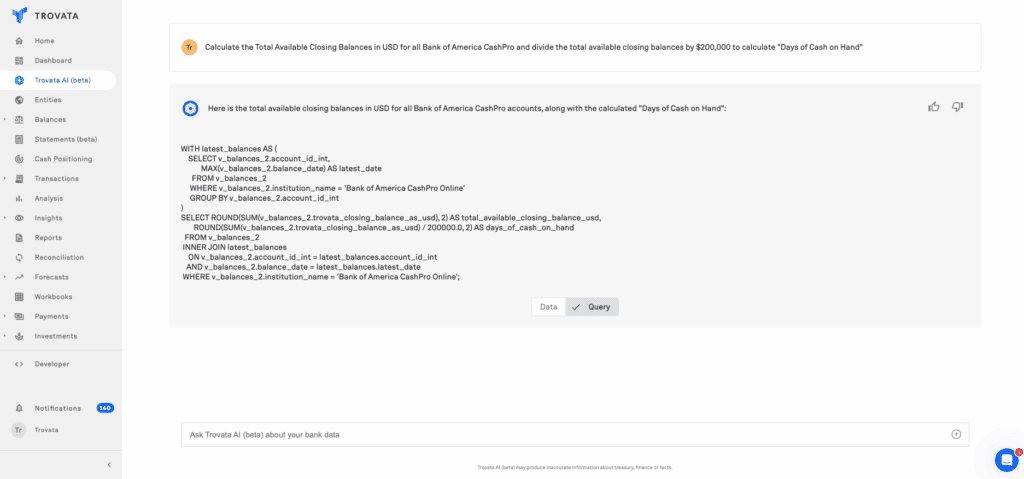
When AI outputs can’t be traced back to source transactions, clearly documented assumptions, time-stamped datasets, and transformation logic, they fail a basic test of trust. This is ultimately a data lineage problem. If treasury can’t see where data came from, how it was transformed, and how an answer was generated, AI outputs won’t survive audit, executive review, or regulatory scrutiny.
This is where many early AI pilots quietly die. The output looks impressive, but no one can explain how it was produced. Treasury teams default back to Excel because, for all its flaws, it is explainable.
4. AI Is Treated as a Productivity Toy, Not An Operating Model
Asking AI to summarize a report or draft commentary is useful, but it’s not transformational. The real value in treasury comes when AI interacts directly with live cash data, applies consistent assumptions, triggers follow-on actions, and operates inside core workflows rather than alongside them.
This shift from AI as a tool to AI as an operating participant is what will define the next generation of treasury systems.
Think of it less as an unpaid intern and more as a second or third-year graduate. You’re not looking to give AI the most basic tasks, but you need to set appropriate guardrails to maximize its usefulness.
AI Readiness Is a Data Discipline, Not a Feature
Many failed AI initiatives share a common misconception: that AI readiness is about tooling rather than discipline. In reality, AI in treasury depends on five foundational data capabilities:
- Accuracy: Cash and transaction data must be complete, timely, and validated
- Governance: Clear ownership, definitions, and standards for how data is managed
- Lineage: The ability to trace insights back to source systems and transformations
- Trust: Confidence that outputs reflect reality and can be defended
- Access: Secure, real-time availability across systems and teams
These aren’t abstract principles. They determine whether AI accelerates decision-making or creates risk.
For a deeper look at how treasury leaders should think about setting up AI programs for success, watch our podcast on data-readiness in treasury:
What Successful Treasury AI Initiatives Do Differently
The treasury teams seeing real value from AI share a few common traits. None of them start with prompts.
They Start With Real-Time, API-Driven Data
To have that foundational trust in your dataset, so that you know the AI has access to all it needs to provide accurate answers, you need data that is automated. APIs are one of the best ways to make this happen.
Teams that succeed invest first in:
- Direct API bank connectivity (where it makes sense)
- Continuous balance and transaction updates
- Preservation of full transaction metadata
- A single, trusted source of cash truth
This gives AI something solid to reason over.
Just as importantly, it ensures the right people — and the right systems — have access to that data under clear controls, rather than relying on fragile exports, manual handoffs, or shadow spreadsheets.
They Structure Data Before They Analyze It
Rules-based tagging, categorization, and normalization matter more than model choice. When data is consistently tagged by entity, bank, region, counterparty and cash flow type, AI can answer questions with precision instead of guesswork. Forecasting, variance analysis, and scenario modeling become far more reliable.
They Embed AI Into Existing Decision Flows
Successful teams don’t ask AI abstract questions, but rather why use it to accelerate the decisions treasury already makes.
For example:
- Explaining forecast variances as they emerge
- Surfacing liquidity risks tied to specific assumptions
- Comparing actuals to budget without manual prep
- Highlighting anomalies that warrant human review
AI becomes a co-pilot inside treasury workflows, not a separate tool.
They Demand Explainability By Design
Every AI-generated insight must be traceable. That means clear links to underlying data, visibility into assumptions used, the ability to drill down to transaction-level detail, and outputs that support audit and controls
Without this, adoption stalls no matter how impressive the demo looks.
The Uncomfortable Truth About AI-Readiness
Many treasury teams want AI outcomes without making AI-ready decisions. The teams that will receive these benefits are those that have already invested in cloud-native platforms, API-first architectures, clean, structured data models, and integrated ERP and bank connectivity.
For those who haven’t, it’s almost surely doomed to fail. This is why AI is such a forcing function in treasury. It doesn’t just introduce new capabilities, it exposes technical debt that has been tolerated for years. That can mean some short-term pain for some organizations, but the payoff is a more efficient, strategic treasury function, AI or not.
Where Treasury Leaders Should Focus Now
If you are evaluating using AI in treasury, the most important questions are not about models or roadmaps, they are about fundamentals.
- Is our cash data real-time and complete?
- Can we trust and explain every output?
- Are our workflows automated enough to act on insights?
- Does our technology stack make AI easier or harder to use?
Get those right, and AI becomes a practical advantage rather than an experiment. Get them wrong, and AI becomes another initiative that looks promising but never scales.
The Bottom Line
AI initiatives do not fail because treasury teams lack ambition. They fail because it magnifies weak data, fragile processes, and disconnected systems.
For finance leaders, the opportunity is not to chase AI hype, but to build the treasury foundation that makes AI inevitable, explainable, and useful. When that foundation is in place, AI stops being a risk, and becomes leverage.To see how Trovata could allow your finance and treasury function to modernize data capture, reporting forecasting and AI integration, book a demo today.
Recommended: Prompts Over Dashboards: How to Use Trovata AI to Deliver Treasury Metrics in Minutes