The treasurer's toolkit for centralized multi-entity finance
How next-gen treasury tech helps you tame reporting, currency, and security complexity across every entity.
Introduction
Sealaska, which owns more than 30 subsidiaries, ran its cash forecast in a spreadsheet that limited the view to the next month and to the top corporate level. After moving to Trovata, the treasury team saves more than 10 hours a week on bank data aggregation and forecasts across a range of 13 weeks to one year. That is time a multi-entity treasurer can put into financial models and yield decisions instead of report wrangling.
For most treasurers running multiple entities, the day still looks like the before picture. Consolidating reports across dozens of bank accounts, reconciling transactions from vendors and customers, managing liquidity, and tracking foreign exchange all grow harder with each subsidiary, and the manual work breeds errors that erode trust in the numbers.
The data problem is widespread. In the 2026 CFO Sentiments Survey from Datarails, only 4% of organizations say they have a single source of truth for finance and operational data, and 23% rely on disconnected systems and manual reconciliation. Cherry Bekaert’s 2025 Middle Market CFO Survey found 49% of CFOs feel blocked from critical financial decisions by poor data quality.
Treasury is expected to move faster and get the numbers right at the same time. Spreadsheet-based processes cannot do both. This guide covers where multi-entity reporting and forecasting break down, what connected treasury infrastructure changes, and how Trovata centralizes cash management across every entity.
The intricacies of reporting and forecasting in multi-entity organizations
Forecasting across multiple entities means tracking the cash position of each one and reporting across the whole organization at the same time. Every additional moving part in that process, and every manual step in collating and analyzing the data, adds a place for an error to enter. A typo in a formula or a copy-and-paste mistake in one subsidiary’s spreadsheet flows into the consolidated numbers.
The systems make it worse. Crisil Coalition Greenwich reports that about 40% of corporate treasury departments run on multiple ERP systems with limited integration, and roughly one in five still run on spreadsheets and manual processes.
Data aggregation
Reconciling individual forecasts, often kept in separate spreadsheets by each entity, takes real time to confirm every transaction is captured. Errors in data entry and calculation across subsidiaries cascade into unreliable consolidated reports.
Intercompany transactions
Identifying and accounting for intercompany loans, sales, and services by hand is slow and error-prone, and the errors distort the picture of individual subsidiaries and of the group.
Currency conversion
Converting forecasts into a single reporting currency with fluctuating rates adds another layer. A wrong rate understates expenses in one region and overstates results in another, and FX exposure becomes harder to see and manage.
Version control
With multiple users editing, spreadsheets lose any claim to a single source of truth. Teams end up working from outdated or conflicting copies.
Error-prone entry
Typos, formula mistakes, and accidental deletions ripple through reports and forecasts and into the decisions built on them.
How connected infrastructure simplifies global treasury management
Next-gen treasury infrastructure centralizes cash flow management and gives treasurers current data to work from. Sealaska’s 10 hours a week is one example of what that returns.
Automated data aggregation with APIs
Manual collection from siloed systems is where most errors and wasted hours originate. APIs connect bank data directly to a central data foundation, which removes the manual re-keying that introduces errors and keeps the numbers consistent no matter how many subsidiaries a team manages.
Granular transaction categorization with tagging
Tagging classifies transactions by entity, bank, country, or any other criterion treasury needs. The result is a detailed view of global cash flow patterns that supports targeted analysis and keeps data ready for planning.
Automated reporting and forecasting with AI and machine learning
Machine learning models read historical data and custom tags to automate reporting and forecasting, producing reports and cash flow forecasts with little manual effort. Real-time analysis surfaces cash flow issues and opportunities as they develop.
Integrating new entities
Deal activity keeps feeding new entities into treasury. PwC’s 2026 mid-year M&A outlook puts global deal value on track for about $4 trillion in 2026, up 13% from 2025, and Bain’s Global M&A Report 2026 found 80% of M&A executives expect to sustain or increase deal activity this year.
Each acquisition adds work for the treasurer. More subsidiaries mean more bank accounts and payment methods, and reconciliation grows with the number of counterparties. New jurisdictions bring local tax rules, currency exposure, regulatory requirements, and banking relationships that treasury has to absorb.
Connected treasury infrastructure gives treasury one real-time view of cash positions, transactions, and other key metrics for every entity, which turns integration into a repeatable process.
Entity-level visibility. Drill into the financial position of each subsidiary.
Bank connectivity without IT. Connect a new entity’s bank mix without an IT project.
Consolidation. Build a group-wide view of cash flow from the entity data.
Custom groupings. Analyze segments of the business for targeted planning.
Security and control through data compartmentalization
Managing financial data for many subsidiaries means sharing enough information for alignment while keeping tight control over sensitive data. Data compartmentalization handles both. Each entity gets its own space with access to its relevant accounts, reports, forecasts, and data, and nothing outside its purview. Corporate treasury at headquarters keeps the complete view across the organization.
Security. Restricting access limits the exposure of sensitive financial information.
Collaboration. Treasurers share relevant data with subsidiaries without opening the whole dataset.
Efficiency. Each entity works with the information that applies to its operations.
Solutions for centralizing global cash management
Finance leaders are funding the change. Gartner reports that technology budgets are set to rise for 75% of CFOs in 2026, and nearly 60% plan to increase finance function AI investment by 10% or more. In Deloitte’s Q4 2025 CFO Signals survey, 50% of North American CFOs say digital transformation of finance is their top priority for 2026.
Centralizing global treasury management depends on real-time visibility into cash across every entity. When evaluating cash management software, look for a platform that does four things.
Provides a single source of truth. Real-time cash flow visibility for all entities in one place, with no reconciling across sources.
Automates with AI and machine learning. Data aggregation, reconciliation, and forecasting run without manual effort, which returns time to analysis.
Scales with growth. New entities and subsidiaries come on without a loss of efficiency.
Keeps treasury workflows on the same data. Payments, intercompany, and hedging run on the same foundation as visibility, so the team is not rebuilding data for each workflow.
How Trovata centralizes cash management across entities
The largest API library for real-time visibility
Trovata maintains the world’s largest library of APIs in corporate banking, with direct API connectivity to hundreds of banks and access to SWIFT’s network of 11,500+ financial institutions. The company is backed by some of the largest financial institutions in the world, including J.P. Morgan, Wells Fargo, National Australia Bank, Capital One Ventures, Mastercard, State Street, and PNC. Trovata manages bank connection, onboarding, and maintenance as a service.
Centralized entity management
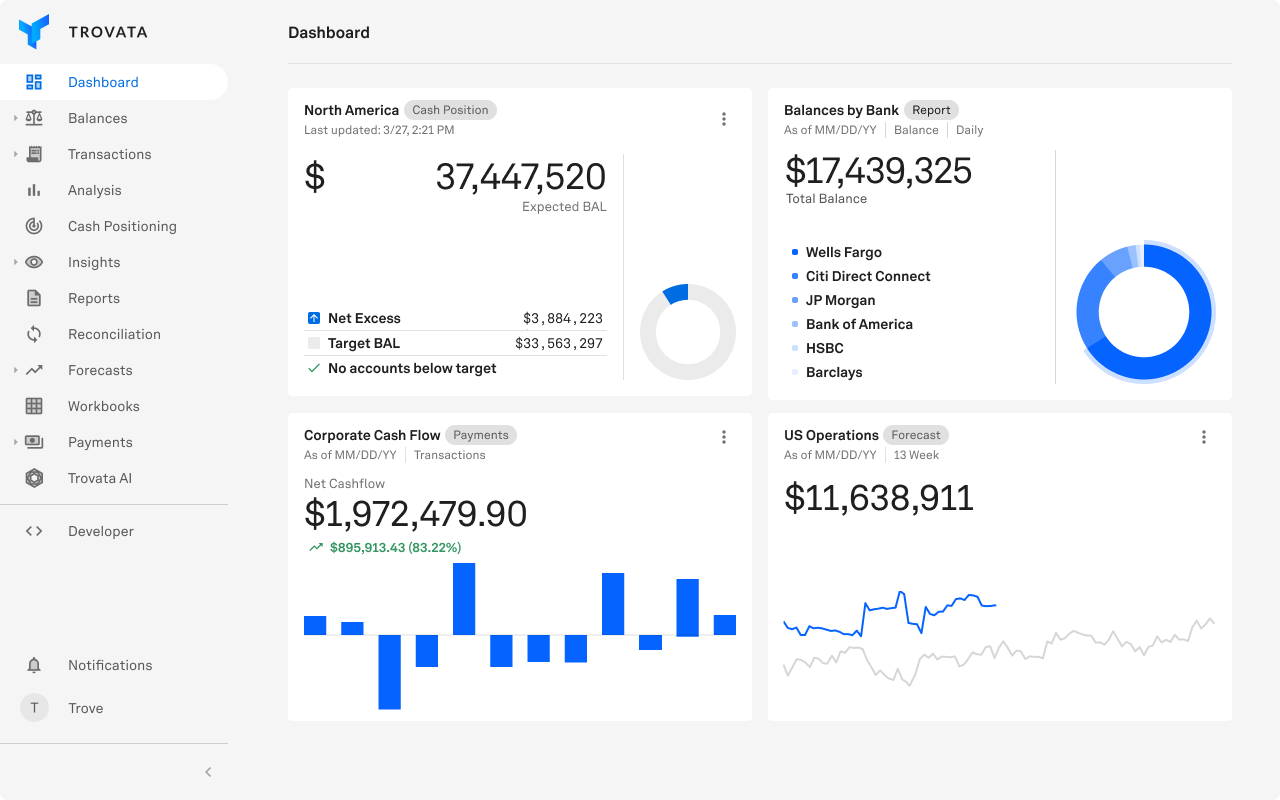
Treasury is not limited to one combined cash position. Entities can be segregated and grouped in almost any way the business needs, such as a consolidated view for the whole company, a view for North American entities, and a separate view for entities in joint venture partnerships. Custom dashboards and reports present the data with far more flexibility than a spreadsheet.
A real-time data foundation (Trovata Data)
Trovata Data is a fully managed service for bank connectivity and normalized financial data. Every account, balance, and transaction lands in one real-time data foundation, so visibility into the cash position never depends on finding the right one of 20 spreadsheets.
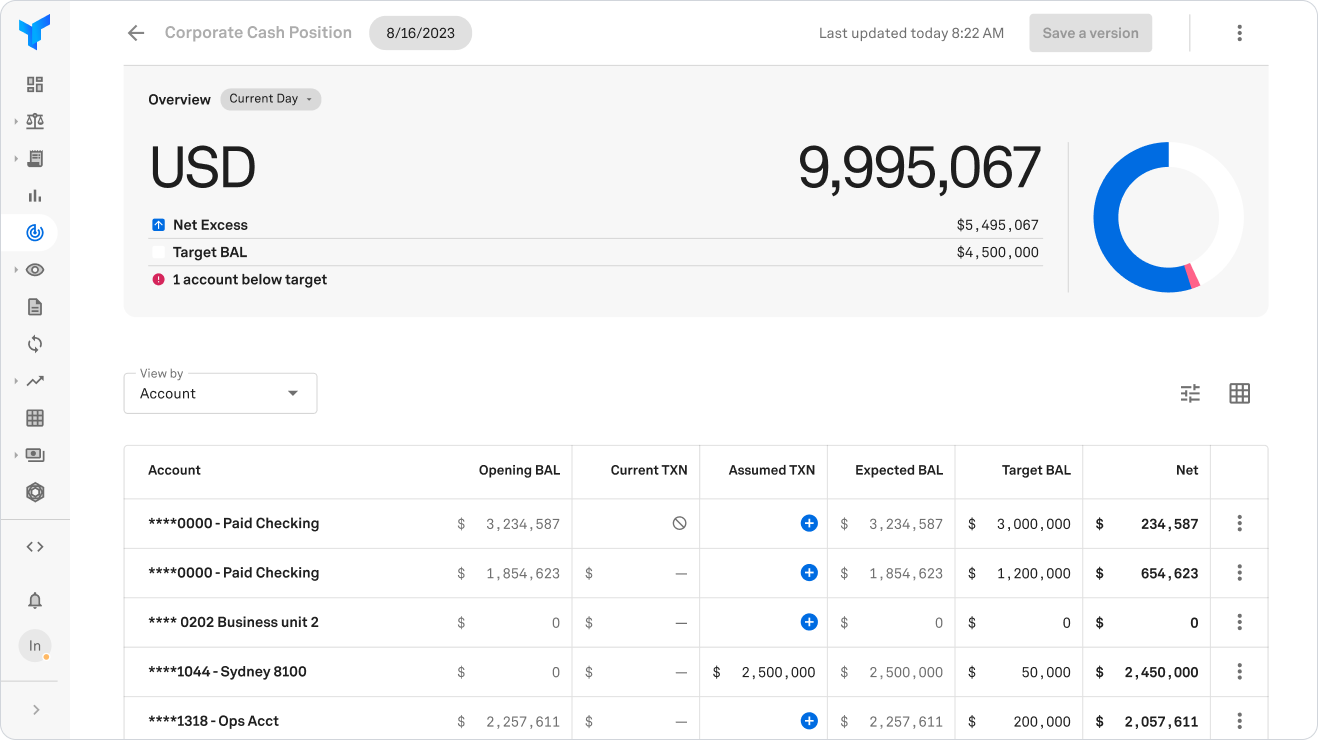
Automated reporting and forecasting
Bank data arrives through APIs, and machine learning standardizes and normalizes it for a complete view of accounts, balances, and transactions. Treasury teams set up tags that catalog transactions, which organizes the data to automate reporting and forecasting across short- and long-term horizons, including the 13-week forecast customers such as Park Place Technologies run.
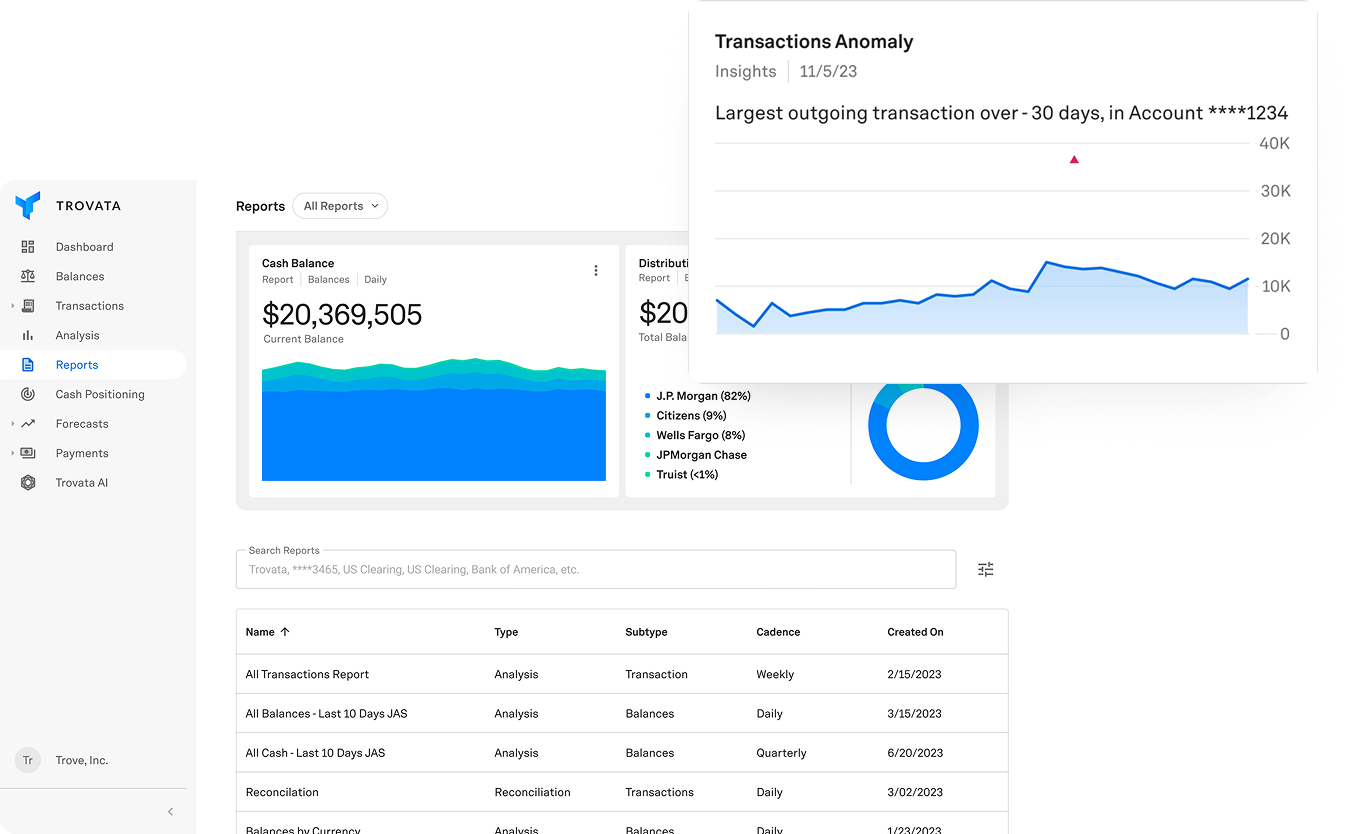
Trovata AI 2.0
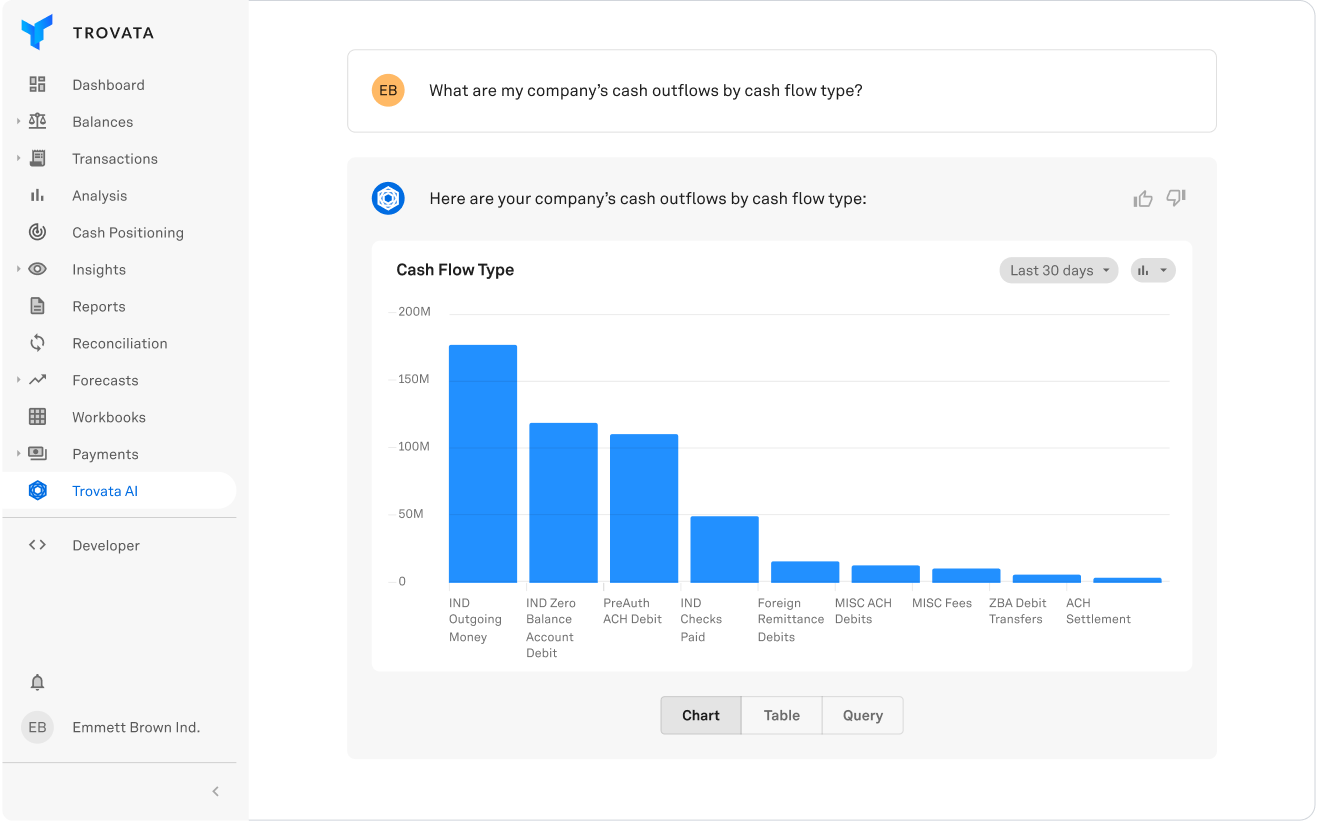
Trovata AI 2.0 brings Trovata AI Chat, Trovata AI Insights, and Trovata AI Agents to the same data foundation, running in an airgapped AWS environment. Teams ask questions in plain language, run scenario plans, build custom models and reports, and get answers on anything from cash burn to currency holdings. The Trovata MCP Connector gives read-only access to Trovata balances, transactions, tags, and reports from AI assistants such as Claude, ChatGPT, Gemini, and Copilot.
Trovata TMS for in-house banking, intercompany, and FX hedging
Trovata TMS extends the platform into the workflows that matter most to multi-entity groups. In-house banking and intercompany modules manage intercompany positions and netting. Hedging and risk manages FX exposures and hedging activity with shared data and built-in controls. Payments, bank account management and fee analysis, capital markets, and a treasury sub-ledger run on the same foundation.
Cloud-native infrastructure on AWS
Trovata is built for the cloud on AWS, which keeps the platform modular and integration-ready. Updates and new bank connections roll out continuously. Trovata Cash is typically up and running in days or weeks, depending on bank connectivity, and Trovata TMS implementations take several weeks, depending on the number of banks, entities, and workflows in scope.
How multinational corporations benefit from Trovata
Krispy Kreme
Rapid revenue growth and a series of international expansions left Krispy Kreme, which operates in more than 30 countries, needing treasury technology that could keep up with increasingly complex workflows and reporting. Referred by its banking advisor, the treasury team chose Trovata’s API and cloud platform over a legacy treasury management system and gained 100% visibility into its multibank data from a single source of truth.
Since we started using Trovata, our treasury technology capabilities have completely transformed for the better.”

James Krikorian
VP & Treasurer, Krispy Kreme
Cloud Software Group
Cloud Software Group runs more than 300 accounts across 40+ banks and over 100 entities on Trovata. The daily API feed makes bank data available across the group without manual pulls, and implementation took weeks.
It took a week or two.”

Bruce Edlund
Group Director, Assistant Treasurer, Cloud Software Group
Centralized treasury management with Trovata
Trovata combines open banking APIs and cloud infrastructure into one real-time data foundation that gives finance teams every entity’s financial data in one place. Forecasting and scenario modeling run across all entities. Trovata AI 2.0 lets treasurers work with that data in plain language, and Trovata TMS adds in-house banking, intercompany, and hedging on the same foundation. To see how Trovata centralizes multi-entity finance for your organization, book a demo at trovata.io.
Subscribe to our newsletter
In this guide
- Introduction
- The intricacies of reporting and forecasting in multi-entity organizations
- How connected infrastructure simplifies global treasury management
- Integrating new entities
- Security and control through data compartmentalization
- Solutions for centralizing global cash management
- How Trovata centralizes cash management across entities
- How multinational corporations benefit from Trovata
- Centralized treasury management with Trovata
Subscribe to our newsletter
Other resources


Book Trovata Demo
Watch Recording