The Essential Treasury Reporting and Forecasting Guide
Key treasurer insights
38%
say their capabilities fall short
62%
struggle most with cash or liquidity forecasting
57%
cite manual processes as a top barrier
Introduction
With ongoing tariffs, currency fluctuations, and increasing demands for real-time reporting, treasury teams can no longer rely on static cash positions. They need accurate, forward-looking forecasts that help them respond quickly to both risks and opportunities.
Yet many treasury teams still rely on manual workflows to create essential reports and forecasts. This slows down decision-making and makes it harder to spot risks and opportunities in real time.
In fact, according to Deloitte’s 2025 Global Treasury Survey, nearly half of treasurers have made enhancing cash flow forecasting a key priority. However, only a small portion, 18%, consider their forecasting abilities to be strong, while 38% admit their current capabilities fall short. A major challenge is the difficulty of collecting data from different ERP systems and the fact that business forecasts often focus on revenue and profit margins instead of cash flow.
The 2025 AFP Treasury Benchmarking Report confirms these challenges at scale: 62% of treasury professionals identify cash or liquidity forecasting as the most difficult task in their role. An additional 57% cite automating manual processes as a top operational barrier, highlighting the inefficiencies that still dominate treasury workflows.
Treasury teams that can analyze, report, and forecast cash faster gain a clear advantage. They can uncover growth opportunities hidden in their data and reduce their cost of capital. You can accomplish this by digitizing operations with best practices for reporting and forecasting natively built into workflows and operations.
In this guide, we’ll explore how your treasury team can strengthen forecasting and reporting, improve accuracy, and free up valuable time by automating key cash management tasks, all essential steps for staying resilient and competitive.
How a 13-week cash forecast helps
A 13-week cash forecast remains a foundational tool for treasury teams to ensure liquidity, align cash with operations, and model near-term risk. Here is how it helps.
Ensure your business is adequately capitalized
Knowing how much cash you have in the bank helps you be proactive with securing the right type of financing options to meet your business’s cash flow needs.
This has become especially important in 2025, as interest rates remain elevated. The Federal Reserve has signaled that interest rates will remain at the current 4.25% to 4.5% range, in an effort to keep inflation under control. As a result, access to affordable credit is more limited, and financing decisions now require greater precision and foresight.
In this environment, maintaining a reliable 13-week cash forecast allows treasury teams to anticipate future liquidity needs and engage lenders or internal stakeholders early—before cash gaps become urgent.
Properly allocate cash surplus
Understanding when your organization may have a cash surplus through forecasting helps you make the best investment decisions possible and provides an opportunity to let your capital grow on its own, thus doing the work for you.
With clear short-term cash visibility, treasury teams can put surplus funds to work—whether by investing, paying down debt, or funding key initiatives—while staying ready to act on new opportunities without risking liquidity.
Identify and plan for cash shortages
Seasonality is something every business faces to varying degrees. Understanding your business’s seasonality alongside your typical level of cash reserves ensures that you can meet your working capital needs throughout the year. By layering historical trends and expected inflows/outflows into a short-term forecast, treasury teams can anticipate periods of constrained liquidity and prepare appropriate mitigation plans in advance. This proactive approach helps avoid last-minute funding decisions and reduces reliance on high-cost borrowing during off-peak cycles.
Plan for different scenarios
Geopolitical threats, navigating a changing economy, emerging growth opportunities, and the consideration of entering new market segments all bring unexpected changes in cash flow.
In 2025, escalating trade tensions have significantly impacted global economic stability. The International Monetary Fund (IMF) has downgraded its global growth forecast to 2.8% for 2025, citing the adverse effects of widespread tariffs introduced by the U.S. administration. These tariffs have disrupted global trade flows, leading to increased inflation and financial instability worldwide.
Utilizing scenario planning within your cash forecasts can help your organization identify potential unforeseen circumstances in cash management plans that can be implemented quickly as these situations may arise.
How to build a 13-week cash forecast
Determine your forecast’s objectives
The purpose of your 13-week cash forecast is to help your organization better understand what cash you are going to have during a certain period. Though, every organization’s requirements are going to depend on the organization’s size, strategic objectives, and whether the company is cash rich or cash poor.
Having a deeper understanding of your organization’s strategic objectives is going to help you paint a picture of what your forecast requirements should be. When determining your forecast objectives, you should consider the following aspects:
1
Set the right forecasting frequency
Your forecast’s frequency can depend on a number of factors. Those being:
Is your organization cash rich or cash poor? If you are a small business starting out, or perhaps just don’t have a large cash reserve, you may consider forecasting weekly, if not even daily. But if you are at a cash rich company, like a company in the Fortune 500, you may just have to forecast monthly to ensure that you are reaching your quarterly cash objectives.
Does your organization have a big planning date coming up? Perhaps your organization is considering acquiring a company, taking on long-term debt, or just having a larger, untypical cash outflow going out on a particular day. Even if you are at a cash rich company, you may want to consider increasing your forecast’s frequency to ensure you have enough cash in the right accounts to cover outflows.
2
Define the right level of forecast accuracy for your business
While everyone wants highly accurate forecasts, reaching 99% precision can require significant time and effort, often more than your team can realistically commit. Instead, your target level of accuracy should depend on your cash position and business context.
For cash-rich companies, 90–95% accuracy may be sufficient. But if your organization has limited reserves, you may need to aim higher to ensure all base expenses are covered.
The key is to align expectations with leadership. Be transparent about the trade-offs between accuracy, time, and resources, so your team can deliver a forecast that’s both reliable and sustainable.
3
Identify the strategic purpose behind your cash forecast
The purpose of a direct cash forecast is to understand how much cash you have and where it is located at various points in time. Going further, your organization may have some short-term strategic objectives they are looking to accomplish that are going to require knowing exactly where your cash is.
Questions you may ask yourself include, are you:
Focused on accelerating your collections?
Trying to forecast your necessary short-term cash to have more borrowing options with the bank?
Expecting a large cash expenditure that isn’t typical, like making an acquisition or purchasing upfront equipment?
Trying to gain a better understanding of where your cash reserves need to be at quarter-end?
The answers to these questions will not only inform the frequency or accuracy your forecast requires but may also influence your cash management strategy. No one understands your business more than you do. Ensuring key stakeholders are in agreement on the purpose of your direct cash forecast empowers you and your organization to make more informed, data-driven decisions.
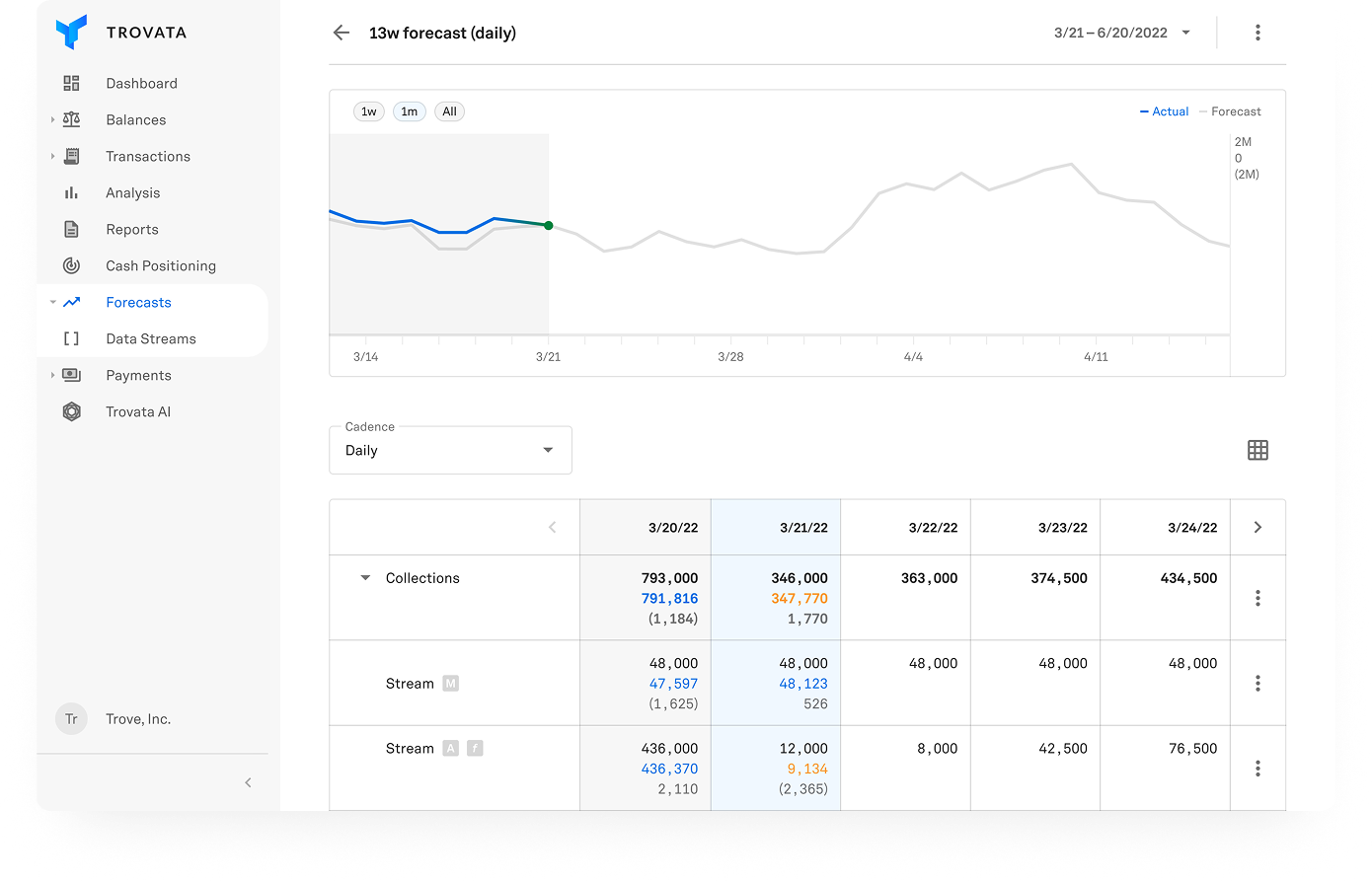
Cash Forecasting.
Break your cash flow down into inflows and outflows
Developing a 13-week cash flow forecast can look simple on paper, but it can grow to become more complicated as your business grows. For start-ups, it may be easier as it is simpler to wrap your arms around all the functions of the business. Global businesses have many more key stakeholders and divisions to consider, ensuring that a degree of automation is needed to maintain an accurate forecast.
First, it is important to understand potential sources of cash and outflows. In direct cash forecasting, cash is recognized when cash enters and leaves your bank accounts. This means that your cash inflow and outflow categories are going to be based on the methods your cash travels in and out of the bank.
Cash inflows
Lockbox/deposits: Deposits from checks or cash gained from sales
Wire transfers: Wire transfers from sources outside the organization
ACH: Deposits as a result of batch payments from clients
Borrowing: Any cash gained from short-term loans
FX: Cash obtained from differences in exchange rates
Cash outflows
Payroll: Outflows as a result of paying employees
Accounts payable: Outflows from paying vendors
Wires: Outflows via wire transfers to other bank partners or vendors
Debt payment & debt maturity: Outflows as a result of paying off debt
FX: Outflows as a result of losing cash due to a lower exchange rate
These lists are not exhaustive of the types of inflows and outflows you may have within your business, but it is a great starting point to start thinking about your unique sources of cash and expenditures.
Different methods for forecasting cash flow
When forecasting your cash flow for any given period, there are a variety of statistical methods that can be utilized. The most common are naïve, simple moving average, and exponential moving average.
Naïve forecasting
The naïve approach is the most cost-effective forecasting model as it is produced based on historical bank data. From this bank data, you can make assumptions that cash flow will be similar to previous periods, especially if your business has recurring revenue.
Machine learning technology can be utilized to increase the accuracy of this model as it can analyze and find trends within your bank data. The weakness of this modeling method is that it assumes that business will remain steady over time, and doesn’t consider the seasonality of your business.
Simple moving average forecasting
Simple moving average forecasting (SMA) is useful for discovering trends in your cash flow as it adds your closing cash balances over time and divides that sum by the number of periods. This can be useful to discover whether your cash flow is following either an uptrend or downtrend over a 30- or 90-day period.
While a simple moving average smooths out the volatility of cash movement over time, it assigns equal weight to all cash positions. If your most recent data have much more of an impact on cash flow, it would not be reflected in this forecasting model.
Exponential moving average forecasting
Many businesses prefer crafting an exponential moving average forecast (EMA) because EMA gives a higher weight to recent cash positions compared to SMA, which assigns an equal weight to all cash positions over a given time period. If your recent cash movement activity has more of an effect on your cash flow, you may want to consider crafting an exponential moving average forecast.
Keep track of your actuals vs. your forecast
One of the most critical aspects of cash forecasting is gauging the accuracy of your forecasts over time. Without comparing your ongoing forecasts to your baseline, produced at the beginning of the quarter, it’s difficult to understand if you are utilizing your organization’s cash efficiently. By keeping track of your actuals versus your forecast, you can benchmark your performance over the quarter.
Establish a baseline forecast
Many companies update their baseline forecast every day with actuals, but the problem with this is that you have no data to compare your actuals to. Make sure to save your first initial 13-week forecast at the beginning of the quarter and keep it in a safe place, so you can continue to perform variance analysis to gauge your forecast’s accuracy over time.
Perform variance analysis
For every week of your forecast, it is critical to understand the difference between your actuals vs. your forecast for each inflow and outflow. By performing this analysis, you can start to piece together what factors affected your actuals and adjust your forecast accordingly.
Craft the story behind your forecast
The numbers are only one part of your cash forecast. Link your financial results to your business outcomes to paint a picture regarding the health of your business.
Communicate the ‘why’
Every department within your business has an effect on your cash inflows and outflows. By establishing visual, succinct methods of communication to key stakeholders, you can ensure your organization is making the most informed, strategic decisions.
Tips to manage your direct cash forecast
1
Automate your data management processes
With open banking APIs, your organization can securely automate the collection, normalization, and analysis of your bank data across all your bank accounts, obtaining complete cash and transaction visibility. Pairing this technology with an automated cash management platform, like Trovata, your organization can quickly generate and automate cash forecasts and reports based on accurate, historic bank data.
2
Plan for multiple scenarios
With how quickly our digital world evolves, new opportunities and threats can arise quickly. The goal of your cash forecast is to identify these opportunities and threats as early as possible and establish cash management strategies to take advantage of those market changes.
Through forecast automation with an automated cash management platform, scenario planning becomes even easier as your organization is able to generate new cash flow forecasts for different investment decisions and sales fluctuations in seconds.
3
Communicate with stakeholders to know operational changes that could impact your cash flow model
The market is always changing, so businesses often have to change their strategy and processes to take these changes into account. Historical data only provides you with so much detail. There are always one-off events that could occur throughout quarters such as acquisitions, share repurchasing, or other events that can cause large fluctuations in cash outflows. Communicate with key stakeholders to understand when these unforeseen events could occur, so you can build your forecast to be agile.
Direct vs. indirect cash forecasting
While you may be focused on knowing when cash is flowing in and out of bank accounts, it is valuable for treasurers to compare their direct cash forecast with the indirect cash forecast. Within the indirect cash forecast, revenue is recognized when it is earned, compared to direct cash forecasts which recognize revenue when cash is received.
The indirect cash forecast is useful for treasurers to:
Gain better visibility into your AR and AP
Understand your organization’s Days Sales Outstanding (DSO) and Days Payable Outstanding (DPO)
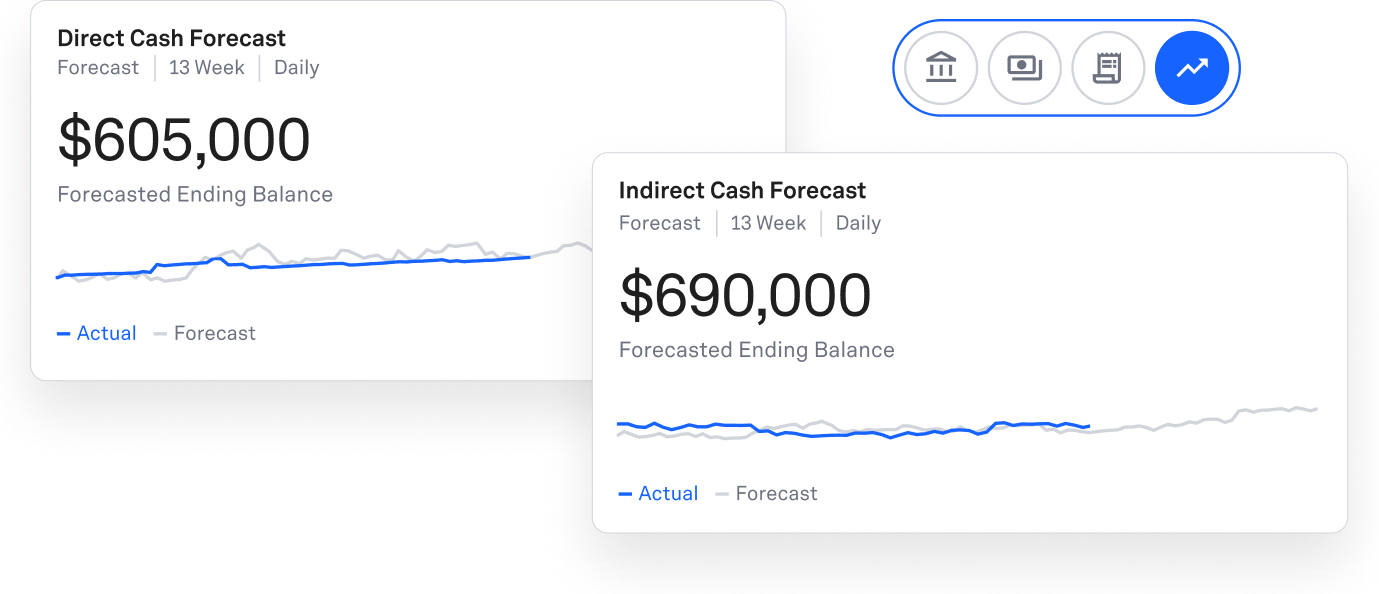
Direct vs. Indirect Cash Forecast
Levers you can pull in response to your organization’s cash forecast
Accelerate collection of accounts receivable
If you need to increase your cash reserves for large outflow events, you could reach out to your clients who are reliable in paying their bills on time and incentivize them to pay in advance by providing them with a discount, improving your DSO.
Schedule out your accounts payable in response to your required cash levels
If your organization isn’t actively forecasting cash required for operational expenses, you may find yourself either paying your AP too early or too late when that money could have been utilized in different areas of the business. It’s critical that you have visibility into your DPO, as you certainly do not want to be paying your bills quicker than clients are paying you unless you are receiving a discount for doing so.
Accounts payable best practices
1
Track the efficiency of your DPO
Some organizations have different collections and policies for billing terms. Some common billing terms are net 30, 60, and 90 days. Many companies may provide a discount for paying your bills within 30 days to increase their DSO, but some may not enforce fees for paying after 60 or 90 days. Having a deep understanding of your vendor’s billing practices will empower you to schedule the optimal time to pay outstanding invoices.
2
Enter your invoices into your ERP as they are received
If your finance team is entering invoices into your ERP right as they are due, your treasury won’t have enough time to forecast and respond to receivables or payments. By actively entering invoices as they are received, you can ensure that your organization has complete visibility into what payments and receivables are coming down the pipeline and adjust your cash management strategy accordingly.
Better optimize short-term debt
Knowing the cash you may need on hand at any given time can assist you with negotiations when borrowing from the bank. To receive term loans, typically given out as a 30-day, 60-day, or 90-day loan, organizations have to give the bank at least three days’ notice.
If you don’t have clear visibility into the cash you need to run your organization’s operations, you may have to resort to prime-day loans. These loans can be received on the same day you ask, but have higher interest rates, leading to your organization paying more in the long run. Having an accurate forecast on hand ensures that you are borrowing efficiently and getting the lowest possible interest rate.
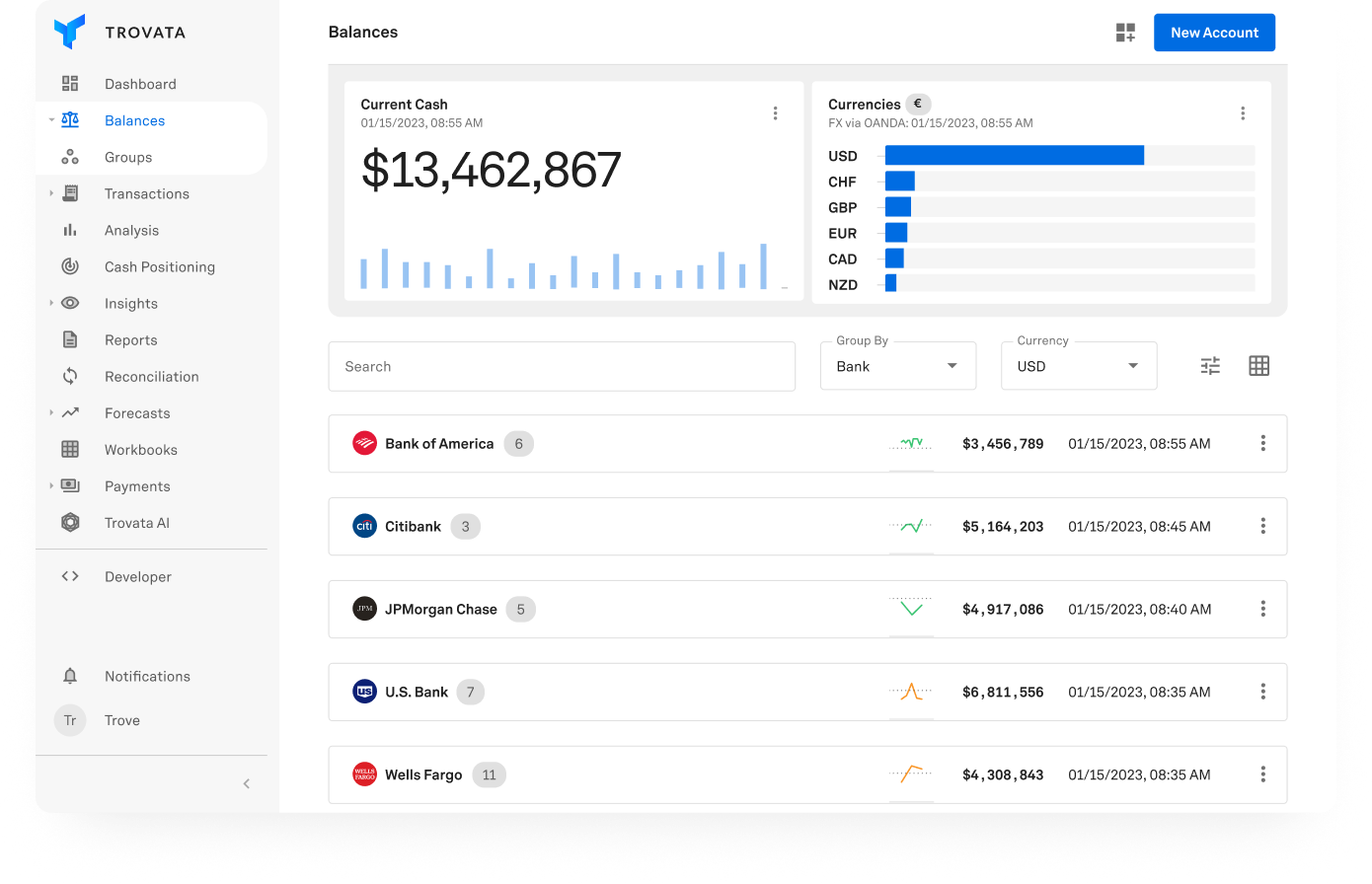
Balances — current cash and distribution by bank
Measure the accuracy of your cash forecast with variance reporting
You cannot know the effectiveness of your forecast without comparing your active forecast with your baseline forecast that you saved at the beginning of the quarter. This is where variance reporting comes in handy:
Understand how accurate your assumptions are
By comparing your cash actuals in week two, for example, compared to what you planned for in your baseline forecast, you can calculate a percentage of the difference between them. Perhaps, by week 8 out, you find that, on average, your forecast is 80% accurate. Through understanding the accuracy, you can dig further into your cash flow to discover inflows and outflows you didn’t take into account.
Learn what actions created positive outcomes and how to replicate them
By helping you identify the differences between your baseline and actual forecast, you can begin to piece together how to increase the accuracy of your forecast and replicate future actions that have a net positive on cash flow.
Bake proactivity into your organization’s processes
Performing variance reporting helps build a culture around making more data-driven decisions. By making variance reporting a part of your weekly operations, you can continually build analysis into your cash management processes and begin to form a feedback channel between your treasury team and leadership.
Other reports to effectively monitor cash flow
While the 13-week cash forecast is the most critical report your treasury should take care into crafting and monitoring, there are a number of other reports that can help you measure the efficiency and effectiveness of your organization’s cash management processes, such as:
Total closing average cash
Share of wallet report
Bank accounts per treasury employee report
Total closing average cash
Monitoring your total closing average cash across your global bank accounts is critical as it provides a detailed look into whether your organization is utilizing its cash effectively. For example, if interest rates are high, it’s better to maximize your organization’s use of cash to pay off debt or put it in solid investments.
Your total closing average cash report may also be broken down into several categories to understand where most of your highest and lowest closing balances lay. You may want to break down your total closing average cash by entity and by currency.
Number of bank accounts per treasury employee
Having a breakdown of your total bank accounts per treasury employee can empower your organization to better manage your bank accounts and the cash flow going in and out of those accounts. If you have a small number of treasury employees managing over 10 bank accounts each, you could be stretching your treasury thin and they may not have enough time to optimize your treasury processes. On the flip side of the coin, you may find yourself in a situation where you have multiple treasury employees responsible for managing the same bank account, which can lead to a potential increase in human error and communication breakdowns.
Share of wallet
Share of wallet refers to the percentage breakdown of your total cash by bank account. Having this percentage breakdown can help you gain a better understanding on where most of your cash reserves are stored, where you can reallocate cash if you have a larger outflow event coming up, and help balance your share of wallet so you can optimize the benefits and services you have access to with each institution.
Increase the efficiency of your treasury’s cash management through automation
The most valuable thing your treasury can do to set up your organization for success is to craft a direct cash forecast that CFOs and treasurers use in conjunction with an indirect forecast in order to gain a more accurate view of short-term cash, and better forecast your cash requirements in the future.
Utilizing new technologies like open banking APIs and machine learning, Trovata can empower you to automate the aggregation of your raw bank data and perform predictive analysis.
At the end of the day, the most important aspects of cash forecasting are the assumptions used to create the forecast. We designed forecasting in Trovata to give our customers an Excel alternative to store and manage those assumptions, as well as provide automated reporting of actual cash flows for cleaner variance reporting.”

Chris Brown
Solutions Engineer, Trovata
How modern treasury teams are transforming their workflows with Trovata’s lightweight platform
As your business and bank data expands, the volume of treasury data increases exponentially, making it more difficult to manage your cash flow. While many legacy technologies promise to automate the aggregation of bank data, they do so in a way that is inefficient, difficult to customize, and often requires manual intervention, leaving your treasury with a cash visibility gap.

Customer story
Park Place achieves multibank cash visibility
Park Place Technologies, a global IT infrastructure support provider managing over 100 bank accounts across 15 banks, faced exactly this problem. Dissatisfied after undergoing a year-long implementation of a legacy TMS, Park Place decided to start over with Trovata. In just 3 months, they were able to get up and running with no hidden costs or added consulting fees.
The result? Park Place reduced treasury technology costs by 77%, gained real-time access to all accounts globally, and accelerated reporting for both tactical decisions and strategic planning.
“If our CFO wants to see the consolidated 13-week cash forecast on a global level, we can show him that—or we can quickly pivot to show it by region or by country. That was something our consultants struggled to help us within the legacy TMS.”

Megan McLaughlan
Treasury Manager at Park Place

Customer story
EVERSANA moves Excel forecasts to Trovata for improved accuracy and time savings
EVERSANA’s Excel-based cash forecasting process was time-consuming, rigid, and limited in visibility—especially across international accounts. Treasury Manager Tim Green, CTP, had to manually input transaction data, wrangle massive files that could take 20 minutes to open, and rely on broad categorization that lacked the granularity needed for strategic decision-making.
After adopting Trovata, EVERSANA built a modular, high-precision forecast powered by real-time bank data and advanced transaction tagging. Within four months, they fully transitioned out of Excel—with flexible tagging, global cash visibility, and streamlined variance analysis, the team could finally drill into transactions by customer, vendor, or region with just a click.
“Since implementing Trovata, we’ve seen far better accuracy in our cash forecast. We’ve gained visibility into all of our accounts globally that we didn’t have before, and we’ve significantly reduced the time we spend manually reporting data to our senior leadership.”

Tim Green, CTP
Treasury Manager at EVERSANA
Automate your cash management with Trovata
Manual processes slow down decisions and add unnecessary complexity to your workflows. With Trovata, you can automate the aggregation of your bank data, streamline reporting, and improve forecasting accuracy: all in one unified platform.
Give your treasury team the tools they need to focus on strategy, not spreadsheets. Discover how Trovata can modernize your cash management.
Subscribe to our newsletter
In this guide
- Introduction
- How a 13-week cash forecast helps
- How to build a 13-week cash forecast
- Break your cash flow down into inflows and outflows
- Different methods for forecasting cash flow
- Keep track of your actuals vs. your forecast
- Tips to manage your direct cash forecast
- Direct vs. indirect cash forecasting
- Levers you can pull in response to your organization’s cash forecast
- Measure the accuracy of your cash forecast with variance reporting
- Other reports to effectively monitor cash flow
- Increase the efficiency of your treasury’s cash management through automation
- How modern treasury teams are transforming their workflows with Trovata’s lightweight platform
- Automate your cash management with Trovata
Subscribe to our newsletter
Other resources



Book Trovata Demo
Watch Recording