The ultimate guide to scaling treasury at high-growth companies
Introduction
As a business scales, its volume of financial data grows faster than its headcount. Transaction counts multiply, bank accounts and entities are added with every expansion and acquisition, and the treasury team is expected to keep a daily pulse on cash with the same tools it had at a fraction of the size. For most teams those tools are bank portals and a spreadsheet. Analysts spend hours pulling statements and aggregating them by hand, and leadership ends up working from numbers that are days old.
High-growth companies in this position face two decisions. The first is how a small team keeps visibility and control over cash as complexity compounds. The second is when it makes more sense to invest in infrastructure than to hire more people to work by hand. This guide identifies the constraints that hold treasury back at high-growth companies, describes the API-first technology that removes them, and lays out best practices for making the case internally.
What holds high-growth companies back from scaling cash management
Budget is the first constraint. PwC’s 2025 Global Treasury Survey found that the leading blockers to treasury technology adoption are budget constraints (70%), limited technology skills (56%), and integration partner challenges (40%). Even where the budget exists, teams lack the skills and partners to put new systems in place.
So many high-growth companies stay on what they have. Crisil Coalition Greenwich reports that roughly 1 in 5 corporate treasury departments are still run on spreadsheets and manual processes, and about 40% run on multiple ERP systems with limited integration.
Neither option scales. Spreadsheets were never meant to hold large data sets across a team, and version control is impossible once several people are editing. A legacy treasury management system (TMS) promises to automate the tedious work, but every custom workflow requires an IT lift, and implementations run long. Park Place Technologies abandoned an eight-month legacy TMS implementation before switching to Trovata, where it was live in three months with a 77% annual cost reduction.
Growth at scale
A high-growth company’s perspective on digital transformation
Cloud Software Group manages more than 300 bank accounts across 40+ banks globally and over 100 entities. At that scale, a typical treasury workflow (cash visibility, forecasting, moving cash, investment and borrowing decisions, identifying problems, and supporting accounting) depends on downloading data from every bank portal, normalizing and pivoting it into a usable shape, and building custom models and reports on top. Each of those steps is manual in a spreadsheet, and each one adds error and delay.
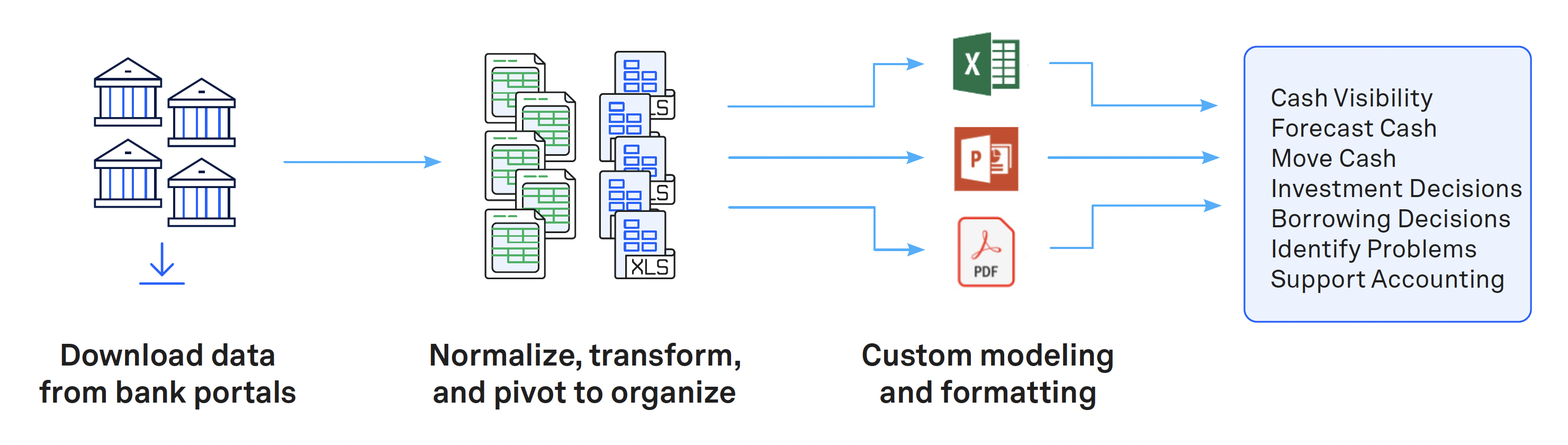
Bruce Edlund, Group Director, Assistant Treasurer at Cloud Software Group, chose a different path. “I gravitated to Trovata because of the APIs. The daily feed makes data readily available.” Implementation of the bank connections took a fraction of the time a legacy TMS would have required. “It took a week or two,” Edlund says.
The three spreadsheet problems his team left behind are common to every high-growth company.
Spreadsheets create silos of information.
A spreadsheet was never meant to be shared among many team members, so it becomes difficult to pin down who has the most current version.
Consolidation is slow and error-prone.
Building a new report means visiting every bank portal, downloading the statements, and normalizing all transactions into one sheet. The more hands in the spreadsheet, the more room for human error, and the reconciliation work that follows consumes hours every week.
Scenario modeling and variance analysis are out of reach.
When basic reports take most of the team’s time, advanced modeling never happens.
An API-first approach to cash management
APIs have been in use across industries for decades. In the last several years, banks have built their own APIs, which allow third parties to connect directly to bank data. Banks and treasury platforms can now exchange balance and transaction data and initiate tasks such as payments between systems.
Paired with an automated cash management platform, open banking APIs consolidate and normalize balance and transaction data into one standard format within a real-time data foundation. That foundation stores bank data continuously, so historical analysis no longer depends on requesting thousands of statements from banks. Lemonade, which runs 39 accounts across five global banks and 15 entities, cut a six-month transaction history report from hours to under a minute this way.
The same foundation lets machine learning find patterns in transaction history that no analyst could spot by hand, which is what makes automated cash reporting and forecasting possible.
How high-growth companies digitally transform treasury operations
Where a company’s primary banks support APIs, establishing a single source of truth for cash data moves quickly. Accounts at banks without API connectivity connect through SWIFT and BAI. The treasury team gains complete visibility into cash flow with no IT involvement. From there, four outcomes follow.
Gain richer insights with automated analytics
With aggregated bank data and machine learning tools available out of the box, a treasury team can analyze cash in ways that were never possible in a spreadsheet. Historical inflow and outflow behavior becomes the baseline for a reliable forecast across short- and long-term horizons, including the 13-week forecast customers such as Park Place Technologies run. Custom transaction tags tailor the forecast to the company’s own categories, and outliers are easy to identify and exclude.
Eversana retired its Excel cash forecast within four months of going live on Trovata and brought forecast variance down to a single-digit percentage. “After four months, we retired our Excel cash forecast. I haven’t opened it since,” says Tim Green, CTP, Treasury Manager.
Drive better decisions with automated cash insights
Automated, real-time daily cash positioning takes the reporting burden off the team. Customers such as Eventbrite and Caruso report saving more than 40 hours a month on bank data aggregation. That time goes to analysis, and the shift changes how treasury is seen. Reports that show cash balances, weekly trends, and liquidity against projected interest income give leadership a data-backed basis for short-term investment decisions, and treasury moves from an operational function to a strategic partner.
Minimize risk by identifying anomalies
At high transaction volumes, finding errors or fraudulent activity in a spreadsheet is close to impossible. Trovata AI Insights surfaces patterns and anomalies in transaction flows, so an erroneous monthly fee on a rarely used account or an unexpected FX intermediary charge stands out instead of hiding in a statement. Tagging makes direct debits easy to classify into risk categories and quantify, which helps treasury prioritize cleanup work with internal audit.
Increase accounting efficiency
Transaction tagging also supports the accounting team’s daily review of outstanding bank transactions. Labeling transactions with the affected debit and credit G/L codes makes reconciliation faster and lets the team complete the right journal entries at month-end close. With tags and G/L codes in place, exporting a set of transactions for any date range is a single click instead of a manual pass through bank statements.
Treasury digital transformation best practices
Digital transformation has become a requirement for companies that want to scale, and the time to put the right technology, processes, and people in place is before growth outruns the team. Pairing bank data with machine learning and AI makes it possible to:
Automate the forecast baseline
Generate multiple scenarios with user-defined variables
Perform variance analysis to improve forecast accuracy
Segment transactions into tags automatically, based on patterns in the data
Search transactions across vendors, institutions, clients, and types in milliseconds
Initiate and send payments across banks and rails from one platform
The technology simplifies the day-to-day. Winning buy-in across the organization, and in particular from leadership, is a separate task. Leadership weighs decisions by their effect on the bottom line, and the practices below frame cash management automation in those terms.
Align digital transformation with strategic priorities
Strategic priorities should focus on eliminating reporting and forecasting roadblocks and on how removing them supports growth. These priorities guide the team as it builds a scalable, connected cash management strategy, and they make the case to leadership that automation frees treasury for strategic analysis.
Identify strengths and weaknesses in current processes
Analyzing what is working and what is not is the first step toward agility. A SWOT analysis of cash management processes is a practical format.
Strength.
Payments go out on time because the team enters every invoice the day it arrives.
Weakness.
Building a basic cash forecast requires manually logging into bank portals and consolidating and normalizing data every time.
Opportunity.
A cash management platform built on banking APIs establishes a single source of truth for normalized bank data.
Threat.
An outage at any bank portal cuts off access to that bank’s data at the moment it is needed.
The weaknesses column becomes the project list.
Back up digital transformation with results
Leadership listens to metrics. Digital transformation improves the bottom line in several measurable ways.
Time saved through automation.
Customers such as Eventbrite and Caruso report saving more than 40 hours a month by automating the aggregation and normalization of bank data. That time goes to strategic analysis and to finding growth opportunities in the data.
Lower total cost than a legacy TMS.
Legacy treasury management systems carry long implementations and expensive training programs. Trovata Cash is typically up and running in days or weeks, depending on bank connectivity. Eventbrite reports a 50% cost reduction after moving from a legacy TMS to Trovata, and Park Place Technologies reports a 77% annual cost reduction.
Bank fee visibility.
With Trovata TMS bank account management and fee analysis, treasury can benchmark fees across banks and spot hidden charges, and because everyone works from the same data, fewer people are making calls to banks for balance and transaction information.
These are the metrics leadership can check against the budget line.
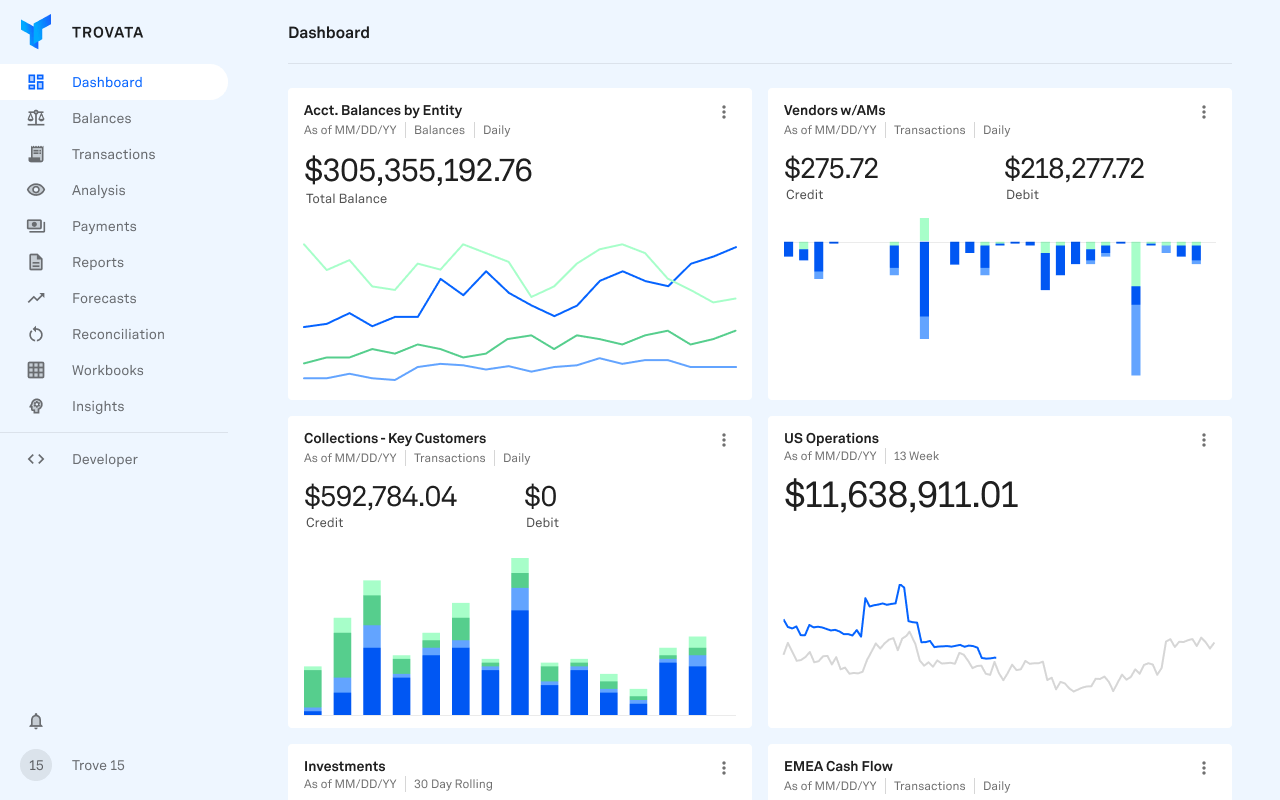
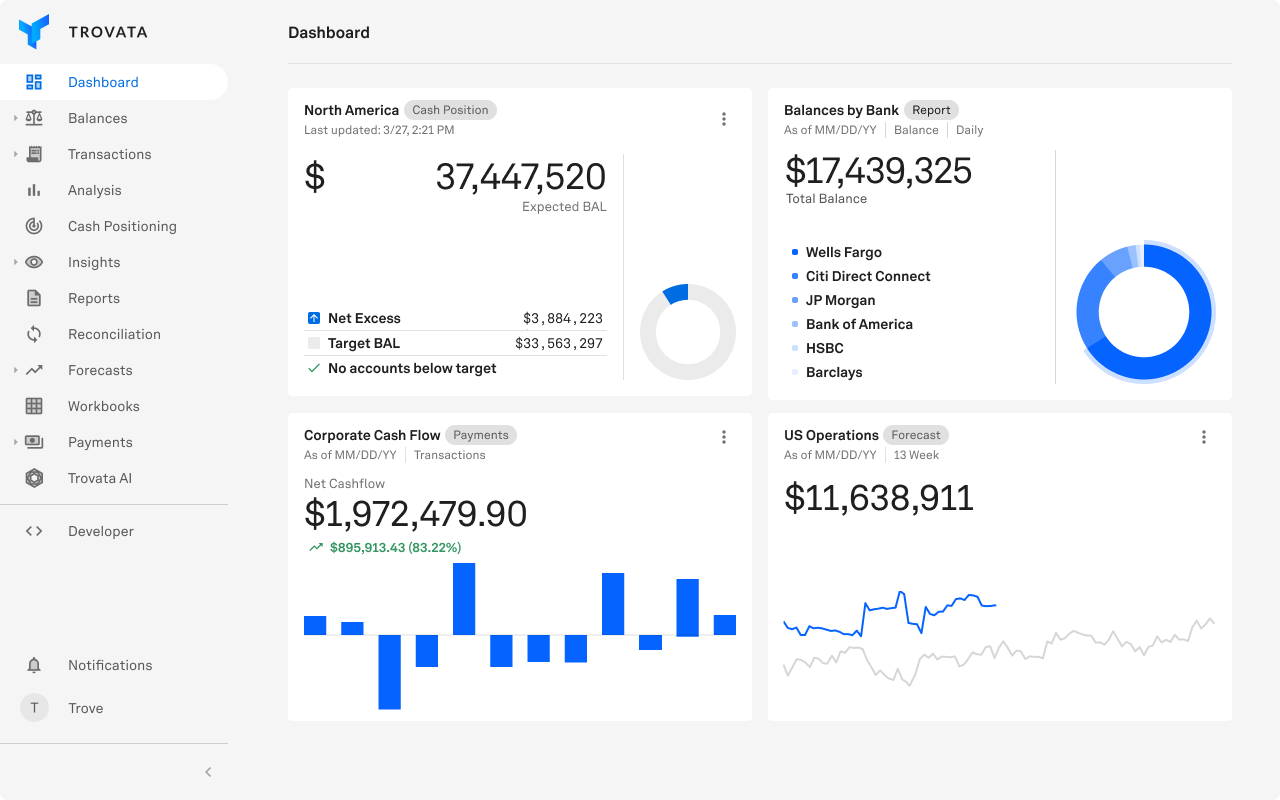
Manage cash like a pro with Trovata
Trovata gives finance and treasury teams one platform to analyze, forecast, and transact, no matter who the business banks with. Trovata is headquartered in San Diego and serves over 400 mid-market and enterprise customers in the U.S., Canada, and Japan. It is backed by J.P. Morgan, Wells Fargo, National Australia Bank, Capital One Ventures, Mastercard, State Street, and PNC.
Unified bank data
Direct API connectivity to hundreds of banks and access to SWIFT’s network of 11,500+ financial institutions put current cash and balance data in one place. One single source of truth replaces logging into multiple bank portals.
Automated cash reporting and forecasting
Intuitive search, clear reports, and forecasts built on machine learning make it easy to identify trends in customer receipts, vendor disbursements, and more.
Fast onboarding with no IT required
With nothing to install or configure and support from a team of treasury experts, Trovata Cash is up and running in days or weeks, depending on bank connectivity.
Trovata TMS
When workflows grow beyond cash visibility, Trovata TMS adds payments, bank account management and fee analysis, capital markets for debt and investments, hedging and risk, in-house banking and intercompany, and a treasury sub-ledger, all on the same normalized bank data. Most Trovata TMS implementations take several weeks, depending on the number of banks, entities, and workflows in scope.
Trovata AI 2.0
Released in March 2026, Trovata AI 2.0 brings together Trovata AI Chat for plain-language questions about cash, Trovata AI Insights for patterns and anomalies, and Trovata AI Agents for automated treasury workflows. It runs in a fully airgapped environment within Trovata’s AWS architecture, and the Trovata MCP Connector extends read-only access to Trovata data from AI assistants such as Claude, ChatGPT, Gemini, and Copilot.
Cloud-native innovation
As a cloud-native, API-first platform backed by leading global banks, Trovata rolls out updates and new bank connections continuously.
See for yourself how managing cash at scale is better with Trovata.
Request a demo today.
Subscribe to our newsletter
In this guide
- Introduction
- What holds high-growth companies back from scaling cash management
- A high-growth company’s perspective on digital transformation
- An API-first approach to cash management
- How high-growth companies digitally transform treasury operations
- Treasury digital transformation best practices
- Manage cash like a pro with Trovata
- See for yourself how managing cash at scale is better with Trovata.
Subscribe to our newsletter
Other resources


Book Trovata Demo
Watch Recording