Forecast with precision
Forecast cash like a pro with Trovata's advanced forecasting suite.
The forecast every treasury team is asked for
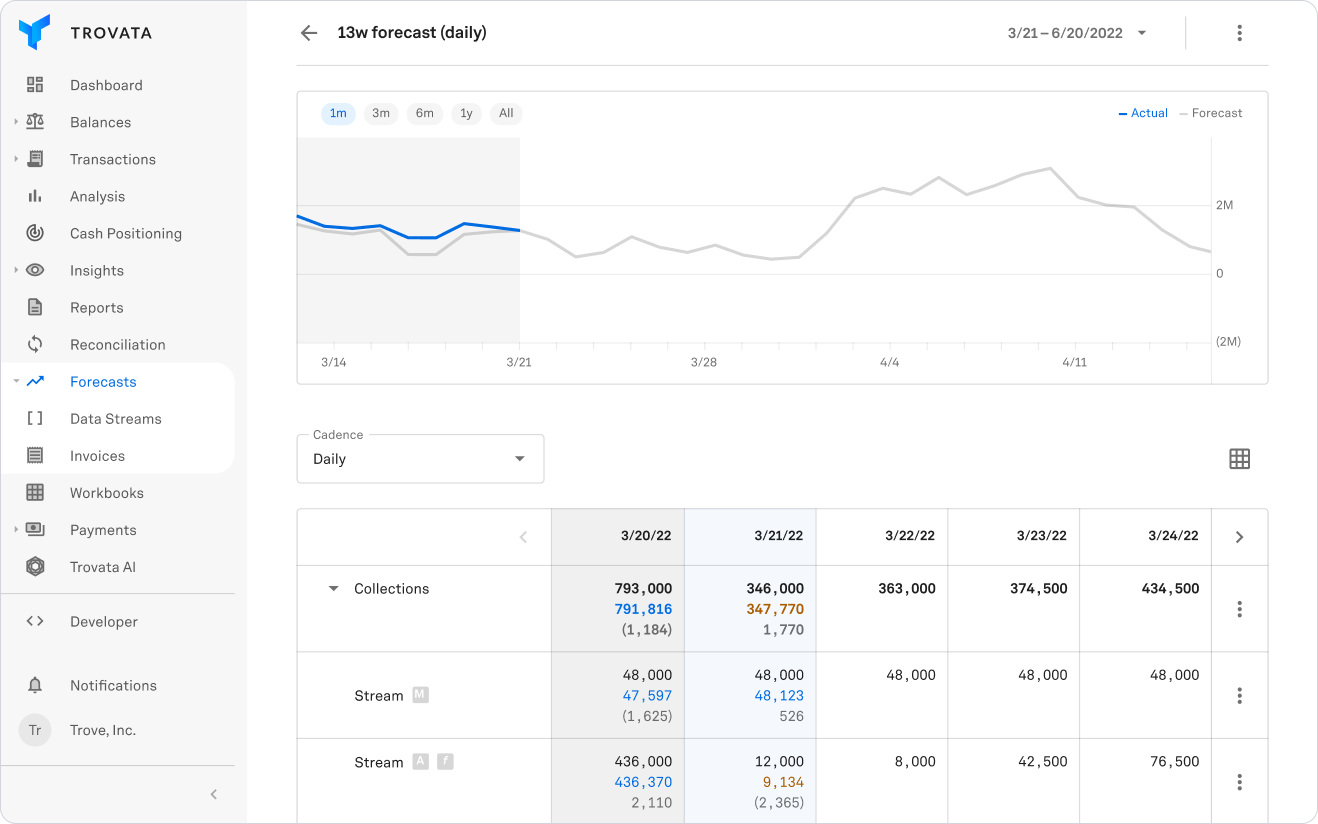
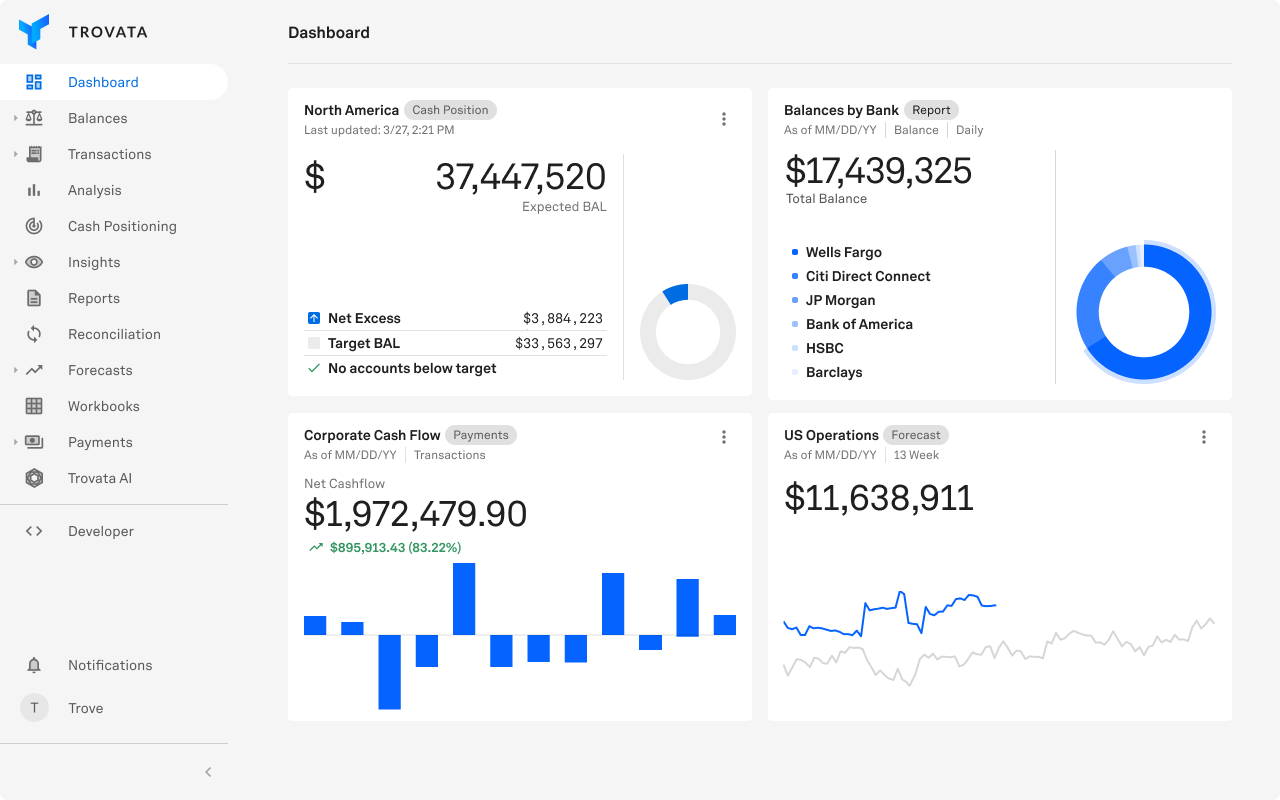
According to the 2026 AFP Treasury Benchmarking Survey, cash and liquidity forecasting is the top priority for 63% of treasury teams and the most challenging activity for 49%. The gap between the two is the data. Trovata Cash collects and normalizes bank data from every connected account and builds the forecast on that data, so the forecast stays current as new transactions arrive.
Data streams that keep the forecast current
Forecasts in Trovata build from streams. Tag-based streams link to an existing transaction tag and project future values using Trovata’s forecasting model. Open invoice streams use receivable and payable due dates from connected ERPs to predict upcoming activity. Manual entry streams add values the model does not have. When a stream changes, every forecast built on it updates.
Forecasts built from your own data
Trovata’s forecasting model builds the baseline from historical tagged transactions and open invoices, so the treasurer does not have to pick a method by hand. Filter by tag, institution, account, or keyword to build a forecast for one entity, one bank, or one category of cash flow, and see the result as it is built. Forecasts cover short- and long-term horizons, including the 13-week forecast customers such as Park Place Technologies run.
A global view across entities and currencies
Forecasts for subsidiaries in different currencies roll up into one global forecast in the reporting currency. Each subsidiary keeps its own forecast, and the consolidated view updates as the underlying forecasts change. Sealaska extended its forecasting from one month to 13 weeks to one year across more than 30 subsidiaries.
Variance against actuals
Actuals appear against forecasted values by default, so accuracy is visible without a separate reconciliation. Prior forecast versions are retained, so the team can see how a change moved the numbers. Eversana brought its forecast variance down to single-digit percentages, and variance analysis that took one to five hours a month is now instant. “After four months, we retired our Excel cash forecast. I haven’t opened it since,” said Tim Green, CTP, Treasury Manager.
Scenarios with custom variables
Add custom variables to any forecast to test how a decision changes cash flow. A planned investment or a change in collections can be modeled against the baseline, and the result is a second forecast the team can compare with the first.
Trovata AI on the forecast
Trovata AI Insights surfaces variance and anomalies in the forecast without being asked. Trovata AI Chat answers questions about the forecast in plain language, such as which stream drove a change or where the consolidated position lands at week 13.
Time back for the team
Customers such as Eventbrite and Caruso report saving more than 40 hours a month on bank data aggregation. The forecast is built on the same data, so the time saved on aggregation is time available for the forecast itself.
See your forecast on your data
Request a demo and build a forecast on your own bank data.
Subscribe to our newsletter
In this guide
Subscribe to our newsletter
Other resources


Book Trovata Demo
Watch Recording