The CFO’s playbook to drive agility and achieve real-time treasury
Introduction
The CFO’s job keeps widening. You are a strategic partner to the CEO, expected to question plans, find new sources of revenue, and manage liquidity so the business can absorb shocks. 2026 has supplied the shocks. The Federal Reserve cut rates twice in late 2025, then raised the target range by 25 basis points on September 16, 2026 to 3.75 to 4.00%, citing inflation still above its 2 percent goal. Tariff policy was rewritten twice in one year. The Supreme Court struck down the IEEPA tariffs in February, and by July the administration had replaced them with Section 301 duties of 10% or 12.5% on imports from 60 economies plus additional 50% tariffs on listed Canadian goods, effective August 22. The war with Iran that began in February closed the Strait of Hormuz, and Brent crude was trading near $100 a barrel in early October, against about $72 before the war.
Each of those events changes a cash forecast. Higher rates reprice debt and raise the return on idle cash. Tariffs change landed cost and working capital for every importer. Energy prices move freight, input costs, and the FX rates of the currencies you operate in. A CFO who cannot see today’s cash position across every bank, entity, and currency cannot model any of it, and the modeling has to start again with each new headline.
Most finance teams are still not set up for that. Datarails’ 2026 CFO Sentiments Survey (October 2026) found that only 4% of organizations have a single source of truth for finance and operational data, and 23% rely on disconnected systems and manual reconciliation. The 2026 AFP Treasury Benchmarking Survey puts cash and liquidity forecasting as the top priority for 63% of treasury teams and the most challenging activity for 49%.
Tracking cash consistently is hard when a company has many bank accounts spread across continents and currencies. This guide covers how CFOs gain agility and get data in real time, starting with the market forces in play.
The 2026 economic backdrop
Rates turned up again
After two cuts in late 2025, the Fed reversed course. The September 2026 FOMC minutes cite energy prices tied to the Middle East conflict, tariffs, and AI-related demand as upside inflation risks, and most participants expected another increase by year end. CPI was 3.4% in August 2026, second-quarter GDP grew 2.2%, and unemployment held at 4.2%. The economy is growing and borrowing costs are rising at the same time. For treasury, that means refinancing decisions carry more weight and idle cash is worth more. Three-month Treasury bills yielded about 4.05% and the Crane 100 money fund index paid 3.69% in early October 2026. Knowing how much cash is surplus, and for how long, is now a direct contributor to earnings.
Tariffs rewrote landed cost twice
The Supreme Court’s February 20, 2026 ruling that IEEPA does not authorize tariffs ended the reciprocal tariffs and sent importers to CBP and the Court of International Trade for refunds. A temporary 10% Section 122 surcharge followed, then expired on July 24, the same day the Section 301 duties took effect. Canada is the sharpest case. The Section 338 tariffs apply regardless of USMCA origin, and Canada retaliated on about $27.6 billion of U.S. goods from September 8. At the July 1 joint review, USTR stated that the USMCA was not renewed in its current form. Any company importing from or selling into Canada and Mexico is forecasting duty costs on a rulebook that keeps changing.
Geopolitics moved from headline to balance sheet
The Iran war began on February 28, 2026, and the ceasefire agreed in April collapsed on July 8 after attacks on commercial vessels. Gulf oil flows excluding Iran had recovered to over 81% of prewar levels by September, with about 40% of exports bypassing the strait by pipeline and ship-to-ship transfer, and attacks on shipping continued into October. The IMF’s July 2026 update cut 2026 global growth to 3.0% and put energy prices about 25% above prewar levels. Ukraine is in its fifth year of war with port and energy infrastructure under attack on both sides. Treasury teams are managing FX, commodity, and counterparty exposure in markets that reprice daily.
Fraud is a treasury problem
The 2026 AFP Payments Fraud and Control Survey found that 76% of U.S. organizations experienced attempted or actual payments fraud in 2025, and 74% were affected by business email compromise. Only 17% use AI to combat it. The FBI’s 2025 Internet Crime Report recorded $20.877 billion in reported losses, up 26%, with business email compromise accounting for $3.05 billion. Payment controls, visibility into every account, and an audit trail for every instruction are part of liquidity management now.
Strengthening treasury for the road ahead
In conditions like these, liquidity is the first priority. Treasury strategy has to account for shifting demand, supply chain disruption, and fluctuating capital costs at once. A proactive approach to cash flow management and forecasting keeps the business stable and lets it act on opportunities, whether that is an acquisition, a refinancing window, or a supplier willing to trade price for early payment. The practical moves are the same under every scenario. Predict the liquidity the organization needs so you can negotiate from strength with banks. Improve forecast accuracy to absorb rising logistics and input costs. Get invoices into the ERP on time. Hold the cash you need to keep operations going when a shipping lane or a trade agreement closes.
Business agility starts with visibility
With these forces in play, CFOs are building teams that generate strategic insight efficiently. That means the team needs tools that deliver data in real time, let them filter and analyze it in a variety of ways, and let them act on opportunities quickly. Technology is how treasury gets real-time visibility, and open banking, APIs, cloud computing, and AI are the pieces that make it possible.
The gap is measurable. Cherry Bekaert’s 2025 Middle Market CFO Survey found 49% of CFOs feel blocked by poor data quality from making critical financial decisions. In PwC’s 2025 Global Treasury Survey, 76% of treasurers named poor data quality as their top forecasting challenge. TD Bank’s survey at the AFP 2025 conference found nearly 80% of treasury departments still rely on manual or fragmented systems. The budget is moving. Gartner reported in February 2026 that technology budgets are set to rise for 75% of CFOs.
Five solutions for achieving real-time treasury
1
Cloud computing
One of the simplest innovations in finance has some of the biggest impact. Cloud treasury software gives the entire department a single source of truth. Everyone looks at the same numbers, changes are saved by whoever makes them, and analysis and data are shared without emailing files. There are no servers to maintain and no upgrade projects, because updates roll out continuously.
2
Open banking APIs
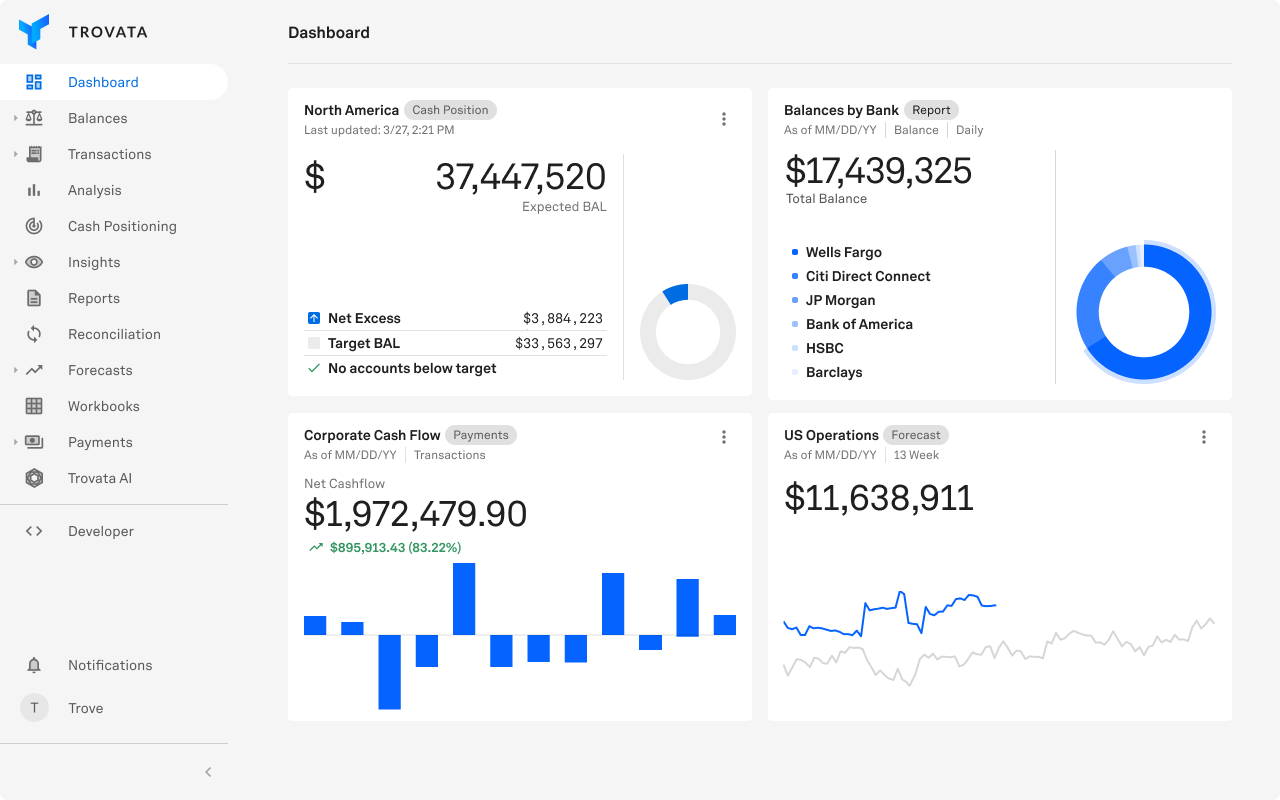
An analyst in Portland seeing the same information as one in Mexico City is only useful when the data is correct. With spreadsheets, there is no way to know. Input and formula errors throw off an entire liquidity overview or forecast. Open banking APIs fix that at the source. Instead of collating data by hand across many banking portals, the API gives your treasury platform read-only access to your bank, and balances and transactions arrive normalized and in real time. The result is one dashboard showing the liquidity position across every bank, and a single, consistent dataset for modeling, analysis, and forecasting.
3
Analytics and AI
The next step is to use that data to answer questions. To give the CEO forecasts and insight, you need to know how and when cash is coming in and going out, by entity, by bank, and by category. With cloud-native, API-based treasury software, every transaction is gathered, tagged, and stored automatically, so those questions get answered in the platform instead of in a week of manual gathering.
AI changes what the team can do with that data. Trovata AI 2.0 has three parts. Trovata AI Chat lets anyone on the team ask a question about balances, transactions, or forecasts in plain language and get an answer built from the underlying data. Trovata AI Insights surfaces trends and unusual patterns proactively, so the team looks at what has changed rather than scanning for it. Trovata AI Agents carry out defined treasury workflows within permissions the team sets. All of it runs inside an airgapped environment within Trovata’s AWS architecture. The Trovata MCP Connector extends the same data to the AI assistants your teams use every day, including Claude, ChatGPT, Gemini, and Copilot, with read-only access to balances, transactions, tags, and reports.
4
Payments
Connected treasury software also runs payments. The same platform that shows today’s position can move the money. Consolidating payments into one place cuts the time the finance team spends processing them across bank portals and lets approval workflows, permissions, and policy controls apply consistently across banks and rails. Trovata supports ACH, wire, book transfers, and real-time payments (RTP), with initiation, controls, and visibility in one system. For intercompany settlement, Trovata Stablecoin, powered by Paxos with fiat held in custody at State Street, offers another rail for moving funds between entities.
5
Enhanced security
Data has value, which is why keeping it secure has to be a primary concern for any finance team. Open banking improves security rather than weakening it. One platform for every bank means fewer login credentials in circulation and more control over who can see what. You can see which users access which information and change permissions in a few clicks. All data moves through encrypted connections, and you are never asked to share bank login credentials, PINs, or account details with the platform.
Trovata is SOC 1 Type 2 and SOC 2 Type 2 audited and hosted on AWS. Data is encrypted with AES-256 at rest and TLS 1.2 in transit, with single sign-on via SAML 2.0 and multi-factor authentication.
Five steps to a treasury management strategy
Identify your cash management strengths and weaknesses
Analyzing which processes work and which need improvement is the first step toward agility. A SWOT analysis of your current processes shows where the strengths, weaknesses, opportunities, and threats sit.
Establish strategic priorities that address the organization’s needs
Your priorities should focus on removing reporting and forecasting roadblocks. They guide the team as you build a proactive treasury strategy.
Determine the resources and technology required to execute
Start by automating bank data aggregation with a platform built on APIs. The sooner you can access your data, the sooner you gain insight into cash flow.
Build a high-level roadmap with specific, achievable goals
The roadmap sets the scope, deliverables, schedule, milestones, and risks of the new strategy. Involve the whole team in mapping departmental goals so everyone works toward the same results, and use project planning tools to track progress.
Involve others throughout the organization
Treasury management takes a team. For the strategy to hold up in uncertain conditions, integrate all financial systems, including the ERP. After establishing an initial baseline of automation, work with IT to connect the finance tech stack and get the most out of your normalized bank data.
Case studies: tech-driven strategies in practice

Customer story
Lemonade
Lemonade is an insurance company headquartered in New York and founded in 2015. Lemonade offers renters, homeowners, car, pet, and life insurance, using AI to replace brokers and paperwork with bots and machine learning. With 39 bank accounts across five banks and 15 entities, Lemonade implemented Trovata to automate cash data aggregation and normalization. Using Trovata’s tagging, the team introduced real-time reporting with on-demand report generation, automated reconciliations, and faster responses to audit requests. A six-month transaction history report that used to take hours now takes under a minute, and FBAR reporting dropped from days to minutes. Within three months, Lemonade had automated cash flow tracking across all entities and was delivering real-time financial insight to executive leadership.
“Before, if my CFO asked for our cash burn without marketing expenses, I’d have to go back, clean up data, and pull a new report. Now, I can do it on the spot. The report lives there, updates automatically, and I can pull it up whenever I need it.”

Rob DiTondo
Senior Treasury Manager at Lemonade

Customer story
GoTo
GoTo is a software company headquartered in Boston and founded in 2003. GoTo (formerly LogMeIn) makes products including GoTo Connect, GoTo Resolve, LastPass, Rescue, and Central. As GoTo scaled organically and through acquisition, it gained new banking partners, and managing that bank mix became a repetitive manual process. A consolidated view of cash flow could take days or weeks. With Trovata’s bank APIs, GoTo automated the collection of bank data onto one normalized foundation and now has complete cash visibility across 50+ global bank accounts, saving more than seven hours a week on bank data aggregation.
“Trovata provides cash visibility and data when and where we need it.”

Tim DiLillo
Sr. Director of Treasury and Investor Relations at GoTo

Customer story
Eventbrite
Eventbrite is an event management company headquartered in San Francisco and founded in 2006. Eventbrite’s global self-service ticketing platform helps businesses host live events in nearly 180 countries. Before Trovata, a daily view of Eventbrite’s liquidity was a manual, time-consuming process. The treasury team spent two to three hours a day consolidating and normalizing transaction data before uploading it to their treasury management system. With Trovata, Eventbrite saves more than 48 hours a month by automating routine data processes, cut annual costs by 50% versus its legacy TMS, and reports 100% data accuracy from Trovata’s direct-to-bank APIs, which update transaction detail intraday.
“While you can build reports in many legacy treasury management systems, it’s not as user-friendly as Trovata. The daily API with transaction details makes reconciliations on Trovata much easier compared to our previous TMS.”

Niall Burke
Global Treasury Manager at Eventbrite
The future of CFO leadership: a tech-forward approach
The traditional model of finance as crisis management is giving way to a proactive one. As the function moves from operational tasks to strategy, CFOs are leading treasury teams into the role of strategic partner, and in a rising-rate environment, treasury has yield to find.
The investment is following. Gartner’s February 2026 research found technology budgets set to rise for 75% of CFOs in 2026, with 48% planning increases of 10% or more and nearly 60% raising finance AI investment by 10% or more. Deloitte’s Q4 2025 CFO Signals survey found 50% of North American CFOs say digital transformation of finance is their top priority for 2026.
The modern CFO has evolved from a number cruncher to a strategic architect. In the past decade, the focus has shifted from financial reporting to proactive forecasting and now extends to shaping long-term business strategies. Efficiency is key, as technology streamlines day-to-day operations, providing speed, real-time data, and insightful analytics. With automation handling repetitive tasks, CFOs can elevate their focus to strategic decision-making, leveraging technology for a competitive edge in the dynamic business landscape.”

Catrina Zhang
CFO, Trovata
Build your treasury on an AI-ready foundation
Agility comes from one connected foundation. Trovata Cash gives you real-time visibility and reporting across every bank, built on direct API connectivity to hundreds of banks and SWIFT’s network of 11,500+ financial institutions, and is typically up and running in days or weeks, depending on bank connectivity. Trovata TMS adds the full treasury suite on the same data, including payments, bank account management and fee analysis, capital markets for debt and investments, hedging and risk, in-house banking and intercompany, and a treasury sub-ledger, with implementations that take several weeks depending on the number of banks, entities, and workflows in scope. Trovata AI 2.0 runs across both. Because the data is normalized before AI touches it, the answers from Trovata AI Chat, the patterns from Trovata AI Insights, and the workflows Trovata AI Agents run are built on the same numbers the CFO sees.
Achieve agility and real-time treasury with Trovata
Companies need to move and adapt quickly to stay ahead in this market. Strip away the hype, and technology is how that happens. It gives your team the capability to do more with the same headcount.
The treasury technology market has been very static for 30 years now. With Trovata’s developmental platform, AWS hosting, and API connectivity and use of AI, we are truly new and different. Market buyers of treasury systems have been somewhat frustrated with such limited choices to buy because of vendor consolidation and we are the new kid on the block.”

Paul Bramwell
Enterprise Treasury Lead, Trovata
See how Trovata delivers real-time visibility across your banks.
Subscribe to our newsletter
In this guide
- Introduction
- The 2026 economic backdrop
- Business agility starts with visibility
- Five solutions for achieving real-time treasury
- Five steps to a treasury management strategy
- Case studies: tech-driven strategies in practice
- The future of CFO leadership: a tech-forward approach
- Build your treasury on an AI-ready foundation
- Achieve agility and real-time treasury with Trovata
Subscribe to our newsletter
Other resources



Book Trovata Demo
Watch Recording