Checklist: What CFOs need to ask before approving new finance tech
The CFO’s technology mandate has grown
CFOs are expected to run financial operations, drive digital transformation, manage risk, and inform the decisions the business makes next. Data volumes keep growing, and finance leaders are now data stewards. With advanced analytics and cloud technology, CFOs can improve forecasting, manage cash with more precision, and rethink how the finance organization is structured.
Those outcomes require technology, and technology projects underperform more often than boards assume. Gartner’s 2025 CIO and Technology Executive Survey (October 2024) found that only 48% of digital initiatives enterprise-wide meet or exceed their business outcome targets. In finance, Gartner’s 2025 AI in Finance Survey (November 2025) found that 91% of finance leaders reported low or moderate impact from their AI initiatives initially. Knowing what to ask vendors before you sign is the cheapest way to improve those odds. Use the checklist below to cover the bases and protect the ROI on your technology investments.
Key questions to ask yourself and your team
What are the specific challenges your team faces?
Which tasks could benefit most from automation?
How accurate and accessible is your current financial data?
Who will own the system after go-live, and do they have the capacity to run it?
Key questions to ask vendors
Implementation and onboarding
What is the expected implementation timeline, and what drives it?
How much internal IT involvement is required?
What resources do you provide for onboarding?
What level of post-implementation support is offered?
Can you provide a reference customer that went live on the timeline you quoted?
Bank connectivity
What does the bank connection setup process look like, and what level of effort is required from our end?
Do you provide API bank connectivity?
How do you handle file-based transfers?
Do you connect through SWIFT, and do we need our own SWIFT membership to use it?
Do you support ISO 20022 formats, and how do you handle banks that still send legacy formats?
How does the system normalize and reconcile data between different connections?
How do you maintain the health of the connections and confirm they are working?
What happens when there are connection issues?
Integration
Does your system integrate with our existing tech stack, including our ERP?
Do you provide APIs or a developer portal to retrieve our normalized multibank data?
Payments
Which payment rails do you support (ACH, wire, book transfers, real-time payments)?
How are approval workflows, permissions, and policy controls configured, and do they apply consistently across banks and rails?
Do payments initiate through bank APIs, or through files we upload to bank portals?
How are payment instructions logged and audited?
Scalability
Is your system cloud-native or cloud-based?
How does the platform accommodate future business growth?
How does the platform handle increasing data volumes and complexity?
How will the platform perform under heavy workloads, and what does processing speed look like at billions of data points?
AI and automation
What specific AI applications do you provide?
How does the platform automate tasks and workflows?
Where does our data go when we use your AI features, and is the model environment isolated from the public internet?
Can we trace an AI output back to the underlying transactions and reports it was built from?
What can AI agents do without a human approval, and how are their permissions scoped?
Can we reach our treasury data from the AI assistants our teams use, for example through an MCP connector?
Security and compliance
What security measures are in place?
Does the platform comply with industry regulations, and what audits or certifications do you hold?
What disaster recovery and business continuity plans are in place?
Additional considerations
What is the total cost of ownership for the system?
What is the vendor’s reputation and financial stability?
Should you conduct a proof of concept before full implementation?
What is your exit strategy if the software does not meet expectations?
Working through these questions helps you select a solution that aligns with the organization’s strategic objectives and delivers a measurable return.
Trovata: next-gen treasury technology that CFOs trust
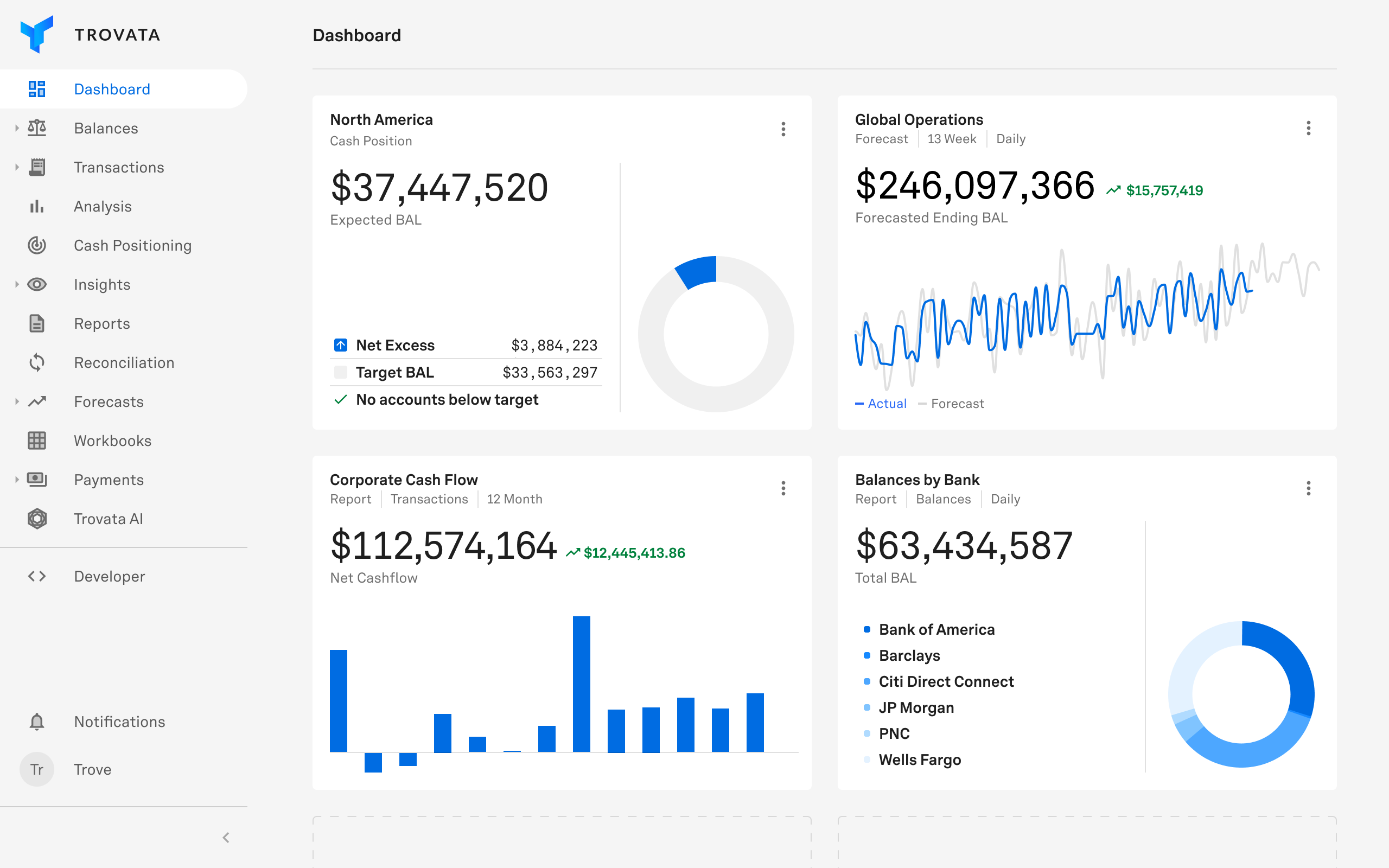
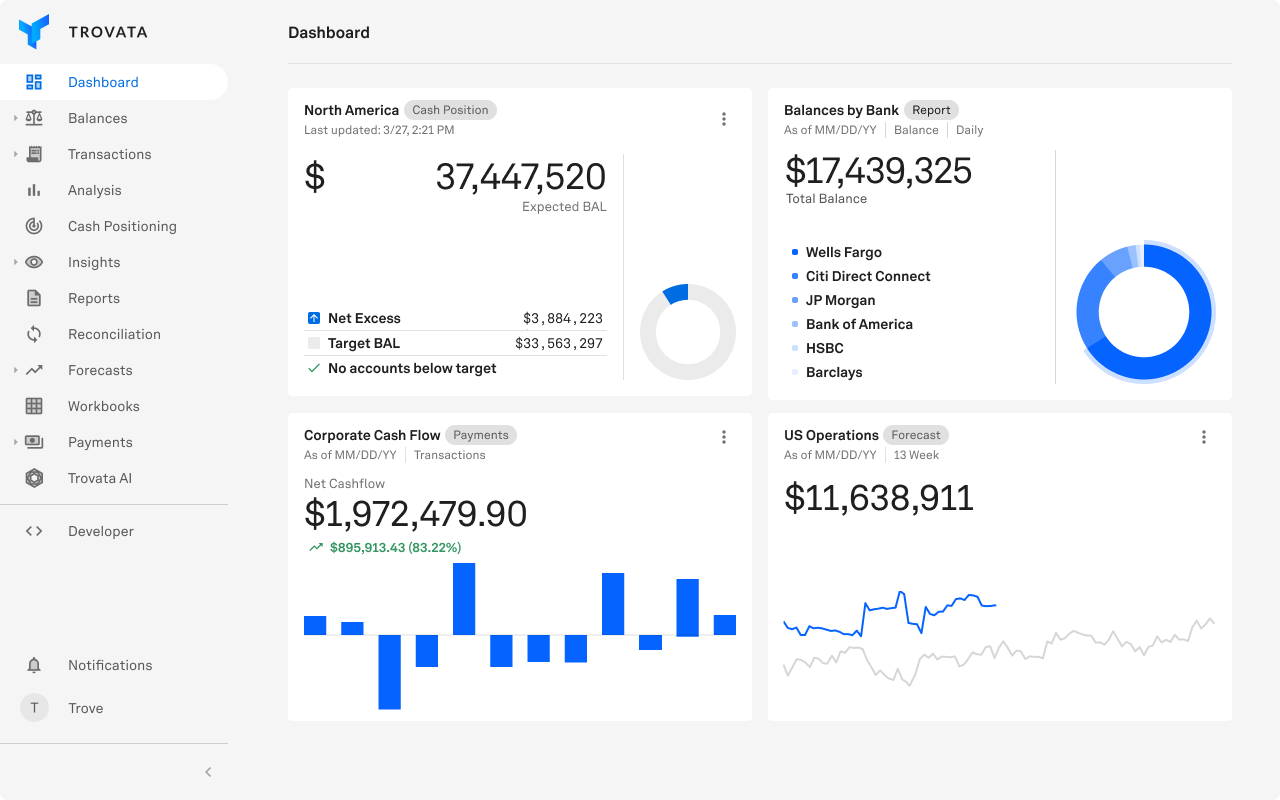
Trovata describes itself as “the first new platform to manage corporate cash and liquidity in nearly 30 years.” Its cloud-native, API-first platform gives you a real-time view of your entire financial position in one place. Beyond visibility and forecasting, treasury teams transact within the same platform, with payments initiated and controlled alongside the bank data they reconcile against.
Built for what comes next
Trovata’s API-first approach is the current standard for bank connectivity, with direct API connectivity to hundreds of banks and access to SWIFT’s network of 11,500+ financial institutions. Cloud-native infrastructure means updates and new bank connections roll out continuously, without disruptive upgrades. Trovata AI 2.0 (Trovata AI Chat, Trovata AI Insights, and Trovata AI Agents) runs in an airgapped environment inside Trovata’s AWS architecture, and the Trovata MCP Connector gives read-only access to Trovata data from AI assistants such as Claude, ChatGPT, Gemini, and Copilot.
Time savings
Built on AWS, Trovata automates bank data aggregation, reconciliation, and reporting, which reduces operating expense and returns time to the team. Customers such as Eventbrite and Caruso report saving more than 40 hours a month on bank data aggregation.
Implementation
We work closely with your team to configure the platform to your needs and provide a dedicated account manager for continued support. Trovata Cash is typically up and running in days or weeks, depending on bank connectivity. Trovata TMS implementations take several weeks, depending on the number of banks, entities, and workflows in scope.
Managed bank connectivity
Once connected, Trovata maintains all of your bank connections as a managed service. We monitor for changes or disruptions and address them, so the flow of financial data is uninterrupted.
Integration
Trovata’s APIs and developer portal connect to external platforms. Integrate with your ERP to automate the flow of bank data, and connect investment platforms and custodians to manage positions inside the platform.
Payments
Trovata centralizes payment initiation, controls, and visibility across banks and rails, covering ACH, wire, book transfers, and real-time payments (RTP), with approval workflows, permissions, and policy controls applied consistently across banks.
Security
Trovata is SOC 1 Type 2 and SOC 2 Type 2 audited, hosted on AWS, with data encrypted with AES-256 at rest and TLS 1.2 in transit.
Since we started using Trovata, our treasury technology capabilities have completely transformed for the better.”

James Krikorian
VP & Treasurer, Krispy Kreme
See how Trovata answers every question on this list.
Subscribe to our newsletter
In this guide
Subscribe to our newsletter
Other resources
Book Trovata Demo
Watch Recording