Optimizing Bank Connectivity for Treasurers: Unlocking Efficiency and Real-Time Visibility
How to reshape connectivity across your bank mix, automate tedious tasks, and gain a holistic view of cash.
As a treasurer, you’re likely feeling the pressure to go beyond basic cash management and deliver strategic value to your organization. Leadership expects you to not only safeguard the company’s financial health but also identify and capitalize on growth opportunities. It’s a lot to juggle, especially with a lean team, limited budget, and labor-intensive processes.
Keeping up requires a shift from traditional treasury operations to automated processes and seamless data integration. Manual data entry just won’t get you the visibility you need when working with a complex bank mix. But, even when ready to kickstart digital transformation, you may realize your banks offer different connection methods.
Treasury challenges often point back to the issue of disparate banking connections and file formats. This creates fragmented data, forcing treasurers to spend countless hours each week manually pulling information together and meticulously ensuring its accuracy at a granular level.
This is why it’s important to start reshaping connectivity across your bank mix. By leveraging the power of modern connection methods, you can unlock a new level of efficiency and gain real-time visibility into cash flow. This newfound agility empowers you to automate tedious tasks, streamline processes, and gain a holistic view of your company’s financial health.
Throughout this guide you’ll get valuable insights from leading finance and tech experts:

Paul Bramwell
Enterprise Treasury Lead at Trovata

Chris Brown
Sr. Solutions Engineer at Trovata
The impact of outdated bank connectivity methods
Fragmented bank data acts as a major obstacle to efficient and effective treasury management. Achieving visibility into global cash flow and risk exposure remains one of the hardest problems treasurers face, and disconnected data is at the root of it. Without a unified view, treasurers struggle to gain a comprehensive understanding of their financial health and make informed decisions.
This can lead to:
Delayed and inaccurate cash flow reporting
Delays in data consolidation lead to outdated and potentially inaccurate cash flow reports. This can hinder insight into short-term funding needs and investment opportunities.
Inefficient forecasting
Fragmented data makes it difficult to get a reliable prediction of future cash flows. This can lead to inaccurate forecasts, impacting strategic planning and potentially exposing the company to unexpected liquidity risks.
Reduced time for strategic analysis
Treasurers bogged down by manual data tasks have less time for analysis and strategic thinking. They’re unable to dedicate sufficient time to tasks like identifying cost-saving opportunities, optimizing payment strategies, or managing foreign exchange exposure.
Expensive data entry mistakes
The risk of errors and inconsistencies due to manual data entry in spreadsheets can have serious consequences. Inaccurate financial data can lead to misleading reports, unreliable forecasts, or misallocation of cash — and a single mistyped figure can go unnoticed for months when no one is reconciling against a real-time source.
Disconnected data creates significant roadblocks to efficiency.
That’s why treasurers need to prioritize improving bank connectivity as the foundation to transforming operations. The first step to modernizing your treasury processes is optimizing how you store and manage your bank data.
There’s no value in advanced treasury functions like detailed forecasting if the data you’re using is incomplete or outdated. That’s why I’d argue that getting bank connectivity right is the most important aspect of modern treasury operations. With access to accurate, real-time data, everything that follows becomes easier and far more strategically useful.”

Jason Mountford
Financial Commentator featured in Forbes, Bloomberg and more
Where do you manage bank data?
Spreadsheets have been a go-to resource for treasurers. After spending hours manually logging into various bank portals to pull files, spreadsheets are often used to consolidate that data due to their flexibility. But, let’s face it, this is hardly efficient—and can wind up being an incredibly time-consuming process.
Spreadsheets will likely always have a place in treasury operations, but they shouldn’t be your go-to resource. Today’s treasurers need more time to focus on value-add tasks and gleaning strategic insights.
That’s why it’s important to have a technology solution that can automate repetitive tasks and empower you to focus more on strategy rather than data collection. So, what are your options?
Enterprise resource planning (ERP) systems
These systems are essential for managing various aspects of a business. However, ERP bank integration is a complex process that requires heavy IT support. Furthermore, they don’t provide comprehensive data analysis features unique to the needs of treasurers. Here’s why relying solely on ERPs can hinder your treasury function:
Lack of cloud-native capabilities: Traditional ERPs are often built for on-premise deployments, limiting their scalability and integration potential. Cloud solutions offer a more agile and adaptable environment, crucial for handling the ever-growing volume and complexity of financial data. Scaling up or down becomes easier, allowing treasurers to adapt to changing business needs without significant infrastructure investments.
Difficulty handling diverse data formats: Banks utilize a wide variety of data formats and structures. ERPs may struggle to ingest and interpret this diverse data, leading to errors and inconsistencies. This can create significant roadblocks in consolidating and analyzing financial information from various sources.
Limited data analysis functionalities: ERPs are primarily designed for managing core business functions. They may lack the sophisticated functionalities needed for treasury. ERP systems often lack cash forecasting capabilities, hindering your ability to identify trends, plan for various scenarios, and optimize cash flow which are all core priorities for treasurers.
Restricted data accessibility outside the ERP: Data housed within an ERP system can often be siloed and difficult to share with external tools or platforms for further analysis. This lack of accessibility restricts treasurers from leveraging advanced analytics tools or integrating their data with other financial systems for a more holistic view.
In practice, this lands on your team. Most ERPs serving middle-market and small enterprise companies do not have strong bank connectivity, so the file-based connections behind them fall to internal IT or the ERP admin to build and maintain. Trovata fills that gap. We act as the bank connectivity layer for your ERP, owning the connections and delivering normalized data into it. For NetSuite environments, that connectivity layer is delivered through our NetSuite SuiteApp.
In essence, while ERPs (Enterprise Resource Planning systems) are well-suited for accountants who primarily focus on historical financial data, treasurers have different needs. Treasurers manage current cash flow and bank relationships, tasks that are more forward-looking. Therefore, a dedicated solution is crucial for treasurers to effectively manage their day-to-day activities and make informed financial decisions.
An API-first treasury management platform
Just as the cloud revolutionized digital transformation over the past decade, banks are now opening up and providing direct access to account data through APIs (Application Programming Interfaces). This presents a significant opportunity but with a twist.
The data itself is raw, unstructured, and richer with a constantly expanding set of data fields being added for bank customers. While it can be delivered in real-time, the lack of a common standard for corporate banking APIs hinders adoption by traditional Treasury Management Systems (TMS). Since the data can be a moving target, TMS vendors struggle to integrate API-based bank data without converting it to their own file formats.
This conversion process creates a bottleneck, preventing many treasuries from taking the next step in their digital transformation journey. They are locked out of this powerful, dynamic, and intelligent next-generation data transport medium (APIs) that holds the key to further streamlining their operations.
Simply put, a platform built for file-based batch delivery cannot pass through what an API actually offers. Only treasury management software designed API-first puts that richer, real-time data in a treasurer’s hands intact. Treasurers who gain real-time visibility into cash flow are in prime position to evolve into strategic leaders of their organization. This is why a treasury management platform designed for API integration empowers you with a new wave of possibilities. They offer a comprehensive solution specifically tailored to the needs of modern treasurers:
Robust API integration capabilities: A modern platform boasts seamless API integration capabilities, allowing you to connect effortlessly with a multitude of banks and centralize all of that data into a single source of truth. This eliminates the need to log into multiple bank portals to pull data and automates data aggregation. Furthermore, the data comes to you in a consistent format, already normalized, so you can focus on analysis.
Beyond bank connectivity: An API-first treasury management platform goes beyond just ingesting APIs – it offers its own robust developer portal. Trovata empowers you to integrate with your own custom applications, seamlessly connect to your existing ERP system, and much more. With Trovata as a centralized bank data hub, you’re equipped to seamlessly feed data wherever it’s needed within your organization’s ecosystem.
Scalable data storage for high-volume global transactions: As your business grows and your global footprint expands, so does the complexity of your bank data. A modern, cloud-native system provides unlimited data storage equipped to handle the ever-increasing volume of transactions, ensuring you can manage all your financial information effectively.
High-speed data processing for real-time insights: Real-time data is the cornerstone of proactive treasury management. With an API-first platform, you gain real-time cash flow visibility. Additionally, modern infrastructure enables lightning-fast data processing. For you, that means no more staring at a loading screen waiting to generate a daily cash position report or short-term forecast.
Simplified bank onboarding processes: Onboarding new banks shouldn’t be a time-consuming hassle. API integration streamlines the bank onboarding process, allowing you to connect new accounts quickly and efficiently. This eliminates the need for IT support and data can start flowing within weeks, not months.
While ERPs can be powerful tools, they often lack the specialized features treasurers need for efficient cash management, especially when dealing with multiple bank accounts. An API-first treasury management platform offers more robust cash reporting and forecasting, risk management, payments, and much more. ERPs, while offering some cash reporting, often lack the detail and automation needed for efficient treasury operations.”
Chris Brown
Senior Manager, Sales Engineering, Trovata
By adopting an API-first treasury management platform, treasurers gain the tools and functionalities they need to thrive in today’s dynamic landscape. Seamless bank connectivity, robust data management, and real-time insights empower you to move beyond basic cash flow management. You’re now well-resourced to become a strategic partner, driving financial performance and delivering value to your organization.
Connecting to your bank mix: choosing the right path
With an API-based treasury management platform in place to store your bank data, you can now rethink connectivity across your bank mix. Optimizing bank connectivity hinges on selecting the most suitable method for your organization. Treasurers have a few options when it comes to connecting with their banks.
H2H — Host-to-Host
SWIFT — Society for Worldwide Interbank Financial Telecommunication
API — Application Programming Interface
It’s important to understand how each works. That way, you can make informed decisions and choose your best options for connectivity.
H2H (Host-to-Host)
This method establishes a direct line between your company’s systems and the bank’s, but it comes at a cost. Setting up and maintaining these connections requires heavy IT dependency, making them complex and expensive. Additionally, these connections often lack scalability, making it difficult to adapt to growing business needs or connect with multiple banks. Furthermore, with file-based transfers, providers may plug data gaps to ensure successful transfers, but this can create blind spots in the audit trail. Finally, the burden of data reconciliation falls on end users, which can be time-consuming and error-prone.
SWIFT (Society for Worldwide Interbank Financial Telecommunication)
For decades, SWIFT has been the backbone of secure international financial communication. However, SWIFT’s reliance on file-based transfers shares some of the limitations of H2H connections. While SWIFT offers a standardized and secure network, its batch processing can lead to delays in data availability, critical for real-time treasury operations. Implementing SWIFT can also be a complex undertaking, requiring significant time and resources. Furthermore, compared to modern API connections, SWIFT messages often lack rich metadata that can provide deeper insights into your financial activity. This limited data can hinder your ability to generate comprehensive reports and forecasts, crucial for informed financial decisions.
API (Application Programming Interface)
APIs offer a modern and agile approach to bank connectivity. They provide a user-friendly interface for exchanging data seamlessly with various financial institutions.
Ease of use: APIs are known for their user-friendly nature. For bank connectivity, set-up and ongoing maintenance typically require no IT involvement at all, freeing up valuable IT resources. Broader platform implementations, such as standing up a full TMS, will still involve your IT and ERP teams.
Real-time data updates: API connections offer real-time or near real-time data updates, ensuring you have access to the latest information for immediate decision-making. No more waiting for batch processing or overnight data feeds.
Rich data with detailed transaction metadata: API-based connections unlock a wealth of detailed transaction metadata. This comprehensive information enables better categorization, reporting, and in-depth analysis of your financial activity.
The API advantage
Given the ease of use, data update frequency, data comprehensiveness, and limited ongoing maintenance, we recommend prioritizing API connectivity amidst these options. Trovata’s API-powered platform offers the largest API library in the world, seamlessly connecting with leading banks to streamline bank connectivity.
An API solution is a worthwhile investment. It gives you real-time information, makes tasks quicker, and ensures data accuracy. The consideration is coverage at the smaller end of your bank mix. Many small regional and local banks offer no information reporting at all, by API or by file. Where that is the case we look at alternatives such as aggregator connections, and in the last resort virtual accounts with data imported by hand — so those accounts still appear in your overall cash position. With more banks rapidly implementing open banking APIs, prioritizing API connectivity future-proofs your treasury operations. Taking an API-first approach to bank connectivity provides a trove of benefits. However, the right treasury management software provider can support any format.
Trovata is the first and only company in the world that has built a standard across corporate bank APIs and all legacy file formats, including SWIFT. This means we can connect you to your bank data through any method and you receive data in a standardized format within our platform. We help you identify what connectivity options are available based on your unique bank mix and manage implementation and maintenance for you.
Working with a provider like Trovata streamlines the entire implementation and maintenance process. However, if you decided to implement these connections on your own, the table below reflects what the process would look like.
Swift | File-based | API | |
|---|---|---|---|
Data format | MT940 | BAI2 | Bank specific data parameters |
IT requirement | SWIFT service provider | IT configured sFTP | Managed data center |
Timeliness | Scheduled throughout day | Prior day / intra day | Event driven, hourly, or custom |
Historical data availability | Point-in-time | May be possible, but bank dependent | Immediate per bank’s retrieval limit |
Cost | Per message + monthly service | IT setup + maintenance (intraday activity extra $) | Bank setup cost and/or free usage |
Many view APIs simply as a communication channel, akin to a modem or VPN. However, the true power lies in the wealth and timeliness of data they provide. Unlike clunky legacy connections such as H2H where you try to retrieve intraday BAIs, MT942s, and CAMT052s, APIs offer on-demand access to a broader range of data points. This richer metadata empowers deeper functionalities like reconciliation, cash application, and even data mining for forecasting and AI applications. The ability to tag this information also adds to the usefulness of data.”
Paul Bramwell
Enterprise Treasury Lead, Trovata
Beyond connectivity: data unleashed with Trovata
Built entirely on Amazon Web Services (AWS), Trovata leverages the most advanced Infrastructure-as-a-Service provider’s global data center network. This cloud-native architecture provides a modern tech stack perfectly suited for the dynamic nature and rich data of real-time bank APIs.
As a result, Trovata unlocks transformative possibilities for treasury management. Corporate banking data becomes usable for a wider range of purposes, including:
Cash flow analysis
Forecasting
Business intelligence
High-performance search
AI powered by natural language processing
This democratizes best practices in corporate treasury management, making cash, liquidity, and risk management faster, cheaper, and more flexible, scalable, and accessible than ever before.
By optimizing your bank connectivity with an API-first approach, and an API-based treasury management platform in place, you’ll be equipped to unlock powerful insights to optimize cash flow. You can unlock the true potential of your financial data by transforming it into actionable insights:
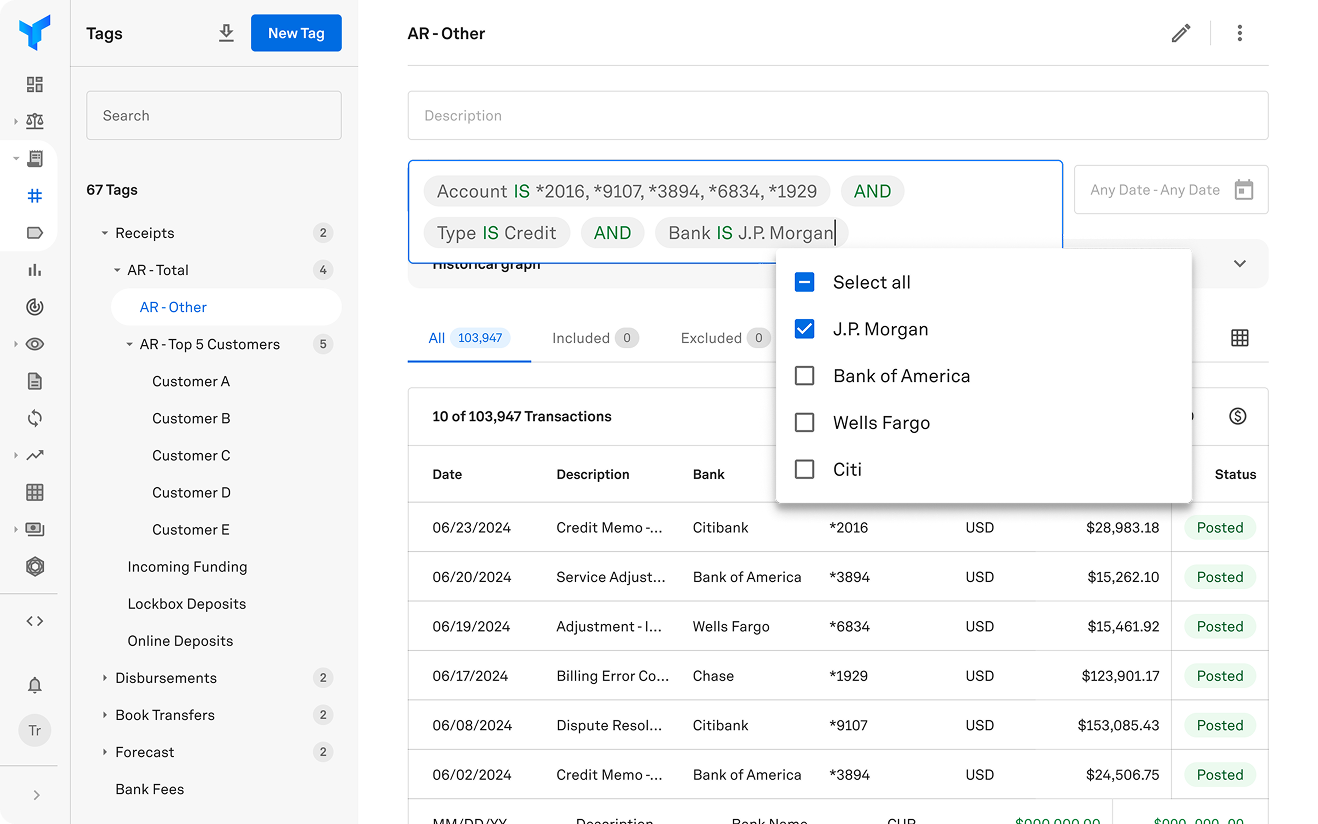
Automated transaction tagging
Say goodbye to manual data categorization in spreadsheets. Trovata leverages AI to automatically tag transactions, saving you time and ensuring consistency in classifying your financial activity. Additionally, API connectivity provides rich metadata for more granular, efficient tagging with more detailed descriptions of transactions. No more wasted hours spent sorting through spreadsheets – the system does the heavy lifting, allowing you to focus on higher-value tasks.
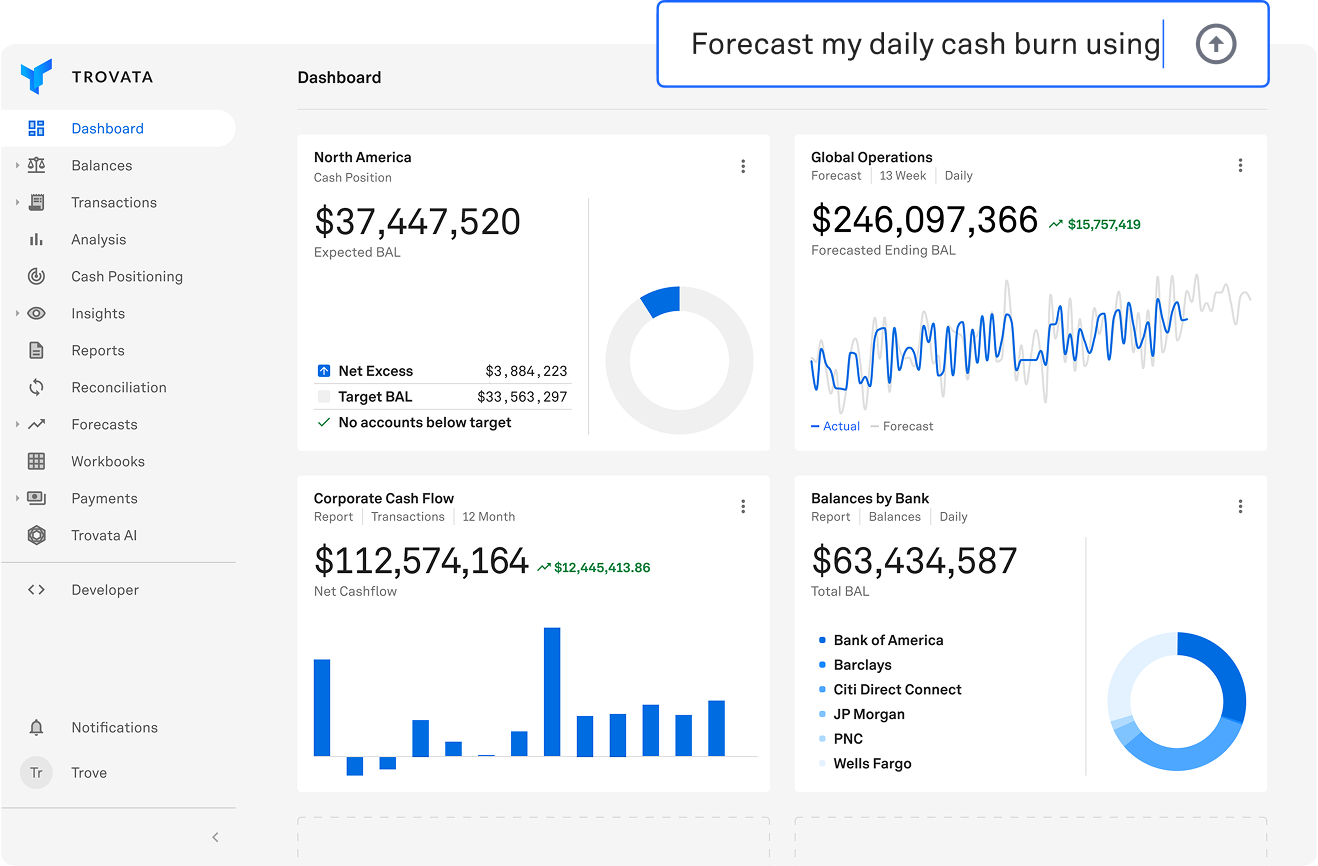
Data-driven reporting and automation with AI/ML
The power of artificial intelligence (AI) and machine learning (ML) goes beyond automation. Trovata leverages these technologies to generate insightful reports and automate repetitive tasks. Reports are automatically updated as your daily balances update. Historical data is automatically analyzed to create a baseline for more accurate cash forecasting. This frees you from manual processes and empowers you to focus on proactive decision-making.

Seamless integration with existing systems
No more data silos! Trovata’s API seamlessly integrates with ERP systems and custom applications, eliminating the need for separate data entry and reconciliation.
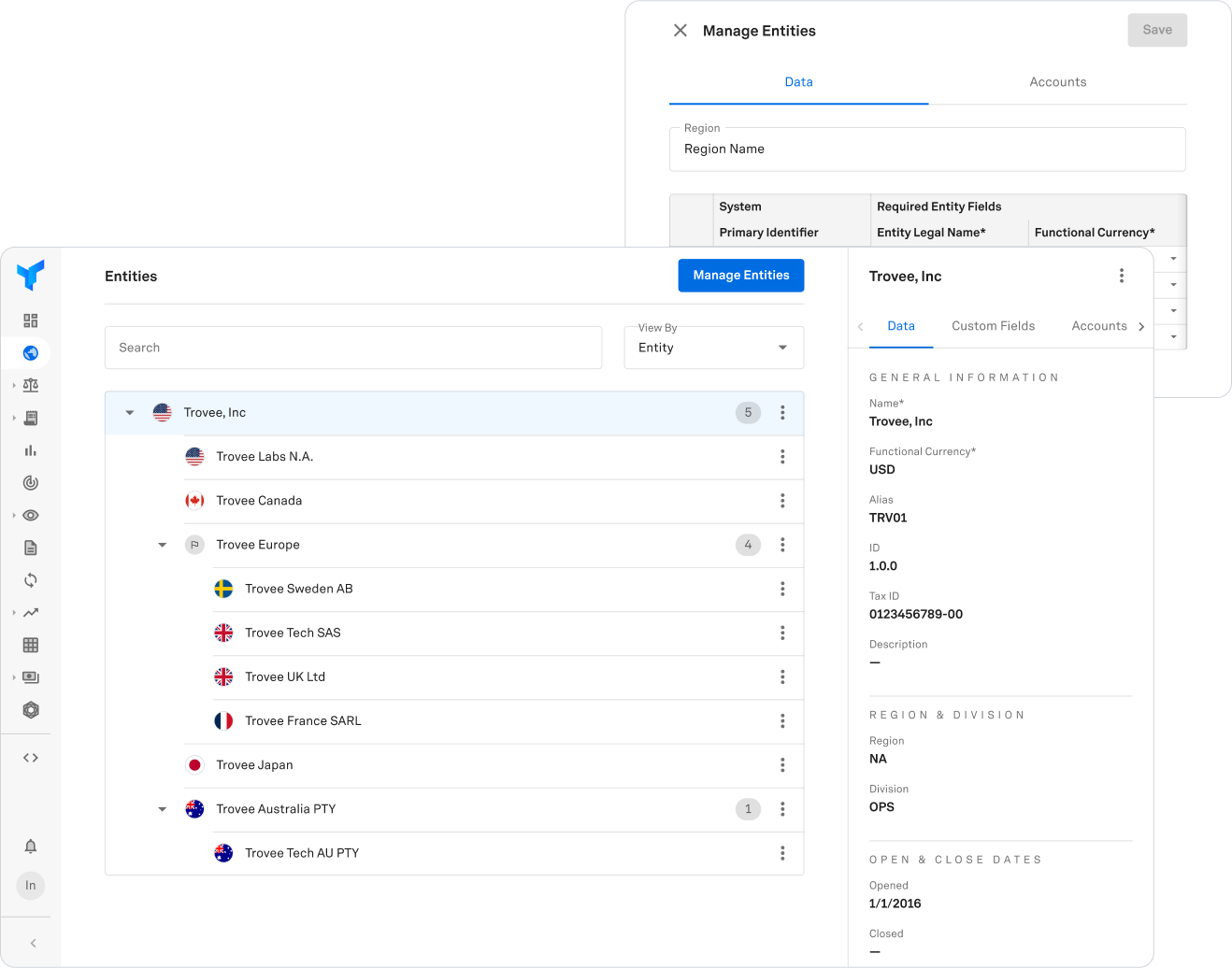
Entity management
For organizations with domestic and international operations, managing cash flow across subsidiaries can be complex. Trovata provides a holistic view of cash flow across all your entities. Furthermore, you gain complete control as you can compartmentalize access to bank data for each entity, while still maintaining a bird’s-eye view of your global financial landscape. This level of control and transparency empowers you to optimize cash flow management across your entire organization.
By leveraging data analysis capabilities powered by AI and ML, Trovata transforms raw data into a strategic asset. This empowers you to move beyond basic cash flow management and become proactive drivers of financial performance.
How treasurers like you benefit from Trovata

Customer story
Cloud Software Group
The treasury team at Cloud Software Group manages a staggering number of bank accounts – over 300 spread across 40+ banks globally for over 100 entities. They leveraged Alteryx and Power BI to transform statements and data into reporting dashboards. However, while these platforms help to automate reporting, they lack real-time data capabilities, hindering daily balance visibility. With Trovata, the team at Cloud Software Group was able to address these challenges by gaining the real-time visibility they need for confident decision-making. Thanks to Trovata’s open banking APIs, they no longer needed to log into multiple bank portals and manually download statements. Trovata automates this process, saving valuable time. Additionally, Trovata streamlines data transformation by automatically converting downloaded bank data into a consistent format. This eliminates the need for wrestling with different file structures and spending hours cleaning data across disparate systems. They now have the latest cash flow information always on hand for proactive cash management and informed business decisions.
“I gravitated to Trovata because of the APIs. The daily feed makes data readily available. Transaction tagging allows for easy categorization and a clear picture of cash flow. Logging in provides instant updates, eliminating the need for manual data pulls.”

Bruce Edlund
Assistant Treasurer at Cloud Software Group

Customer story
Krispy Kreme
In the past five years, Krispy Kreme has experienced rapid revenue growth and multiple international expansion events. Naturally, this led to its corporate treasury team requiring advanced treasury technology capabilities that could facilitate its increasingly complex workflows and reporting needs.
To overcome these challenges, Krispy Kreme chose Trovata. Through our platform, they were able to obtain 100% visibility into their multi-bank data with a single source of truth. Leveraging APIs, a cloud bank data lake, and machine learning technology, Trovata empowers Krispy Kreme to analyze, report, forecast, and move money seamlessly.
“Since we started using Trovata, our treasury technology capabilities have completely transformed for the better. We have more time to focus on driving strategy and unlocking growth opportunities.”

James Krikorian
VP & Treasurer at Krispy Kreme
Get started on your treasury transformation journey with Trovata
In today’s dynamic and competitive financial landscape, optimized bank connectivity is no longer a luxury, it’s a necessity. Traditional methods struggle to keep pace with the ever-increasing volume and complexity of financial data. Treasurers require real-time insights, efficient data management, and seamless integration to make strategic decisions that drive financial performance.
By embracing an API-driven treasury management platform, treasurers unlock a world of possibilities. They gain the tools to transform raw bank data into actionable insights, automate time-consuming tasks, and gain a holistic view of their financial health. The path to treasury transformation starts with the right foundation – a platform designed for the modern era. Take the first step towards a connected future. Explore how Trovata can empower you to streamline operations, optimize cash flow, and become a strategic pillar of your organization.
Subscribe to our newsletter
In this guide
Subscribe to our newsletter
Other resources


Book Trovata Demo
Watch Recording