Trovata: powering bank connectivity and data intelligence
What Trovata connects to
Trovata connects to any financial institution that supports information reporting services, including APIs, file-based reporting such as BAI2 and MT940, and information reporting through the SWIFT network. The same platform connects outward to the enterprise resource planning (ERP) systems, accounting tools, investment platforms, AI assistants, payment rails, and business intelligence (BI) tools that finance teams use every day. Every connection, inbound or outbound, runs on one normalized data foundation. The balances a treasurer sees in Trovata are the same balances an ERP posts, an AI assistant answers from, and a BI dashboard charts.
Data gathering remains the bottleneck for most teams. According to Strategic Treasurer’s 2026 Treasury Technology Analyst Report, 40% of treasury teams say their most significant cash positioning challenge is gathering data from multiple systems. Trovata removes that step by taking on connectivity as a managed service and delivering the result as one dataset.
Why Trovata is API-first
Trovata pioneered the use of corporate bank APIs and has partnered with banks including PNC, J.P. Morgan, and BMO as they developed their corporate banking APIs. Wherever a bank offers an API, Trovata uses it as the primary connection.
Speed
API connections deliver balance and transaction data in real time or near-real time, so the team acts on current positions rather than yesterday’s file.
Accuracy
APIs return structured data straight from the bank’s system of record. There are no formatting issues or broken files to chase.
Data richness
APIs carry metadata that file formats drop, including currency codes, counterparty names, transaction types, and other fields. That context feeds categorization, reconciliation, forecasting, and reporting.
Two-way movement
The same API connections that bring data in can carry payment instructions out, so teams initiate payments from Trovata without logging into each bank portal.
Whatever the connection method, Trovata normalizes the data into one standard format.
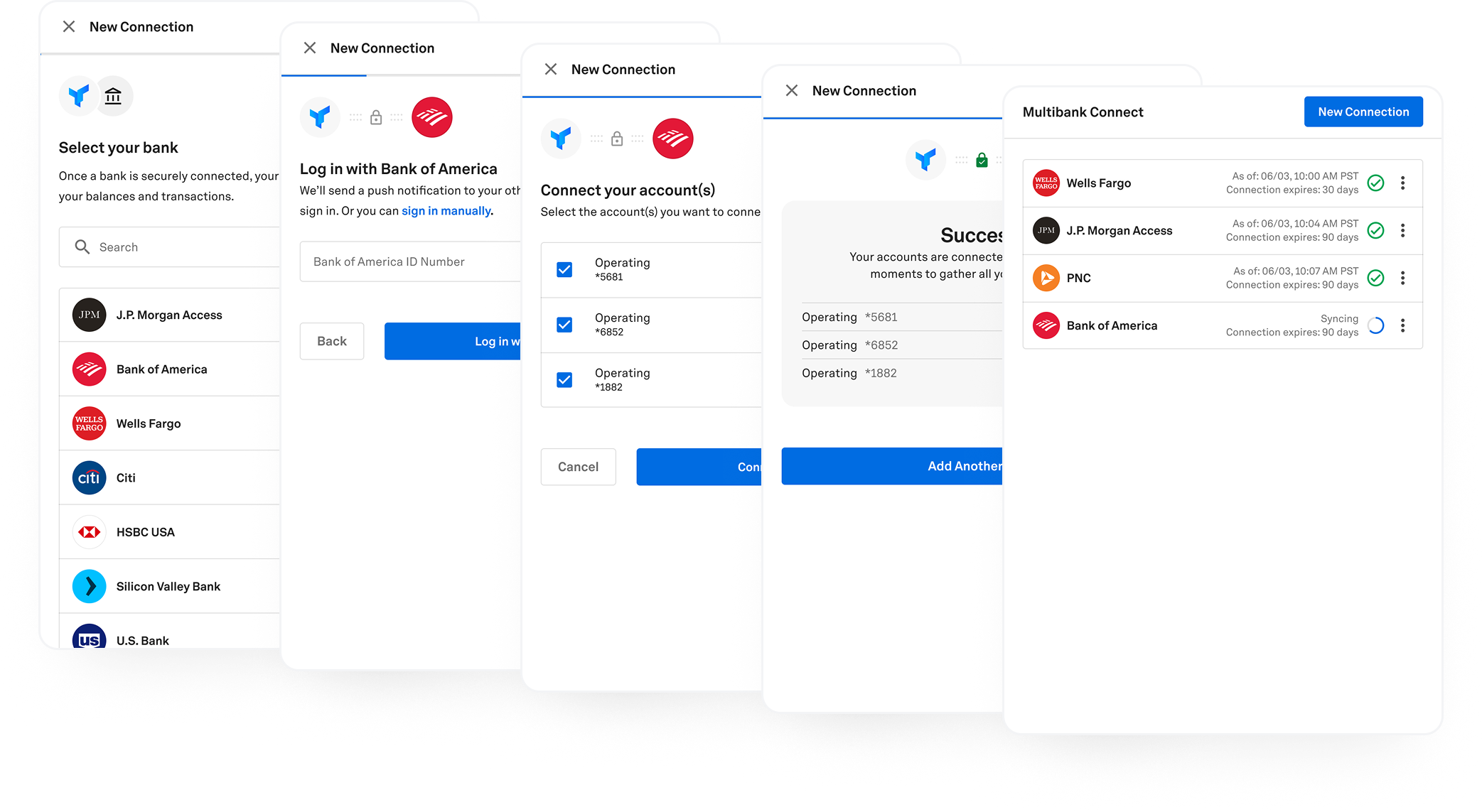
Bank connectivity
Trovata uses four connection methods and recommends the best one for each bank.
APIs. The default wherever a bank offers one. Direct and structured, refreshed through the day.
File-based reporting. Trovata ingests standard bank reporting formats, including BAI2, MT940, CAMT.053, and ISO 20022 messages, as well as custom JSON through the MultiBank Connector.
SWIFT. Trovata operates on the SWIFT network under its own BIC, TRVTUS66. Any bank on SWIFT’s network of more than 11,500 institutions that offers information reporting services can be connected, which covers banks that have not built corporate APIs.
Host-to-host. For banks with an established host-to-host channel, Trovata connects directly and receives files on the bank’s schedule.
Some small regional and local banks offer no information reporting service. For those accounts Trovata can use an aggregator connection where one is available, or a virtual account the team updates by importing bank data.
How long connections take
Connection time depends on the bank. Some banks connect in a few hours. Others take more than a month, because the bank sets the pace. Trovata Cash users typically start working in the product with their first banks connected within days or weeks. The full connection set, ERP integrations, and TMS workflows follow on a plan that depends on bank mix and scope. Trovata TMS implementations take several weeks or longer, depending on the number of banks, entities, and workflows involved.
Managed connectivity
Bank connectivity is a managed service. Trovata handles it with no customer IT or third-party consultants.
Consultative process
During the sales process, Trovata identifies every bank in scope and recommends the connection method that delivers the fastest and most reliable data for each one.
Trovata handles onboarding
Trovata runs each connection from enrollment through go-live and keeps the team informed as banks come online.
Proactive monitoring
Once connected, Trovata monitors every feed for changes or disruptions and resolves them, so the flow of data does not depend on someone noticing a missing file.
Trovata TMS implementations are run with Trovata’s implementation consultants, who configure the payment, accounting, capital markets, and hedging workflows on top of the connected banks.
ERPs and accounting tools
Trovata serves as the bank connectivity layer for ERPs. ERPs built for middle-market and small enterprise companies do not have strong bank connectivity of their own. The work of managing file-based bank connections falls on internal IT or ERP admins. Trovata does that work as a managed service, and does it better than the ERP can, and delivers normalized bank data to the ERP, which is the reason the NetSuite SuiteApp exists.
Current integrations include the NetSuite SuiteApp, FloQast, SAP S/4HANA, and BlackLine. Bank balances and transactions flow into the ERP or close tool for reconciliation and posting, and the same data feeds Trovata’s own financial accounting workflows.
Investment platforms
Trovata connects to investment platforms and custodians including Morgan Money, Fund Connect, GS Mosaic, Tradeweb, and Clearwater. Balances and holdings from those platforms land alongside bank data, so cash positioning and reporting reflect operating cash and invested cash in one view.
AI tools
Trovata data reaches AI assistants two ways.
Trovata MCP Connector. The Model Context Protocol (MCP) connector gives read-only access to Trovata balances, transactions, tags, and reports from Claude, ChatGPT, Gemini, and Copilot. A treasurer asks a question in the assistant they use every day and gets an answer drawn from live, normalized bank data without exporting anything.
Trovata AI 2.0. Inside the platform, Trovata AI Chat answers questions in plain language, Trovata AI Insights surfaces patterns and anomalies across accounts, and Trovata AI Agents automate treasury workflows. All three run on the same data foundation as the MCP Connector, inside an airgapped environment within Trovata’s AWS architecture.
Payments
Teams initiate ACH, wire, book transfers, and real-time payments (RTP) through bank APIs, with approval workflows, permissions, and policy controls across banks and rails. Payment initiation, controls, and visibility live in one place rather than across multiple bank portals.
BI tools and custom applications
For everything else, two paths carry Trovata data downstream.
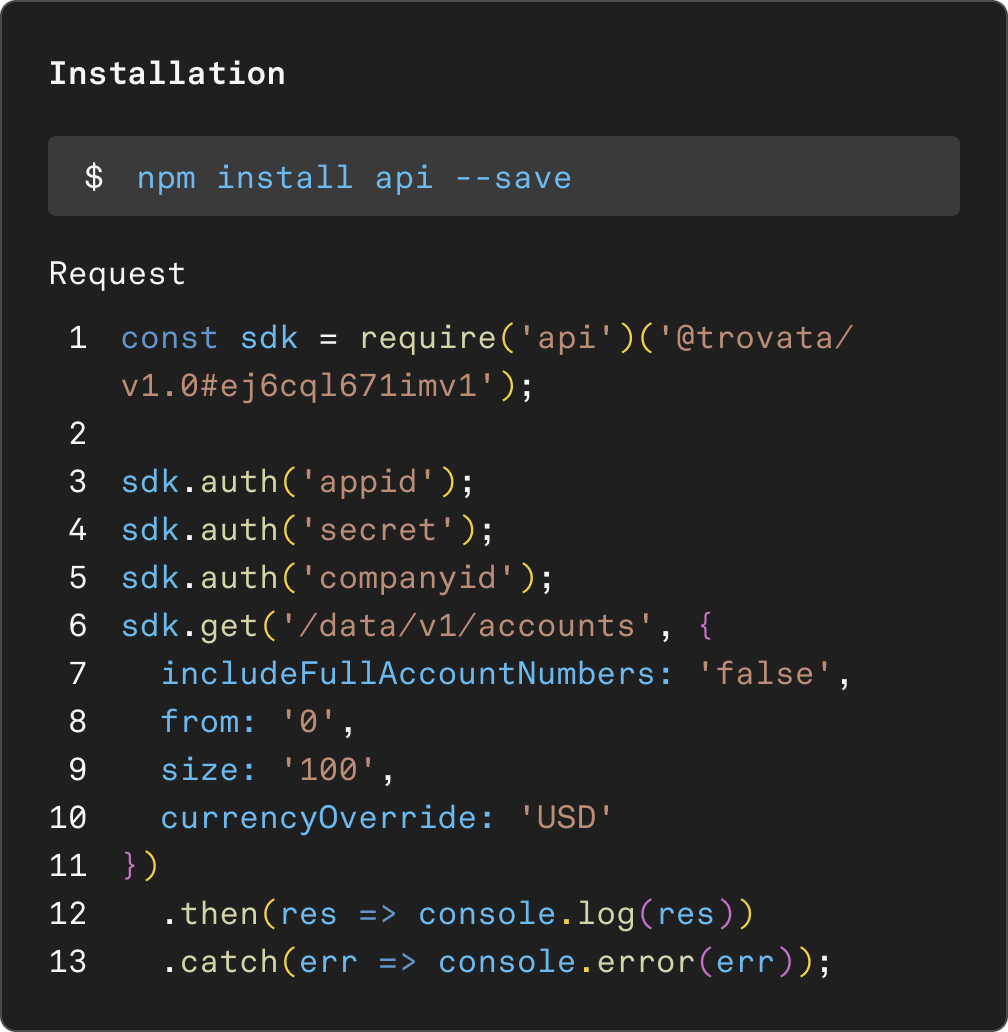
Developer Portal. Trovata’s API gives direct, programmatic access to normalized balances, transactions, tags, and reports for BI tools and custom applications. The API documentation is at docs.trovata.io.
CSV export. Any search or report in Trovata exports to CSV for use in a spreadsheet or any tool that accepts a file.
The data foundation
Every connection above reads from or writes to Trovata’s Multi-Bank Data Lake™, the real-time data foundation under every Trovata product. Trovata Cash, Trovata TMS, Trovata AI, and the MCP Connector all run on it.
Data moves through it in three steps. Ingestion pulls data from every connected bank and platform on each source’s own schedule, through the API, file, SWIFT, or host-to-host channel set up for it. Normalization maps every incoming record, whatever its source format, to one standard structure, so a transaction from a BAI2 file and a transaction from an API carry the same fields. Serving holds the normalized data in an index built for fast search and reporting, and Lemonade, for example, runs a six-month transaction history report in under a minute.
The infrastructure behind it:
An automated cloud-native data pipeline
Cloud-native serverless and microservices infrastructure
Multi-tenant isolation at every layer, including compute, storage, and AI, with dedicated encryption keys per customer
Private data storage in AWS US regions, with AES-256 encryption at rest, TLS in transit, and an airgapped environment for Trovata AI
A 99.9% uptime service level agreement (SLA) with multi-region redundancy
Trovata is SOC 1 Type 2 and SOC 2 Type 2 audited, hosted on AWS, with data encrypted with AES-256 at rest and TLS 1.2 in transit.
What teams do with connected data
Tagging remains one of the strongest features in the platform. Teams set rules that categorize existing and incoming transactions automatically, and Trovata AI recommends tags as new activity arrives. Tags carry through to search, reporting, forecasting, and every downstream connection.
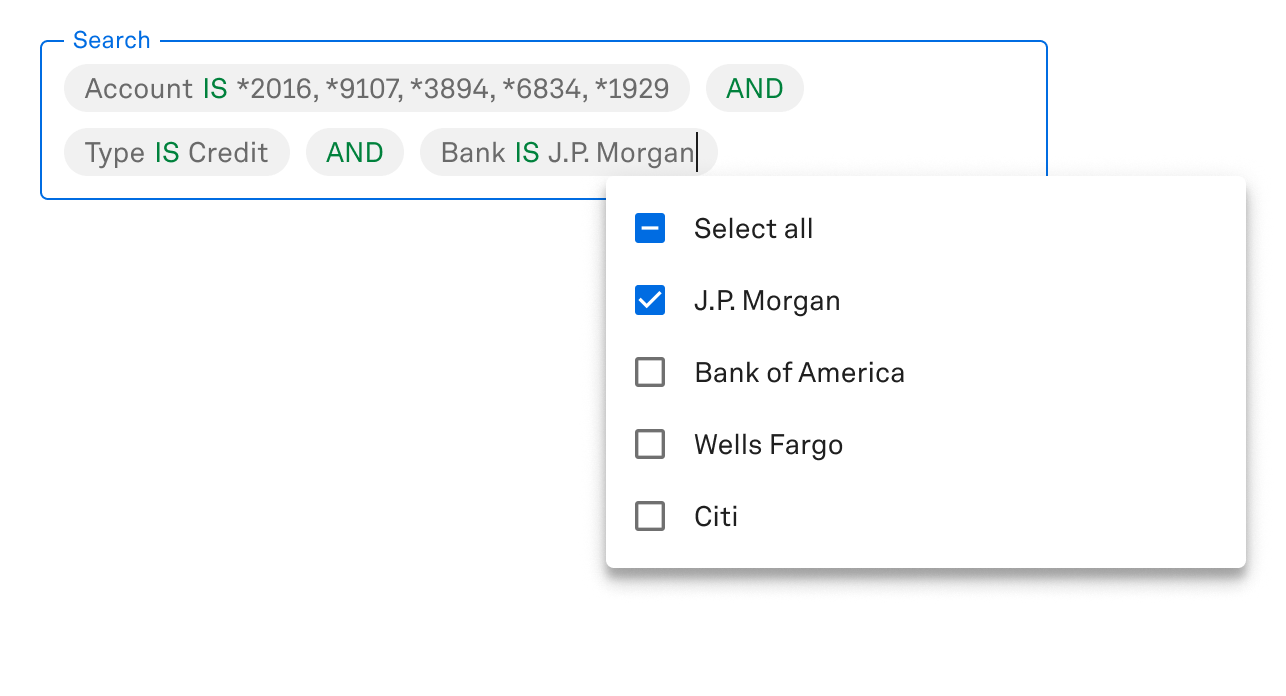
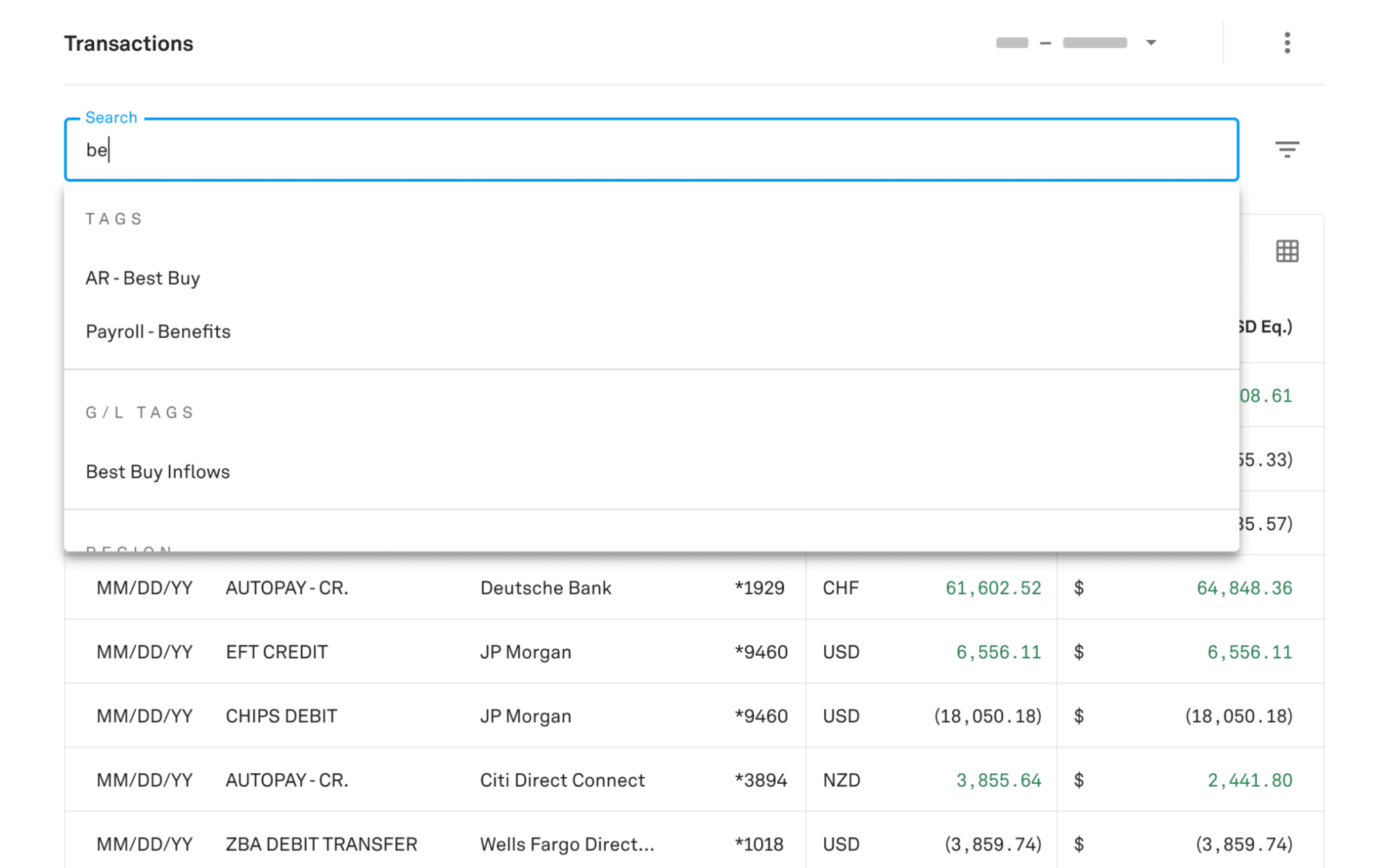
Full-text search across every account, bank, and entity returns transactions in seconds, with filters for tags, amounts, dates, counterparties, and custom fields.
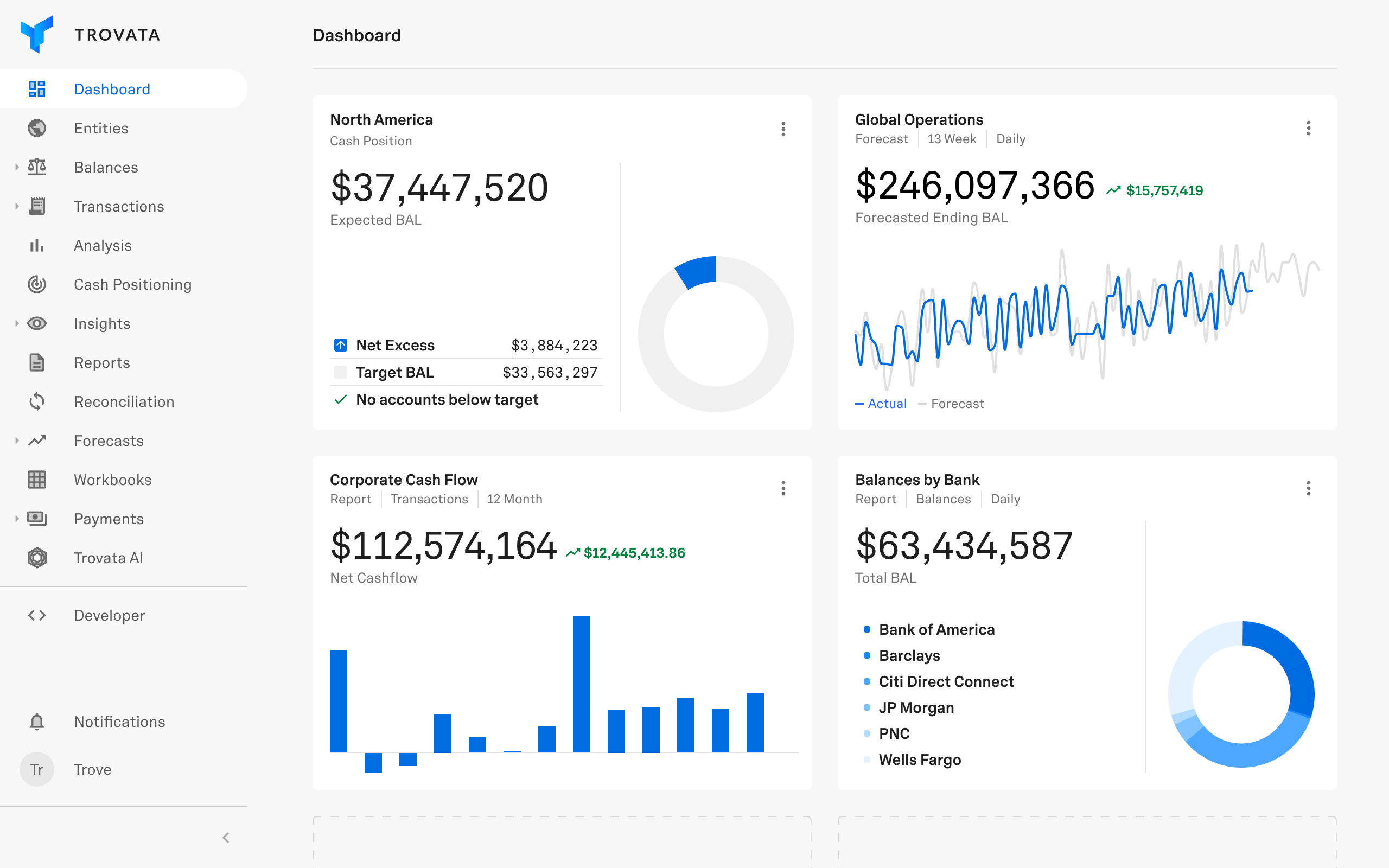
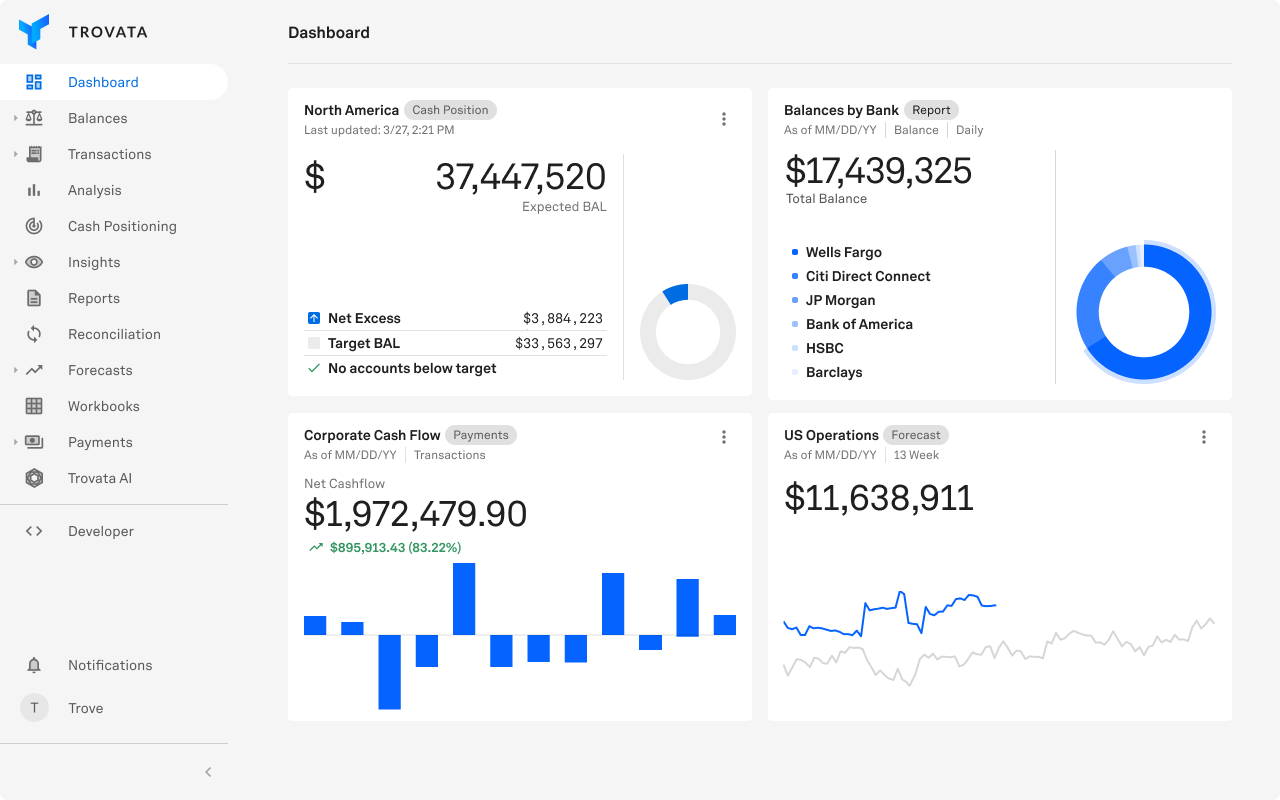
Real-time balances from every connected bank appear in one dashboard. Reports, forecasts, AI answers, and downstream connections all draw from the same normalized data, so the numbers match wherever they are viewed.
Teams with their own reporting stack or internal applications build on the API directly, using the documentation at docs.trovata.io.
Customer results
Cloud Software Group runs more than 300 accounts across 40+ banks and over 100 entities on Trovata.
We didn’t need a huge IT team to implement Trovata. Now multiple teams across the company are using it — and we’re finally getting the full value of our bank data.”

Bruce Edlund
Group Director and Assistant Treasurer, Cloud Software Group
I highly recommend Trovata to treasury teams. It’s like a bank portal experience you can rely on, but for multiple banks. The problem that we have in treasury is that we get tasked with big projects, like bank connectivity, and other teams benefit. Trovata, as an API solution, is finally a solution for us.”
Bruce Edlund
Group Director and Assistant Treasurer, Cloud Software Group
With Trovata the data is normalized and we now have a single source of truth where we can see everything we need to see. We’re no longer manually logging into multiple portals and spending hours aggregating data. Trovata saves us so much time and enables us to focus on adding value.”

Mary Desmond
Director of Financial Operations, Sealaska
Trusted by


Ready to unlock the power of real-time bank connectivity?
Schedule a demo today!
Subscribe to our newsletter
In this guide
Subscribe to our newsletter
Other resources


Book Trovata Demo
Watch Recording