The case for agentic treasury
Treasury has always operated in real time. Cash moves continuously across accounts and entities, balances shift through the day, and the analytical work that makes sense of all of it is never quite finished. The function has been measured for decades against two enduring questions: where the cash sits today and what should be done with it next.
For most of the last three decades, answering those questions required infrastructure that only the largest financial institutions could build for themselves. Cash data lived in fragmented bank portals that each followed their own formats, analysis ran on spreadsheets and human judgment, and the work that mattered most repeated every period at considerable bandwidth cost. Fee audits, variance attribution, runway projection, intercompany funding, and concentration management all consumed senior practitioner time the function could not easily replenish, which meant the work either got done at the expense of strategic priorities or quietly slipped to the next period.
That infrastructure is now in place. Cash data is normalized at the source through direct API and SFTP connections, bank fee statements ingest against standardized AFP codes, and forecast versions, ledger balances, and FX exposures sit together in a single structured layer that the function can analyze rather than assemble.
A new design pattern is emerging on top of that foundation. Treasury work that follows a repeatable shape can be modeled as an agent, which reads from the connected data layer on a defined trigger, applies a written prompt that captures how a senior practitioner would approach the task, and produces a deliverable the treasurer reviews and acts on.
The shape is straightforward, but the craft of building a good agent rarely is. Each agent's behavior reflects the methodology of the team that built it, the policies it operates within, and the iterations it has worked through before becoming reliable. Teams that develop fluency with this design pattern early will define what good looks like in the function over the next decade.
This playbook is a working library of ten such patterns, drawn from the practitioner work behind them. Each entry walks through what the agent reads, what triggers it, how its prompt is shaped, and what the deliverable looks like in practice. The closing sections explain how to recognize the agent candidates already living inside your own workflow and how to approach the first one your team might build.
Treasury's data problem
Cash data lives across every bank a company touches, in formats that vary by institution and in file types that change at the bank's discretion. Cleaning and aggregating that data consumes the first hour of every analyst's day, and the fragmentation is significant. According to the 2024 AFP Bank Relationship Management Survey, more than 40 percent of organizations operate across two to five banking relationships, with another quarter spanning six to ten.
Once the data layer is unified, the analysis above it changes character entirely. Position summaries assemble from a single schema rather than from manual consolidation across portals, variance commentary attributes drivers automatically once the methodology behind it has been encoded, and fee audits run continuously when the agent has been shaped against the team's contracts and benchmarks.
The shift
The platform that owns the data layer enables the agent layer that runs on top of it, and the methodology that shapes each agent stays with the team that built it.
From dashboards to agents
Dashboards have always shown treasury what is happening. The harder work has always been deciding what to do about it, and that work has stayed with the practitioner across every iteration of treasury technology that has come before.
The agent design pattern compresses the gap between observation and action. When the ECR on a relationship slips below benchmark, a dashboard surfaces the gap, while an agent shaped around the team's renegotiation playbook quantifies the dollar impact, drafts the note to the relationship manager, and surfaces the target the treasurer set for that conversation.
Why now
This pattern became production-grade only after three conditions aligned:
1
Cash data became normalized at the source
2
Large language models grew capable enough to apply judgment to structured financial data rather than just summarize text
3
Cloud architecture caught up to the point where those models could operate within a controlled set of tools and an auditable runtime
Each of those conditions developed independently over different timelines, and together they enable a layer of treasury automation that has not previously been within reach for any function below the very largest enterprises. The opportunity for treasury teams today is to learn this design pattern early, inside their own workflows, while the standards are still being written. The skipped work compounds across every period that passes, with pricing violations, ECR shortfalls, closed accounts still receiving fees, and forecast variances that go unexplained accruing silently until the team has the bandwidth to recover them.
That bandwidth returns only when the repeating work moves into the design pattern, and the treasurers who will lead the function over the next decade are the ones already learning to shape this work for themselves.
Anatomy of a treasury agent
An agent is a design pattern for treasury work that follows a repeatable shape, where the work:
Runs on a schedule or trigger
Reads from connected data
Applies a written prompt
Produces a finished deliverable the treasurer reviews
The pattern is not a chatbot, a reporting tool, a data extraction script, or a dashboard with email alerts, all of which have a place in the function but none of which are shaped around the work itself.
The four parts
Every agent pattern in this playbook is built around the same four parts.
1
Trigger · When it runs
A schedule (daily at 7am, first business day of the month), a threshold (balance crossing a defined limit), an anomaly versus prior period, or an event such as a forecast version being approved.
2
Scope · What it reads
A defined set of accounts, entities, banks, currencies, or forecast versions. Scope determines what is in the analysis and what is excluded from it.
3
Action · What it does
The verb defines the work, whether the agent is reconciling, projecting, attributing, ranking, drafting, or escalating.
4
Output · What you receive
A findings report, a position narrative, a draft email, a journal entry, or a scenario brief, depending on what the agent has been shaped to produce.
The depth of any agent comes from how its four parts are shaped, particularly the prompt that defines its action, which carries the team's methodology, ranking logic, and escalation rules. Teams that get the most from this design pattern treat that prompt the way they would treat onboarding documentation for a senior analyst, with edge cases and judgment calls written out rather than left implicit.
Where the agent sits in the workflow
The agent runs in the background, and the treasurer opens the platform to find the deliverable ready for review. Decisions that need human approval flow through the same workflows the team already uses for manual work, which keeps the agent's role inside the team's existing governance rather than alongside it.
The same agent can be reached on mobile, which gives CFOs and CEOs a direct path to daily positions, anomaly checks, and runway numbers without having to route the question through the treasury team. The treasurer keeps ownership of the work, while leadership self-serves the answers, which removes a category of interruptions the team typically absorbs in the moment.
Policy stays where policy belongs throughout this process. The agent does not set the ECR target, the concentration limits, or the hedging ratios. The treasurer either wrote or approved the prompt that defines how the agent ranks findings, what it escalates, and how it formats its output, which means the judgment the team has built up over the years is what makes the agent useful in the first place.
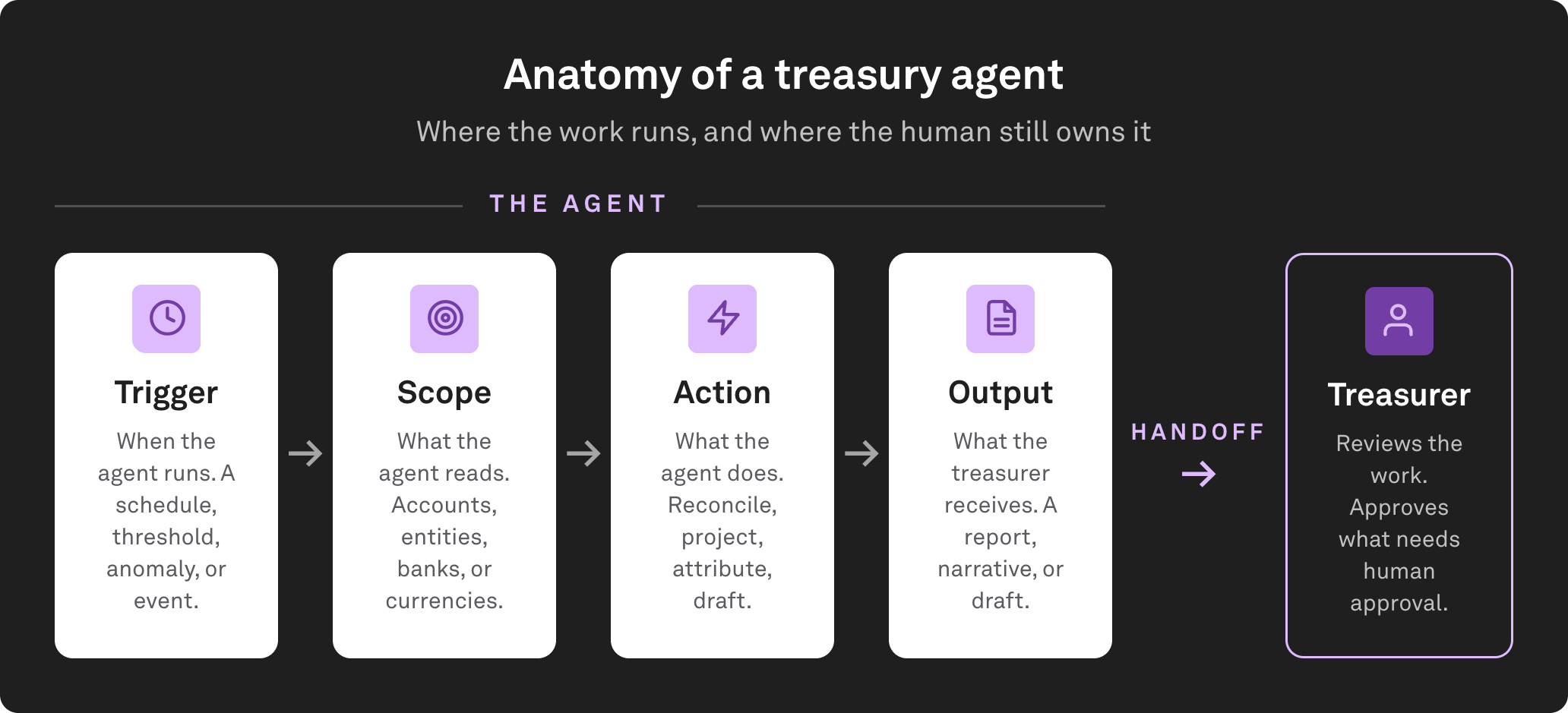
Anatomy of a treasury agent: where the work runs, and where the human still owns it.
Governance in plain terms
Policy stays with the treasurer. The agent runs the work; the treasurer wrote or approved the prompt that defines how it runs, what it escalates, and how it formats what it returns.
The agent library
The library is meant to be directional. Use it as a way to recognize the shape of agent candidates inside your own workflow rather than as a checklist to copy from.
Agent 01
Bank fee analysis (BFA)
A pattern for running the monthly fee audit at the depth a senior practitioner would, on a schedule, across every relationship.
Bank fee analysis at a glance
What the agent monitors, what triggers it, what it does, and who it serves.
What it monitors
Bank fee statements ingested via SFTP and API, MSAs uploaded to the platform, contracted rates, AFP codes, account status, and ECR benchmarks.
What triggers it
First business day of each month, against the prior month's data, with the cycle configurable to other intervals.
What it does
Reconciles every fee line against negotiated rates, surfaces dollar exposure across all findings, audits account status, and delivers prioritized findings, supporting evidence, and recommendations for treasury team review and action.
Who it serves
The treasurer, the treasury analyst, and the relationship manager who carries the dispute conversation back to the bank.
This audit runs against six finding categories, which together cover the most common and financially significant areas of fee exposure that treasury teams encounter. More can be added to the audit per your specific requirements.
1
ECR benchmark analysis
Whether each bank's earnings credit rate meets the current market benchmark, and the dollar gap per period and annualized.
2
Negative collected balance charges
Overdraft fees and the pattern behind them. Multiple occurrences in one period typically signal a structural funding or account structure problem.
3
Pricing violations
Every line item where the billed unit price differs from the contracted rate, comparing the full statement against the MSA and flagging every gap.
4
New or uncontracted services
Charges with no contract mapping, where the 30-day dispute window starts on statement receipt.
5
Missing statements
Relationships or accounts that should have produced a statement and did not. The agent surfaces the gap rather than proceeding on partial data.
6
Closed accounts with active billing
Accounts cancelled internally that continue to receive fee statements; every post-closure charge is disputable in full.
The prompt
You are a bank fee analyst with 25 years of experience auditing corporate fee statements. Run the monthly audit against the six finding categories: ECR benchmark, negative collected balance charges, pricing violations, new or uncontracted services, missing statements, and closed accounts with active billing.
For each finding, calculate dollar exposure for the period and annualized where applicable. Compare every billed line against the MSA. Apply the 30-day dispute urgency window for uncontracted charges. Flag missing statements as audit integrity findings even though they carry no dollar impact, since the gap means the analysis is incomplete.
Rank findings by a combination of financial impact, data completeness, and risk of inaction. A missing statement may rank above a small pricing violation when incomplete data leaves the audit open. Do not apply a fixed formula.
Generate a prioritized findings report with each finding tagged by category, dollar impact, account, and recommended action for treasury team review and decision-making.
Run on the first business day of each month against the prior month's data.
BFA monthly audit, April 2026
Total flagged exposure: $9,847
Closed accounts still receiving fee statements
- Account 8842-001 (closed Jan 12) charged $312 in analysis fees
- Account 8842-014 (closed Mar 03) charged $187 in maintenance
Action: Contact RM Sarah Chen (Wells Fargo) for closure confirmation and full credit memos. Dispute draft attached.
Negative collected balance charges (recurring)
- 4 occurrences in April on operating account 1107-228
- Implied avg negative balance: $48k over the period
- Total fees: $1,420 (incl. 11.2% overdraft interest)
- Pattern suggests structural funding gap, not isolated
Action: Review cash positioning and ZBA structure.
Uncontracted charges (large or non-standard)
- Wire originate (intl) charged at $45/wire on JPM relationship
- No contract mapping for this service category
- 3 charges, $135 total
- Dispute window closes May 10 (30 days from statement receipt)
Action: Confirm whether RM made a verbal commitment.
ECR underperformance (gap compounding silently)
- Bank of America: 2.85% ECR vs current benchmark 3.40%
- Annualized impact at avg $4.2M ECR-eligible balance: $23,100
Action: Schedule renegotiation. Target ECR: benchmark or above.
Pricing violations
- ACH credit charged at $0.18 vs contracted $0.12 at PNC
- 642 transactions, $38.52 overcharge
Action: Submit dispute letter with PNC fee schedule as exhibit.
Missing statements
- Citibank account 4401-005, no statement received for April
- Status: Audit integrity finding (no dollar impact)
Action: Contact bank for reissue before dispute window closes.
Where the work sits
Agent does
Treasurer or RM decides
Finding categories
Analyzes structured data against the six finding categories
Whether to escalate to the CFO or the RM
ECR gap
Calculates ECR gap vs benchmark per period and annualized
The target ECR for each renegotiation
Pricing violations
Identifies every pricing violation with exact dollar impact
Which violations to dispute and in what sequence
Uncontracted charges
Flags uncontracted charges and applies the 30-day window
Whether a verbal commitment was made before billing started
Closed accounts
Detects closed accounts still receiving fee statements
Initiating closure confirmation and reversal with the bank
Dispute drafts
Generates pre-populated dispute drafts for high-priority items
Reviewing, editing, and approving before anything goes out
Prioritization
Ranks all findings by impact, completeness, and risk of inaction
How to allocate team bandwidth across the audit
Surfaces high-priority findings with recommended actions for treasury reviewing, editing, and approving before anything goes out.
Why it matters
A senior bank fee analyst spends four to five hours per relationship to produce this audit by hand, which is why most treasury teams either skip the audit entirely or run a partial version that catches the obvious errors. Encoding the methodology in an agent shifts the time cost from manual production to review while leaving the dollars at stake unchanged, and what changes for the team is bandwidth rather than scope.
Agent 02
Forecast variance tracker
A pattern for attributing forecast variances to their drivers and drafting the period-over-period commentary that follows.
Forecast variance tracker at a glance
What the agent monitors, what triggers it, what it does, and who it serves.
Monitors
Forecast versions, GL or bank-side cash actuals, and the rolling assumption set behind the model.
Triggers
End of forecast period, or any time actuals close. Typically weekly for a 13-week forecast and monthly for a longer horizon.
Does
Compares forecast to actuals, attributes each variance to its drivers, drafts the explanatory commentary in the format the CFO already reads, and proposes assumption updates for the next period.
Serves
Treasurer and FP&A lead, with the CFO as the downstream reader.
Why it matters
Variance commentary is the kind of work that repeats every period and reads exactly once before getting filed away, which makes it a clear candidate for the design pattern. Modeling the work as an agent shifts the rewrite into a review task, leaves the attribution methodology with the team that built it, and moves the assembly onto a schedule the function can rely on.
Agent 03
Cash burn alert
A pattern for keeping runway projections live against committed spend and forecast inflows.
Cash burn alert at a glance
What the agent monitors, what triggers it, what it does, and who it serves.
Monitors
Operating cash, committed spend, forecast inflows, and burn rate trend.
Triggers
Daily for venture-backed companies inside 12 months of runway, weekly otherwise, with a threshold breach triggering an off-schedule run.
Does
Projects runway against committed spend and forecast inflows, surfaces reallocation options that would extend runway, alerts owners before threshold breaches, and drafts the scenario brief for the CFO.
Serves
Treasurer and CFO at venture-backed or capital-constrained companies, with the same pattern useful for any operating team running against a hard runway target.
Why it matters
Runway models tend to get rebuilt every board meeting, which means the projection is most accurate the week it is built and progressively staler from there. Modeling the work as an agent keeps the projection live between cycles and shapes the scenario commentary around what leadership actually reads, which gives the CFO a real-time view of where the company sits rather than a snapshot of where it was at the last governance cadence.
Agent 04
Daily position summary
A pattern for assembling the morning position narrative ahead of the meeting that needs it.
Daily position summary at a glance
What the agent monitors, what triggers it, what it does, and who it serves.
Monitors
Bank balances across all relationships, prior-day activity, sweep rules, and known business events on the day’s calendar.
Triggers
Daily, before the team’s morning meeting, configurable to the team’s start time.
Does
Drafts the daily position narrative, surfaces anomalies versus prior days, highlights sweep and funding actions the team may want to take, and routes only the decisions that need human approval.
Serves
Treasurer and treasury analyst, with the CFO as the downstream reader for the morning brief and either able to pull the same view on mobile.
Why it matters
For teams operating across more than five banks, the morning position consumes two to three hours before the strategic work of the day begins, which makes it one of the most expensive recurring tasks in the function on a time basis. Modeling the assembly as an agent returns the morning to the team and gives leadership a self-serve path to the same numbers, which removes a meaningful share of the ad hoc interruptions the team handles every day.
Agent 05
Idle cash and sweep opportunity
A pattern for evaluating idle balances against investment policy and acting on yield opportunities.
Idle cash and sweep opportunity at a glance
What the agent monitors, what triggers it, what it does, and who it serves.
Monitors
Operating balances, investment policy thresholds, eligible instrument list, and current yield curves.
Triggers
Daily for high-frequency sweep environments, weekly for less active programs, with a threshold breach (balance above operating minimum by a defined margin) triggering an off-schedule run.
Does
Evaluates idle balances against investment policy, recommends sweeps to higher-yield instruments or executes them within policy, and reports realized yield uplift on a recurring basis.
Serves
Treasurer and the team responsible for short-term investment.
Why it matters
Sweep analysis tends to get deprioritized when the calendar fills, which is exactly when idle balances are most likely to sit unattended for a few extra days. Modeling the work as an agent keeps the analysis running on schedule and reports the yield uplift that would otherwise have been left in low-yield operating accounts, which makes the value of the agent visible to the team in dollars rather than activity.
Agent 06
FX exposure summary
A pattern for holding hedge ratios within policy bands and drafting the exposure commentary for management reporting.
FX exposure summary at a glance
What the agent monitors, what triggers it, what it does, and who it serves.
Monitors
Net positions by currency, hedge ratios, hedge effectiveness, and forward rates.
Triggers
Weekly for routine monitoring, with a threshold breach (ratio drift beyond defined band) triggering an off-schedule run, and monthly for management reporting.
Does
Monitors net positions against hedge ratios, surfaces or executes hedge adjustments when ratios drift outside band, and drafts the FX commentary for management reporting.
Serves
Treasurer at a multi-entity, multi-currency company, with the CFO and audit committee as downstream readers.
Why it matters
Hedge ratio drift tends to happen silently, with the exposure already baked in by the time it shows up in a quarterly review. Modeling the monitoring as an agent gives the team a continuous view of where the ratio sits against the policy band, which means the conversation with the CFO becomes proactive rather than retrospective.
Agent 07
Counterparty and bank concentration check
A pattern for managing concentration limits as an active control rather than a periodic report.
Counterparty and bank concentration check at a glance
What the agent monitors, what triggers it, what it does, and who it serves.
Monitors
Account balances by bank and counterparty, payment routing, internal concentration limits, and rating changes on counterparty banks.
Triggers
Daily for balance checks, event-driven on payment initiation, and immediately on a counterparty rating downgrade.
Does
Continuously evaluates balances and payment routing against concentration limits, recommends or executes diversification actions, and escalates only when constraints cannot be auto-resolved.
Serves
Treasurer and the risk function, with the CFO and audit committee as readers for periodic reporting.
Why it matters
TMS platforms have surfaced concentration exposure for decades without doing anything about it, which is part of what makes this category so well-suited to the design pattern. Modeling the control as an agent moves it from a report the team reads once a quarter into an active part of the team’s risk management posture, where the rebalancing has happened by the time the treasurer reviews the work.
Agent 08
Intercompany funding gap
A pattern for surfacing entity-level funding needs ahead of close.
Intercompany funding gap at a glance
What the agent monitors, what triggers it, what it does, and who it serves.
Monitors
Entity-level cash positions, intercompany loan balances, sweep agreements, and the cash forecast at the entity level.
Triggers
Daily during the week leading into month-end close, weekly outside close, and event-driven on a forecast change at the entity level.
Does
Identifies funding gaps and surpluses across entities, surfaces intercompany loan or sweep options that would close the gap, drafts the supporting journal entries, and escalates when policy or tax constraints would be breached.
Serves
Treasurer at a multi-entity company, with tax and accounting as downstream stakeholders.
Why it matters
Intercompany funding decisions usually surface on a Friday afternoon when someone realizes a subsidiary needs cash by Monday morning, which is the worst time to make a tax-sensitive decision under pressure. Modeling the analysis as an agent gives the team a week of lead time on questions that typically arrive at the last minute, which moves the work from reactive scramble to planned execution.
Agent 09
Liquidity coverage snapshot
A pattern for stress-testing the liquidity position continuously rather than once per cycle.
Liquidity coverage snapshot at a glance
What the agent monitors, what triggers it, what it does, and who it serves.
Monitors
Operating cash, committed facilities, maturity schedules, covenant requirements, and stress scenarios defined by the treasurer.
Triggers
Daily for routine coverage, with a threshold breach when coverage drops below a defined level, and quarterly on the regulatory reporting cycle.
Does
Stress-tests the liquidity position against scenarios, surfaces funding actions when coverage drops below thresholds, and drafts the regulatory commentary for the next reporting cycle.
Serves
Treasurer and the regulatory reporting function, particularly relevant for financial services companies and any organization with covenant-driven liquidity requirements.
Why it matters
Liquidity coverage moves between reporting periods, but most treasury teams only see that movement at the next audit committee meeting, by which point the response is reactive at best. Modeling the stress test as an agent surfaces coverage shifts the day they happen and shapes the regulatory commentary as the data evolves rather than at the end of the cycle.
Agent 10
Month-end close readiness
A pattern for tracking close readiness and drafting recurring journal entries ahead of close week.
Month-end close readiness at a glance
What the agent monitors, what triggers it, what it does, and who it serves.
Monitors
Reconciliation status, accrual completeness, intercompany match status, and journal entries pending review.
Triggers
Daily during close week, and on-demand outside close.
Does
Tracks close readiness across reconciliations, accruals, and intercompany matches, drafts journal entries for recurring items, escalates exceptions to the responsible owner, and produces the close-ready package.
Serves
Treasurer and controller, with the close team owning the deliverable.
Why it matters
Close packages typically assemble across three or four people checking different systems and copying numbers into a master file, which creates exactly the kind of fragmented, repeatable workflow the design pattern is built for. Modeling the assembly as an agent gives the team a single view of where the close stands and surfaces only the exceptions that need attention, which compresses the close timeline without compressing the controls.
The automation candidacy framework
Most treasury teams already have between five and fifteen agent candidates running through their week. The framework below is the same one Trovata’s solutions team uses when scoping an agent with a customer, and it works as well for self-directed scoping as it does in a partnered conversation. Five steps move a candidate from idea to first run, sequenced as inventory, score, qualify, sequence, and operate.
Inventory
Start by listing the recurring work the team performs over a typical month, across daily, weekly, monthly close, and quarterly cadences. Inventory before filtering, since the full list matters more than the curated one at this stage and the work that looks unremarkable in isolation often turns out to be the strongest agent candidate once it is scored against the others.
A useful prompt for the exercise is to ask what a new analyst would need to learn in their first 90 days that gets repeated. That question surfaces the standardized work the design pattern is built for, while the work that depends on context, judgment, or unstructured inputs tends to fall to a different part of the conversation.
Score
Once the inventory exists, rate each task on four dimensions, namely frequency, time cost, error risk, and data availability.
Frequency captures how often the work runs across a year. Time cost captures the analyst hours per cycle, which translates directly into an annual hour cost when multiplied by frequency. Error risk captures what fails when the work is rushed or skipped, including missed disputes, missed sweeps, late commentary, and broken reconciliations. Data availability captures whether the input already lives in connected, structured form. Tasks that fail the last dimension are not yet ready to be scoped as agents and need the data connection built first, which is usually a precursor project rather than a blocker.
A simple scorecard surfaces candidates fastest. Score each task one to five on the four dimensions and let the combined scores rank the inventory.
Qualify
A task is a strong agent candidate when it passes three tests. It has a clear trigger, either a schedule or an event, because teams that cannot describe when the work should run will struggle to shape an agent that knows either. It has a defined output, whether that is a position narrative, a findings report, a draft email, or a journal entry, because tasks whose output is “an analyst thinks about it and decides what to do” are not yet ready as scheduled agents and may instead be ready as assistant prompts. And it has connected, structured input data, because tasks that depend on unconnected spreadsheets need the data connection built first.
Sequence
The qualified candidates then need to be ranked by impact against build effort. The first agent should land high impact and low build effort, with high time cost, high skip rate, simple data inputs, and well-understood ranking logic. Bank fee analysis is the canonical first agent for most teams, and forecast variance commentary is a strong second.
More complex candidates are best saved for the second and third agents. Once one agent runs and the team trusts it, the operational muscle exists to scope a harder one, and the compounding value of agentic treasury tends to come from the second and third agents rather than the first.
Operate
Human-in-the-loop checkpoints should be defined up front, before the first run rather than after.
Anything that touches a bank or external counterparty stays human, including disputes, hedge executions, payment initiations, and communications about closing relationships. Anything that changes policy stays human, including investment policy, hedging policy, ECR target ranges, and concentration limits. Anything that requires context the agent does not have stays human, including a verbal commitment that pre-dated billing, a one-time business event behind a variance, or an exception driven by an M&A close.
The agent should run in parallel with the manual analysis for the first cycles, with the outputs compared and the prompt tightened against the gaps that show up between the two. By the time the team trusts the output, the analyst’s job has shifted from production to review and exception handling rather than redoing the work.
Worked example: bank fee analysis end to end
The framework applied to bank fee analysis looks like this in practice.
A treasury team listed monthly fee reconciliation as a recurring task, with four to five hours per relationship per month multiplied across six relationships totaling roughly 30 hours per month, often skipped when the calendar tightened.
Frequency monthly, time cost 30 hours per month or 360 hours per year, error risk high since every missed dispute is dollars left with the bank, and data availability already in place with bank fee statements ingested via SFTP and normalized against AFP codes.
Trigger first business day of each month, output a findings report with dollar impact and dispute drafts, and data connected and normalized. All three tests passed.
Highest combined score in the team’s inventory. Built first.
Early cycles ran in parallel with the manual analysis, with the prompt tightened against the gaps that surfaced between the two outputs. Once the team trusted the findings, the agent ran on the first business day each month. The treasurer reviewed the prioritized findings and decided which to dispute, with disputes going out under treasurer signature and policy decisions on ECR targets staying with the treasurer throughout.
The team moved from running fee analysis once a quarter when time allowed to a full audit every month, on every relationship, with no incremental manual work above the review.
Getting started
Pre-flight checklist
Three conditions should be in place before the first agent is scoped.
Data connectivity
Bank connections live, statements ingesting, AFP codes mapping cleanly, and ERP data flowing if forecast or close agents are in scope.
User roles
Defined entitlements for everyone who will interact with the agent. Role-based access controls that govern manual workflows extend to agent runs.
Governance
Audit logging on, prompt versioning enabled, and model governance policy documented, so that every agent run leaves a trail and every prompt change is recorded.
The first 30 days
Start with one candidate, the agent with the highest combined score from the framework. The first month is about shaping the prompt that captures how the team would do the work, then running the agent in parallel with the manual process and tightening the prompt against the gaps that show up between the two outputs. The methodology that emerges through that work becomes the team’s first agent.
Two numbers are worth instrumenting from the start, namely the findings or insights the agent surfaces with dollar impact where applicable and the hours of analyst time the team would have spent producing the same work manually.
What good looks like
Month one
One agent in development, with multiple cycles of parallel review behind it and the prompt edited against the gaps that surfaced between the manual analysis and the agent’s first runs.
Month three
Two or three agents in some stage of production or active review, with the team’s morning routine starting to shift from data assembly toward exception handling.
Month six
A library beginning to emerge across position summary, fee analysis, forecast variance, and at least one company-specific workflow, with time freed up starting to compound into the strategic work the team has wanted to take on.
Where Trovata fits
The data layer normalizes inputs across banks, the model context layer through Agent Core gives the model a controlled set of tools rather than open database access, and Agent Core handles audit, model governance, and entitlements. Together, those layers form the foundation that makes the agent layer reliable enough to run in production.
The agents themselves are shaped by the teams that build them, and the methodology, ranking logic, escalation rules, and output formats reflect how each team has chosen to do the work. The platform makes the work runnable, and the thinking stays with the practitioner.
Appendix
Glossary
A scheduled or event-triggered process that runs against connected data, applies a written prompt, and produces a finished output with routed decisions.
Association for Financial Professionals service code. The standardized taxonomy for bank fee services, used to normalize line items across banks.
The Amazon Web Services orchestration layer Trovata uses for agent governance, audit, and model management.
Earnings credit rate. The implicit yield a bank pays on collected balances, used to offset analyzed service fees.
Model Context Protocol. The interface layer that gives a large language model access to a defined set of tools and APIs rather than open programmatic access to the database.
Master Services Agreement. The contract that defines pricing, services, and terms with a banking partner.
The written instructions that drive an agent’s behavior. Role, data scope, categories to check, ranking logic, output format, and escalation rules.
See your first agent run on your own treasury data.
Book a working session with Trovata’s solutions team. We’ll walk through the candidacy framework against your function, then scope and demo the highest-impact agent for your team.
Subscribe to our newsletter
In this guide
- The case for agentic treasury
- Treasury's data problem
- From dashboards to agents
- Why now
- Anatomy of a treasury agent
- The agent library
- Bank fee analysis (BFA)
- Forecast variance tracker
- Cash burn alert
- Daily position summary
- Idle cash and sweep opportunity
- FX exposure summary
- Counterparty and bank concentration check
- Intercompany funding gap
- Liquidity coverage snapshot
- Month-end close readiness
- The automation candidacy framework
- Worked example: bank fee analysis end to end
- Getting started
- Appendix
Subscribe to our newsletter
Other resources

Book Trovata Demo
Watch Recording