Stablecoins can move money in minutes, while AI agents can make decisions in seconds. Put them together, and the idea of a treasury that runs itself stops sounding like science fiction. Imagine it’s 2 AM on a Friday, and one of your European subsidiaries is quietly sliding toward a liquidity shortfall. By Monday morning, it will be below its minimum buffer, the banks are closed and your treasury team is asleep.
Right now, that’s generally a problem you won’t find out about until Monday.
But there’s a new version of events which is being made possible through the use of AI and stablecoins.
Instead, at 2 AM a system detects the shortfall, models three funding options, identifies the cheapest one, executes a transfer, and updates your forecast. By the time your team arrives at their desks, it’s already been handled and the audit trail is waiting in your inbox.
That’s the promise of programmable liquidity, and while it isn’t fully here yet, the pieces are falling into place faster than most treasury professionals realize.
The Current Cash Management Landscape
The problem with current liquidity management infrastructure is that bank transfers still largely operate on batch settlement cycles that were designed in the pre-digital era. A payment initiated on a Friday afternoon might not settle until Monday. Cross-border transfers route through chains of correspondent banks, each adding time and cost.
For a treasury team managing a dozen entities across multiple time zones, this creates a persistent, expensive dilemma. They can either hold excess cash in every account to cover the gaps, or accept the risk of short-term shortfalls while you wait for funds to move.
Most teams choose the former. It’s conservative, but it means millions of dollars sitting idle in low-yield accounts as a buffer against a problem that, with better infrastructure, wouldn’t exist.
And then there’s the human bottleneck. Every meaningful decision, from which entity to fund, and which facility to draw, to when to sweep idle cash into something that earns a return, requires a person to identify the issue, model the options, get approvals, and execute. That process respects no one’s time zone, and it can’t run at 2 AM on a Friday.
Looking To The Future
These are problems that impact businesses all across the world, costing millions of dollars in fees, interest, cash flow related operational issues and missed investment opportunities. However, there are two specific pieces of technology which are beginning to disrupt current processes and open up a world of greater flexibility and control for treasurers.
Stablecoin Settlements And Smart Contracts
Stablecoins offer a different answer to the question of how value moves between parties. A stablecoin is a digital token pegged to a fiat currency (usually the US dollar) that settles on a blockchain network rather than through traditional banking rails. The key to what makes stablecoins different, and potentially so valuable, is how settlement works compared to traditional banking.
Where a traditional bank transfer might take one to three business days and require multiple intermediaries, a stablecoin transfer can settle in minutes, at any hour, on any day. And unlike a bank wire, it’s programmable, meaning you can embed conditions directly into the money movement itself.
For treasury, programmable liquidity management has the potential to be revolutionary. It means a payment can be structured to execute automatically when a balance falls below a threshold, when a receivable is confirmed or when a delivery is logged. The money can have rules baked into it.
Traditional Banking | Stablecoin Rails | |
Settlement speed | 1–3 business days | Minutes, 24/7 |
Availability | Banking hours only | Always on |
Programmability | Rule-based, limited | Smart contract-enabled |
Intermediaries | Multiple correspondent banks | Direct settlement |
Auditability | Relies on statements | On-chain, real-time |
While this technology is still new, it’s not just a theoretical idea for the future. Some key examples of blockchain and traditional banking intersection already in practice include:
JPMorgan’s Kinexys network (formerly Onyx) processing billions in daily institutional settlements.
HSBC has built tokenised deposit infrastructure for enterprise clients.
Circle’s USDC, with full reserve backing and monthly attestations, is being used in treasury pilots at multinational companies.
PayPal launched its own dollar stablecoin in 2023.
It’s also worth being clear about what stablecoins don’t change. KYC, AML and sanctions screening still apply. Most suppliers and employees still need to be paid in fiat, which means on/off ramps are still part of the picture.
The stability of any stablecoin depends entirely on its reserves and issuer, so counterparty risk doesn’t disappear, and the tax and accounting treatment is still being worked out across jurisdictions. Banks don’t go away, but rather they evolve into issuers, custodians, and compliance partners for this new infrastructure.
While this is all exciting, stablecoins and smart contracts have one major gap when it comes to fully automated liquidity management. That is that changes can only be executed if the exact scenario has been pre-programmed by a human. If there is a variation in how, why or where the liquidity issue arises, there’s the potential that it doesn’t trigger any smart contracts, but still creates a liquidity problem. That’s where agentic AI comes in.
Agentic AI
Most treasury teams have already encountered AI in some form, usually as a tool that surfaces information, answers questions, and generates reports. That’s useful, but it’s not what makes programmable liquidity possible.
The difference is between AI as an assistant and AI as an agent. An assistant recommends, whereas an agent analyzes the situation and then acts on it.
An agentic AI system can pursue a goal across multiple steps, using APIs, databases, and calculation engines autonomously, and respond to changing conditions in real time. It doesn’t just flag that you have a funding problem, it models the options, selects the best one based on current rates and constraints, executes the transfer, and updates your forecast. The human doesn’t need to plan and program every possible financial scenario, but can instead lay down guidelines and objectives for an agentic AI to work within.
AI agents in high-stakes financial contexts still need careful guardrails. Current systems can produce confident-sounding but wrong outputs (though MCP is going a long way towards fixing this), they require clean, structured data to function reliably, and they introduce new governance questions about how decisions get made and who’s accountable when something goes wrong.
So there are still problems to be solved, but the upside for doing so looks to be substantial.
Where Do Banks and Traditional Infrastructure Fit?
The obvious next question is if cash can move without traditional banking rails, where do banks fit? The answer is that banks aren’t being cut out of this picture, but evolving their role within it. As mentioned above, banks themselves are some of the biggest pioneers in the space, aiming to blend modern blockchain technology with the trust and security of traditional banking infrastructure.
In a hybrid programmable liquidity model, banks remain the primary custodians, the compliance gatekeepers, the credit providers, and the fiat on/off ramps. The most likely structure is a treasury that holds most of its working capital in traditional bank accounts, while using tokenised instruments for the specific use cases where speed and programmability add the most value. Some obvious examples include cross-border intraday sweeps, intercompany funding and large-value settlements.
The banks that will unlock the most value are the ones investing in API infrastructure and tokenisation capabilities now. For treasury teams, that’s worth factoring into banking relationship reviews.
A Huge Opportunity For Corporate Treasury
Treasury has always existed, in part, because money is hard to see and slow to move. Treasurers earn their place by navigating information asymmetry and settlement friction on behalf of the business. Programmable liquidity offers the potential to break down these traditional constraints, and allow treasurers to focus their time, energy and expertise on broader strategic questions, rather than historical and transactional data capture.
If AI can see all cash positions in real time, and stablecoin rails can move money in minutes, the treasurer’s role shifts from operator to architect, designing the policy frameworks and risk guardrails within which intelligent systems operate.
The decisions that matter most to a business, such as capital allocation, risk appetite, strategic financing, banking relationships, become more important when the operational mechanics are handled automatically. Treasury gets to focus on what requires genuine judgment, rather than on the work of executing against decisions that have already been made.
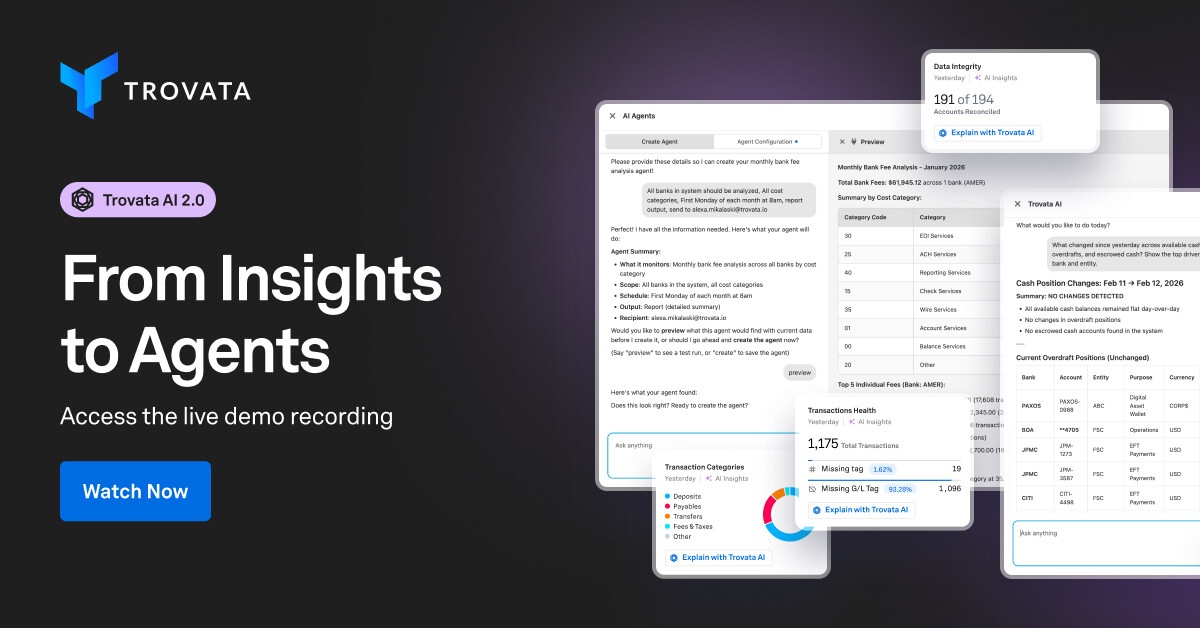
Ready to see Trovata AI 2.0 in action? Book a demo today or watch the livestream recording.

Jason Mountford
Finance Professional
A finance professional with over 15 years in wealth management, Jason started Hedge, a content agency, to bridge the gap between great writers and great finance businesses. He is a fully qualified Financial Advisor in both the UK and Australia, and also works with many clients in the United States and the Gulf Cooperation Council. He’s worked with companies of all sizes, from the Fortune 500 to small boutique firms. As a financial commentator, Jason has appeared in FT Adviser, Bloomberg, Investors Chronicle, the Daily Mail, the Daily Express, Money Marketing and more. Outside of work, Jason enjoys spending time with his wife and 2 kids, and keeping active. He’s a keen (though slow) endurance athlete, enjoying running, cycling and triathlon.
Subscribe to our newsletter
In this blog post
Explore with AI
Subscribe to our newsletter
Other resources
View all in AI & ML