Everyone in corporate treasury has heard the AI pitch by now. You get faster cash visibility, smarter forecasting, automated workflows, and some would have you believe it can do your laundry and pick up your kids from school every day too. The vendors all say roughly the same thing, ‘We've connected a large language model to your data, and now you can just ask it questions!”
So why does AI still feel, for so many treasury teams, a bit underwhelming, a bit buzzword? It all comes down to what’s underneath the model, rather than shortcomings in the model itself.
If you were handed a box of paper receipts for every one of your company's last 12 months of transactions, could you accurately and efficiently answer questions on the data held in the box? It’s all there, after all. Of course you couldn’t. It’s too much data, too little organization. Like you, any AI model needs guidance, organization and context to allow it to effectively live up to its promise.
MCP is a major step in creating this framework.
The Problem with ‘AI on Your Data’
There's something worth understanding about how most AI tools actually work, including early versions of treasury AI platforms, and probably most of the ones your vendors are demoing today.
A large language model, on its own, is extraordinarily capable at language. It can summarize, reason, write, and respond. But it has no inherent connection to your data.
When a vendor says their AI ‘has access to your treasury data,’ what that often means in practice is that they're feeding some version of your data into a prompt, or asking the model to generate a query that might retrieve it.
That's a meaningful first step, but creates a fundamental limitation in that the model is working without full context. It doesn't truly understand the structure of your data, the tools available to it, or the permissions it's operating under. It's making educated guesses, and educated guesses in AI can unfortunately result in what we all know now as hallucinations.
If you've ever asked ChatGPT something and gotten a confident answer that turned out to be completely wrong, you've experienced what happens when a model lacks the context it needs. That’s not the end of the world when you’re asking about past World Series winners or how to bake banana bread, but it’s a much bigger problem when those questions relate to liquidity positions, transaction history and FX exposure.
That's the problem that Model Context Protocol (MCP) was built to solve.
Recommended: Announcing Trovata AI 2.0: AI Chat, Insights and Agents for Corporate Treasury
What is MCP?
In plain terms, MCP is an infrastructure layer that connects an AI model to the specific data, tools, and context it needs to do its job accurately.
Think of it this way. A new hire on your treasury team is smart, credentialed, and eager to help. But on day one, they don't know your systems, your data, or your workflows. Left to figure it out on their own, they'll make mistakes, not because they're incapable, but because they lack context.
MCP is the onboarding system that doesn't just hand the new hire a login. It tells them which data they’re authorized to see, the tools they can use, what they need to know about this customer, and what ‘good’ looks like in this environment. Of course the benefit of AI is that it can take in all this information instantly, rather than a real person who will need some time to get up to speed.
In technical terms, MCP functions as a dedicated server layer that provides the AI model with structured access to relevant data, defined tools, and governed permissions. The model doesn't have to infer what it's allowed to do or approximate the data it needs, because the MCP provides the context and guardrails.
The result is a materially more accurate and useful AI.
The Benefits of MCP for Treasury
Treasury management is highly context dependent. The difference between a correct cash position and an incorrect one isn't academic, it can affect funding decisions, counterparty relationships, and board-level reporting. The margin for AI error is thin and the implications can be huge.
That's precisely why MCP is so valuable for treasury operations. When an AI model operates with an MCP foundation, a few things change in ways that should matter to any treasury professional:
Accuracy Improves
Rather than approximating answers from partial data, the model is grounded in the actual information it needs, such as your real balances, your actual cash flows, and your specific structures and entities. Hallucinations don't disappear entirely, but they drop dramatically when the model isn't filling gaps with guesswork.
Agentic AI Becomes a Real Option
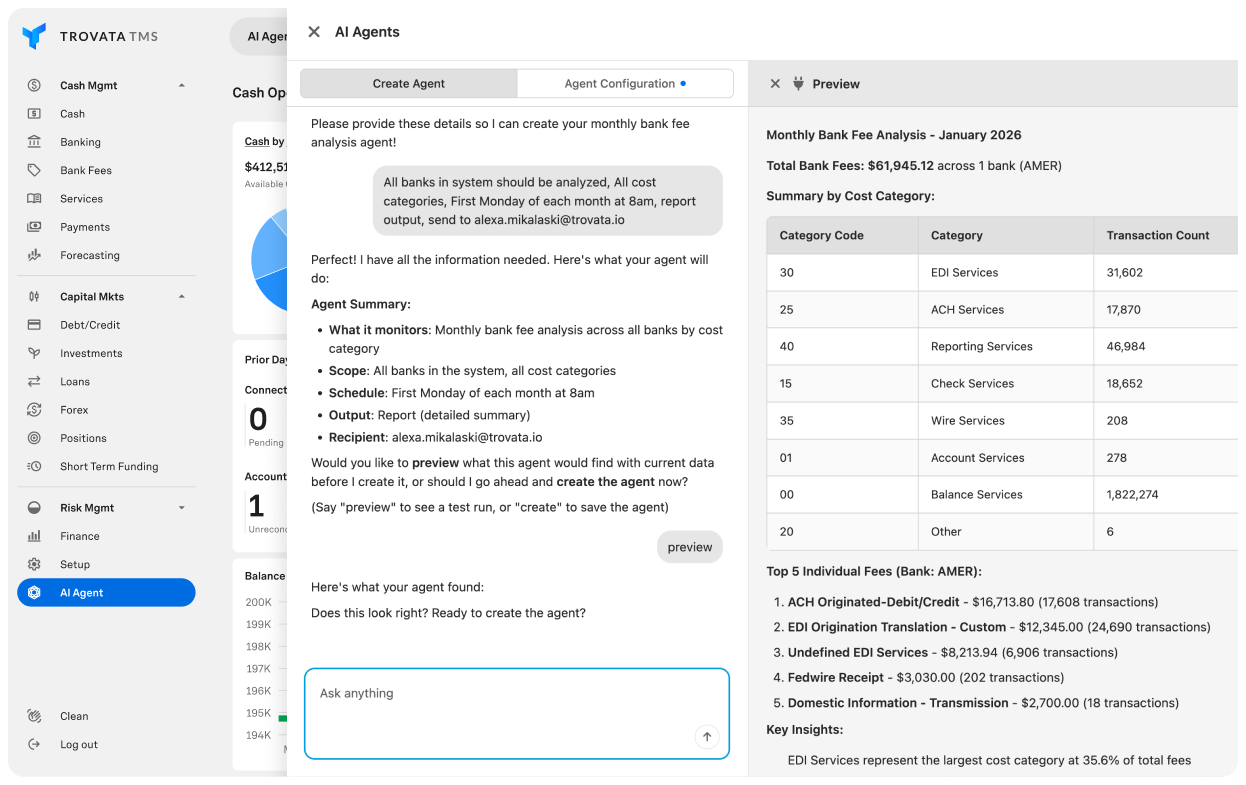
You've probably started hearing about ‘agentic AI’. That’s AI that doesn't just answer questions but takes action on your behalf. Agents are genuinely exciting, but they only work if each agent has access to the right context and tools for its job.
An agent responsible for analyzing your liquidity position needs analysis tools and data access. An agent responsible for executing a payment needs a payment tool and the right authorization. An agent responsible for treasury best practices needs access to your policies, your documentation, your specific guidelines.
MCP is what makes that possible, allowing multiple specialized agents to operate within a governed, coherent framework rather than wandering around with no structure. Without it, agentic AI in treasury is just a demo.
More Durable Infrastructure
This is a subtler point, but an important one for anyone thinking about long-term platform decisions. The AI model landscape is moving fast, and the model that's state-of-the-art today may not be the one you want in 18 months. With an MCP foundation in place, swapping in a newer, better model doesn't mean rebuilding everything from scratch. The context layer and data connections can all remain with a new model layered over the top. You get the benefit of improved models without the platform disruption.
Enhanced Interoperability
Many larger treasury teams and their parent organizations are already building internal AI capabilities, including proprietary models, custom tools and enterprise LLM deployments. An MCP-based treasury platform connects to all these and enhances both sides.
If your organization has its own AI infrastructure, it can access the same treasury context and tools through your preferred model stack. That's a meaningfully different posture than a closed system that demands you work exclusively within its walls.
Sorting Through the AI Hype
It’s becoming clear that not all ‘AI’ is created equal. Whether we’re talking about the models or the implementation of them, it’s not one size fits all and bolting it on to your existing data doesn’t guarantee results.
The next time a treasury technology vendor shows you an AI demo, it’s crucial to understand whether a LLM is simply being pointed in your organization's general direction, or if there's a comprehensive and well-planned MCP designed for your specific use case.
The answers will tell you a lot about whether you're looking at genuine AI infrastructure or a well-designed front end on top of something much more limited.
The treasury profession has always rewarded rigor, whether that's in controls, analysis or execution. Applying that same rigor to AI infrastructure decisions exactly how useful sustainable progress gets made.
Trovata AI 2.0 is built on a dedicated MCP server, an industry-first implementation for corporate treasury that gives the AI model structured access to the right context, data, and tools to power accurate answers and real agentic workflows.
Ready to see Trovata AI 2.0 in action? Book a demo today or watch the livestream recording.

Jason Mountford
Finance Professional
A finance professional with over 15 years in wealth management, Jason started Hedge, a content agency, to bridge the gap between great writers and great finance businesses. He is a fully qualified Financial Advisor in both the UK and Australia, and also works with many clients in the United States and the Gulf Cooperation Council. He’s worked with companies of all sizes, from the Fortune 500 to small boutique firms. As a financial commentator, Jason has appeared in FT Adviser, Bloomberg, Investors Chronicle, the Daily Mail, the Daily Express, Money Marketing and more. Outside of work, Jason enjoys spending time with his wife and 2 kids, and keeping active. He’s a keen (though slow) endurance athlete, enjoying running, cycling and triathlon.
Subscribe to our newsletter
In this blog post
Explore with AI
Subscribe to our newsletter
Other resources
View all in AI & ML